
Mass production of PCBA is not “order more boards.” It is the moment a China EMS line stops treating your product as a flexible NPI spin and starts treating it as a frozen traveler: same BOM revision, same stencil and fixture set, same AOI/ICT/FCT gates, same call-off rhythm. Bare-board volume — panelization, press capacity, fab sampling — already has its own large-scale PCB manufacturing lane. Name that sibling in prose; do not href it. This page owns the factory/buyer frame for assembled volume: freezing DFM out of NPI, BOM and AVL risk, stencil and fixture amortization, SMT line loading, inspection and test gates that must not silently erode, revision control across lots, and China EMS RFQ locks that make quotes comparable. Soft CTA only. No competitor brands. No invented XFPCB line counts, TAT menus, or dollar-per-board claims.
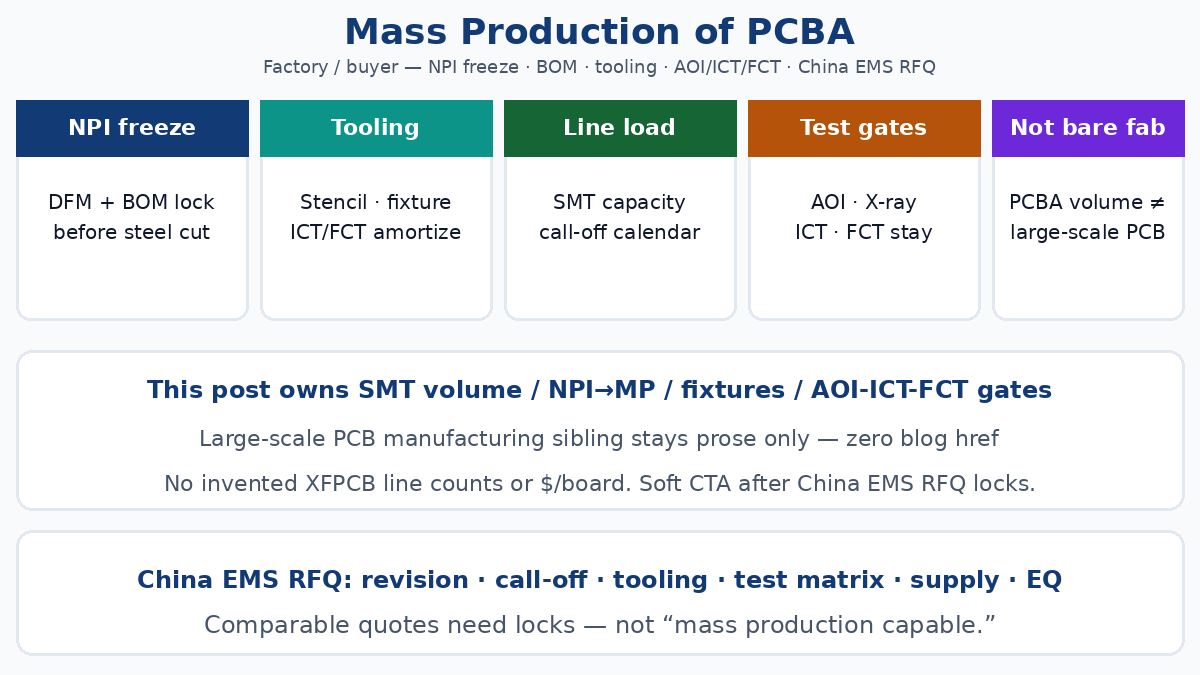
What “mass production of PCBA” means on an EMS floor
In day-to-day Shenzhen EMS language, mass production is a repeatable assembly traveler at production cadence — not a brochure trophy of “SMT capable” or a round quantity field on an RFQ form. That usually implies:
- A locked PCBA revision. Gerbers/ODB++, BOM with AVL alternatives, assembly drawing, stencil aperture map, and test coverage freeze under one revision ID. Open EQs are NPI work wearing a production PO number.
- Tooling that has somewhere to amortize. Steel stencil(s), carrier/fixture, ICT bed-of-nails or flying-probe program, FCT fixture, and AOI recipe libraries are paid once and reused. If you change paste land or connector seating every lot, you are still buying NPI tooling repeatedly.
- Line loading that matches the calendar. Pick-and-place, reflow, selective or wave where used, AOI, and test cells can absorb your lot size on a stated week — and the shop can say what happens if another OEM pulls capacity the same week.
- An NPI → pilot → MP path. First-article and pilot lots prove paste windows, placement recipes, and escape rates; production lots inherit those windows with a written sample plan.
- Supply continuity for the BOM. Long-lead ICs, MSL-controlled parts, and second-source rules are on the traveler — not discovered when the stencil is already cut.
PCB Assembly is the service home for turnkey and consigned builds. This article is the buyer checklist for when that service must run at volume without inventing plant capacity or dollar menus.
Mass PCBA vs large-scale bare-board fab (do not merge the awards)
Large-scale PCB manufacturing owns fab rhythm: panel nest, laminate lot control, fab AOI/electrical sampling, and dock dates for bare boards. Mass production of PCBA owns SMT/TH volume: paste and stencil, placement programs, reflow profiles, ICT/FCT fixtures, and assembled yield. A volume fab award does not automatically make an EMS award. A volume EMS award that assumes “boards will just show up” without fab revision lock is how lines starve mid-ramp.
Geography slogans (“USA large-scale manufacturers”) and capability lists belong in other buyer lanes — keep them prose pointers. Here the question is narrower: can this China EMS run your frozen BOM and DFM at production cadence without silently dropping AOI/X-ray/FCT depth or inventing feeder capacity that is not on the floor calendar.
Freezing DFM from NPI before you cut steel
Volume unit economics open when fixed assembly work amortizes. In practice that means the design that left NPI is the design that enters MP — not “close enough.”
Paste and land freeze. Aperture reductions, home-plate shapes, and via-in-pad fill rules that worked on five FA boards must survive ten thousand. Changing land geometry after the stencil is cut is a tooling ECO, not a free tweak.
Component package freeze. Swapping a 0402 for 0201, or a QFN pitch, mid-ramp resets nozzle libraries, AOI golden samples, and sometimes reflow. Batch package changes into planned spins.
Panelization for SMT, not only for fab. Array orientation, fiducials, rail width, and breakaway method must suit the placement machine and reflow oven as much as the router. Odd outlines that forced hand load on the pilot will crush throughput at volume.
Moisture and bake policy. MSL parts need bake and dry-pack rules written once. Volume amplifies floor-life escapes; “we baked when we remembered” is not an MP process.
Consigned vs turnkey ownership. Who buys the long-lead MCU, who owns shortage escalation, and who may substitute AVL alternates must be on the PO language before the first mass lot. Ambiguity at NPI becomes line-down at MP.
Attach the frozen package through Manufacturing Files so BOM, Gerbers, and assembly notes travel as one packet — not a chat thread with three conflicting Excel tabs.
BOM risk that kills volume ramps
Stencil and fixtures are cheap compared with a wrong reel on a 50k lot. Buyers who only celebrated a unit-price win discover BOM risk as a dock-date or field-escape surprise.
Score these before award:
- AVL depth. Single-source ICs and connectors need an explicit shortage plan — buffer stock, approved alternate, or redesign trigger — not hope.
- Date-code and lot control. Some products need same-lot silicon across a call-off; say so. Others only need date-code windows. Write the rule.
- Counterfeit / gray-market gates. Volume buyers who chase the lowest broker price without incoming inspection own the escape. Name authorized channels or agreed test on suspect lots.
- Lifecycle and PCN. Ask how the EMS handles manufacturer PCNs on your AVL during a multi-month call-off. Silent die shrinks show up as AOI or FCT drift.
- Kit completeness before line load. Partial kits that “will catch up next week” create half-built WIP and rework. Mass lines want full kits or a written partial-build procedure.
Component sourcing and purchasing services are process context when turnkey is in play; your RFQ still has to name who escalates a shortage on day three of a two-week run.
Stencil, fixture, and program amortization
Mass PCBA pricing assumes tooling is paid and reused:
| Tooling / program | What volume assumes | What resets cost |
|---|---|---|
| Steel stencil (and step-stencil if used) | Same aperture map across lots | Land/ECO paste changes |
| SMT nozzle / feeder setup | Stable package mix | Package or AVL swap mid-ramp |
| Carrier / selective pallet | Same outline and keep-outs | Outline or connector change |
| ICT fixture or flying-probe program | Frozen netlist and testpoints | ECO that moves pads or deletes TP |
| FCT fixture / firmware harness | Stable connectors and FW interface | Connector or FW protocol change |
| AOI / X-ray recipe library | Golden boards from FA | Mask color, finish, or BGA swap |
Ask bidders to separate NRE/setup from recurring unit. Do not invent XFPCB fixture menus or “free stencil over N” claims — amortization math differs by lot size and how often you ECO. A Quick Turn PCB proto spin can absorb weekly Gerber churn; a mass PCBA traveler cannot. Use quick-turn for design risk; freeze before you cut volume steel.
Line loading and calendar honesty
Capacity on an EMS floor is feeder slots, placement heads, reflow lanes, AOI seats, and test fixtures — not a slogan. Honest volume RFQs state:
- Lot size and call-off schedule (or a planning horizon with release rules)
- Whether partial releases are allowed
- Expected ship windows and Incoterms
- Mix complexity (fine-pitch BGA count, double-sided vs single, TH density)
- Which lots may share a line with other OEMs vs reserved windows
Soft forecasts without purchase commitment usually get soft quotes. Buyers who only track unit price discover capacity risk when their “volume lot” waits behind three firmer call-offs. Ask for slip notice before the line starves — the same calendar honesty bare-board volume buyers demand of presses, applied to SMT cells.
Inspection and test gates that must stay when quantity rises
The common failure mode on mass PCBA awards is silent gate erosion: FA ran 100% AOI, X-ray on BGAs, and FCT sample; production quietly switches to “visual plus sample AOI” because the lot is large and the calendar is tight. Escape cost lands at the customer, not on the brochure throughput chart.
Gates that usually must stay — or drop only with a written sample plan and escape trigger:
- SPI / paste inspection where the process needs it — especially fine-pitch and BGA lands
- AOI coverage with recipe libraries tuned on golden FA boards; non-stock mask colors and dense packages need tuning before you cut sample rates
- X-ray on hidden joints (BGA, QFN where specified) — 100% on critical assemblies or documented sample with escalation
- ICT or flying probe at the method you bought — sample rates can change after prove-out; “none” is a different product
- FCT where firmware, connector seating, or calibrated sensors matter — volume does not make function self-proving
- FQC and packaging for volume cartons: bake/dry pack when required, humidity indicators, shock labels, count reconciliation
Write which gates are non-negotiable on the RFQ. Then ask which gates the EMS proposes to sample after N lots of zero criticals — and what yield or customer-escape trigger returns the line to 100%. That conversation is mass-production maturity, not distrust. Technical Capabilities pages describe house envelopes at catalog level; your PO traveler still has to name sample vs 100%.
Revision control across NPI, pilot, and MP lots
Ramps fail when production starts on a different revision than FA proved, or when copper, BOM, and firmware drip into weekly live lots.
A clean path looks boring:
- Freeze files, BOM, and assembly notes under one PCBA revision ID.
- Run FA / pilot with agreed SPI/AOI/X-ray/ICT/FCT depth and golden samples.
- Close EQs; lock paste, placement, and reflow parameters that matter.
- Release MP with a written sample plan and escape triggers.
- Batch ECOs into planned spins — do not drip land and AVL edits into live lots.
Hold a single revision owner on your side and a single CAM/MES owner on theirs. Mid-lot ECOs should reset clock and price language you already agreed — not vanish into “we will try.”
China EMS RFQ locks (same packet every bidder)
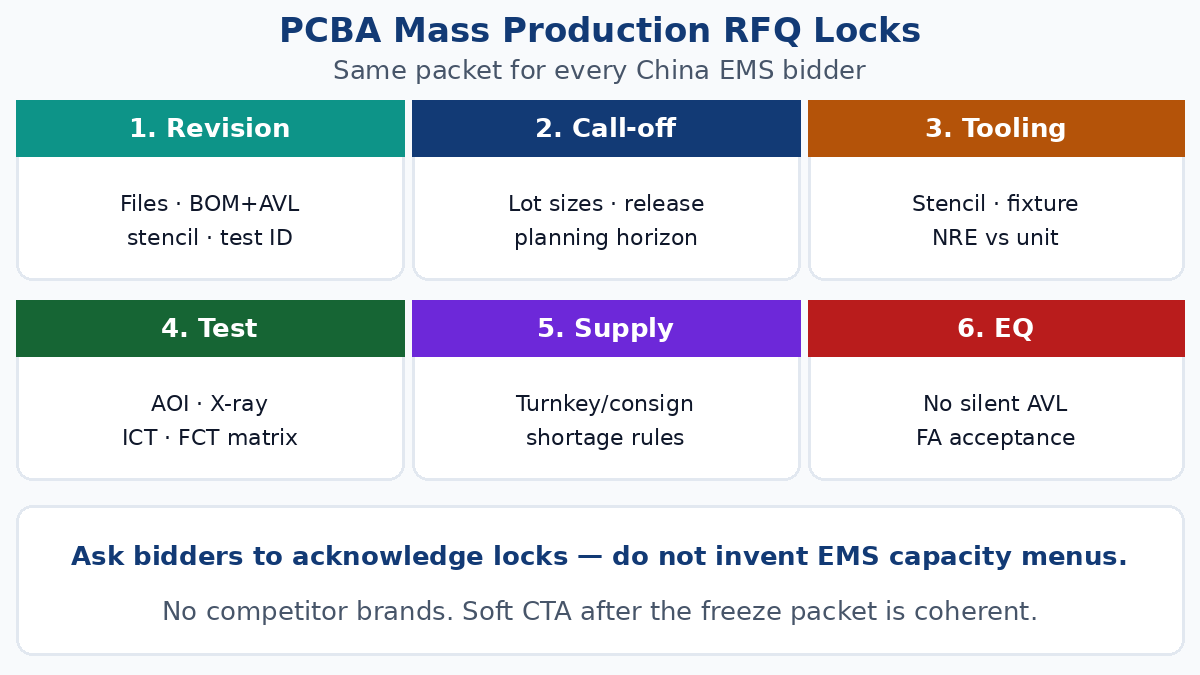
Put the same locks in front of every China EMS bidder so quotes are comparable:
- Revision ID — Gerber/ODB++, BOM+AVL, assembly drawing, stencil map, test coverage under one ID.
- Quantity / call-off — lot sizes, release rules, planning horizon; not “maybe 50k later.”
- Tooling scope — who pays stencil, fixtures, ICT/FCT programs; what ECO resets NRE.
- Inspection/test matrix — SPI, AOI, X-ray, ICT/FP, FCT — 100% vs sample with escape triggers.
- Supply ownership — turnkey vs consigned; shortage escalation; approved alternates.
- Packaging and logistics — dry pack, Incoterms, production-complete vs dock date, buffer days.
- EQ discipline — no silent AVL or aperture swaps; FA acceptance criteria written once.
Ask for structure: NRE vs recurring unit, what is included in test, what changes if quantity or lead time moves. Rank shops on scope match and calendar honesty first. When the freeze packet is coherent, use How to Place an Order to move from comparable quotes into a formal release — soft CTA, not a brochure capacity trophy.
Buyer checklist before you call it “MP ready”
- Is the PCBA revision locked — files, BOM, stencil, test?
- Are stencil/fixture/program NREs scoped and amortized against real lots?
- Is line capacity calendar-honest for your mix and call-off?
- Which AOI/X-ray/ICT/FCT gates stay at 100%, and what escape trigger restores them?
- Who owns shortages and AVL substitutes on turnkey or consigned kits?
- Are logistics buffers and Incoterms on the RFQ — production complete vs dock date?
- Are ECOs batched, with a named revision owner on both sides?
If those answers are vague, you are still in NPI — regardless of how large the quantity field looks. Mass production of PCBA is disciplined repetition of a proven assembly traveler, not a bigger number on an open EQ package. Soft CTA for buyers whose commercial programs fit a China EMS volume line: send the freeze packet, compare gates and calendars, then unit price — without inventing XFPCB capacity ceilings or dollar tables in this guide.