
Clickbait “25 surprise stats” posts still ship market-dollar forecasts, CAGR slides, and e-waste tonnage that never show up on an RFQ traveler. Overseas buyers awarding China fab and PCBA lots need a different job: which industry themes actually change who wins the award — region risk, rigid vs flex mix, automotive and consumer capacity pressure, labor-sensitive cost lines, and NPI-versus-volume routing — written as checkable questions, not unverifiable slideshow numbers. Treat outside industry listicles as orientation only; this page does not invent XFPCB market share, plant capacity percentages, or new dollar forecasts. Sibling XFPCB lanes already own assembly-landscape tech pressure tests, supply-chain buyer buffers, large-scale manufacturing depth, automotive harsh-environment locks, flex primers, and PCB-type overviews — name those lanes in prose; do not clone them. Soft CTA only.
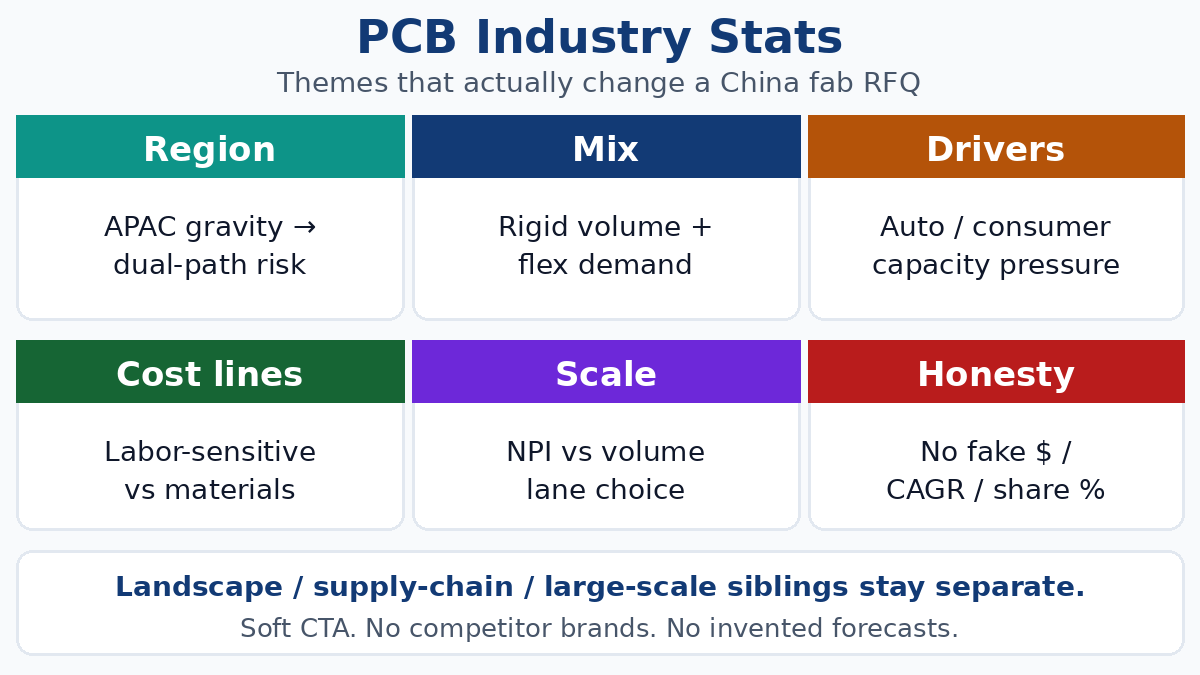
What “industry stats” should mean on a buyer desk
Market reports often cite growth in electronics, concentration of production in Asia-Pacific, continued dominance of rigid boards alongside faster interest in flex, and labor as a large share of assembled cost. Those themes are useful when they force a decision on the RFQ: dual-path risk, stackup class, inspection depth, lead-time buffer, or which cost line you challenge. They are useless when they become a paste of contested forecasts that no bidder can verify and no traveler can enforce.
This guide translates themes into award criteria. It skips inventing global market dollars, CAGR figures, labor percentages, or e-waste tonnes as XFPCB facts. If a theme needs a scale sense, keep it qualitative: “reports often describe APAC as the production center of gravity,” not a fabricated share. Pricing-factor depth already lives on its own live posts where they exist; keep those lanes separate from this RFQ-theme frame.
Theme 1 — APAC production gravity → region and dual-path risk
Industry narratives consistently place Asia-Pacific — and China export fabs in particular — at the center of volume PCB Manufacturing. For overseas buyers that is not a trivia point; it is a risk and optionality question.
What changes on the RFQ:
- Name the shipping and calendar risk you will accept (port congestion, Chinese New Year blackout weeks, air-vs-sea tradeoffs) instead of assuming “China is always fastest.”
- Ask whether the bidder can show a documented escalation path when laminates, copper foil, or chemistry tighten — without demanding an unverifiable “second factory somewhere else” marketing claim.
- Separate bare-board fab risk from assembly and BOM risk. A dual-path on fab does nothing if the long-lead MCU sits in one broker channel.
- Write which documents ride with the lot: CoC-style paperwork, material lot traceability depth, and whether substitution needs written approval.
Region concentration also means capacity is competed for by automotive, consumer, industrial, and telecom programs at once. That is why vague “we have capacity” answers fail. Ask for a named slotting assumption against your forecast ramp — especially when you leave prototype pricing and enter volume fab. Sibling supply-chain buffer grammar stays on its own page; here the only job is turning “APAC dominates production” into dual-path and calendar language on the award sheet.
Theme 2 — Rigid still carries volume; flex demand rises → mix the BOM honestly
Outside reports often describe rigid boards as the volume workhorse while flexible and rigid-flex constructions grow faster in compact, wearable, automotive, and interconnect-heavy designs. Buyers should not treat that as a reason to paste “flex capable” into every RFQ. They should treat it as a construction-mix prompt.
RFQ implications:
- State whether the program is rigid-only, flex, or rigid-flex — and which layers or zones carry dynamic bend, stiffeners, or controlled impedance.
- For flex work, point CAM at Flexible PCB process limits early: coverlay openings, bend-radius assumptions, and stiffener callouts belong in files, not chat threads.
- Do not let a rigid quote silently “absorb” a flex daughter or FPC jumper. Split line items when constructions differ.
- Ask which stackup class and Tg / loss assumptions are frozen for the rigid portion before the first production panel.
Prose pointers to live flex primers and PCB-type overviews are enough; this page does not rewrite those primers. The buyer win is forcing the mix into the quote structure so unit price compares like with like.
Theme 3 — Automotive and consumer growth pressure → capacity, class, and schedule
Automotive electronics and consumer devices are repeatedly named as demand drivers in industry commentary. On a China award, that pressure shows up as contested capacity, tighter discipline on auto-grade lots, and consumer programs that want prototype speed then volume overnight.
What to write before award:
- Class and end-use: IPC class expectation, automotive-grade or consumer commercial — named, not implied.
- Forecast honesty: NPI qty, first production qty, and 6–12 month ramp bands. Vague “will grow” invites soft capacity promises.
- Change control: who approves laminate, finish, or solder-alloy swaps when the plant is under automotive pull.
- Inspection depth: AOI / X-ray / flying-probe / functional gates scaled to the risk class — written as traveler stages, not brochure adjectives.
Harsh-environment automotive fab/assy locks already have their own XFPCB lane — do not merge. Here the theme only means: growth sectors compete for the same export slots, so your RFQ must lock class, ramp, and change control or you lose the lot to the louder forecast.
Theme 4 — Labor-sensitive cost structure → which RFQ lines actually move
Industry primers often note that labor is a large share of assembled PCB cost and that this helped concentrate volume production in lower-labor-cost regions. Specific percentages disagree across sources — do not paste an invented labor % into XFPCB copy. What matters for buyers is the cost-line map.
Labor-sensitive lines (challenge with process clarity, not only unit price):
- Manual touch-ups, selective-solder fixtures, conformal-coat masking, hand-load odd-form, and box-build labor.
- Inspection and rework loops that grow when DFM was soft.
- Engineering hours on EQ / DFM when files are incomplete.
Less labor-elastic (challenge with material and yield discipline):
- Laminate and copper-foil grades, specialty finishes, controlled-impedance coupons, and long-lead ICs via Component Sourcing.
- Panel utilization and scrap rules once the job is on a volume panelization path.
- Speciality tests that are machine-time gated, not headcount gated.
When comparing China quotes, ask each bidder to break NRE / tooling, bare board, SMT / TH labor, materials / BOM, and test — then challenge the labor-heavy cells with traveler evidence, and the material cells with approved AVL language. Soft “all-in” unit prices hide which theme actually moved the number.
Theme 5 — NPI vs volume scale → route the lot to the right lane
Industry growth stories collapse NPI and mass production into one CAGR sentence. Buyers should not. The same plant can quote both — but the process window, panelization, and inspection stack should not look identical on a five-piece bring-up and a five-thousand-piece ramp.
Route language that belongs on the RFQ:
- Early spins and schedule-critical revisions: name Quick Turn PCB expectations (calendar days, panel vs coupon strategy, what is frozen vs still in EQ).
- Sustained fab volume: move into PCB Mass Production assumptions — panelization locked, material lots named, change control tighter than the first article.
- Sustained assembled volume: point the award at High Volume PCB Assembly when pick-and-place rate, SPI/AOI gates, and feeder strategy matter more than a single prototype stencil.
- When fab + BOM + assembly must move as one package, use Turnkey PCB Assembly language so ownership of shortages and substitutions is explicit.
Large-scale manufacturing depth and just-in-time / OTD grammar live on sibling posts — prose-point only. This theme’s only job is stopping buyers from awarding a volume traveler with prototype assumptions still written in the notes.
Theme 6 — Compliance and materials pressure without e-waste slideshows
Outside listicles often parade e-waste tonnage and recall-cost headlines. Those figures vary wildly by source and rarely help a buyer award a China lot. What does help:
- Name RoHS / REACH / halogen-free / conflict-mineral expectations as document deliverables, not slogans.
- Freeze finish and alloy (ENIG, HASL, lead-free paste family) against the end-market rule set.
- Ask how the plant handles material substitution when a laminate or chemistry is constrained — written approval, not silent swap.
- Keep environment / recycling deep-dives on their sibling lanes; here compliance is an RFQ paperwork and AVL problem.
Capability context that is not a stats lecture lives on Technical Capabilities. Keep capability pages separate from this award-theme frame.
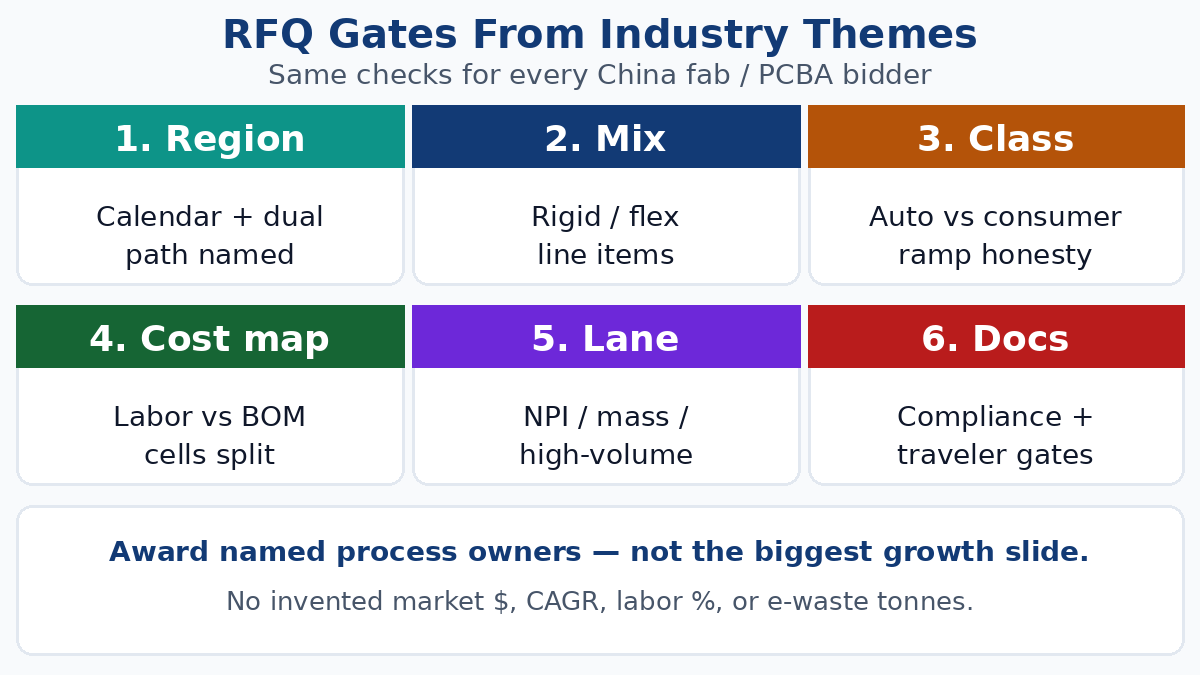
RFQ paste block — questions that turn themes into award criteria
Copy and adapt. Same questions for every China fab / PCBA bidder:
- Region / calendar — Which blackout weeks and freight modes are assumed? What is the documented escalation if laminate or foil lead time slips?
- Construction mix — Rigid / flex / rigid-flex line items split? Flex bend, coverlay, and stiffener notes attached?
- End-use class — IPC class and automotive vs consumer commercial named? Change-control owner named?
- Ramp — NPI qty, first production qty, and next-two-quarter forecast bands attached?
- Cost breakdown — NRE, bare board, assembly labor, BOM, test separated? Which cells are labor-heavy vs material-heavy?
- BOM risk — Long-lead parts dual-sourced or buffered? Broker policy written?
- Lane — Prototype / quick-turn vs mass fab vs high-volume assembly vs turnkey — which traveler applies to this PO?
- Compliance pack — RoHS / REACH / finish / alloy docs listed as deliverables?
- Inspection stack — Traveler stages (SPI / AOI / X-ray / electrical / functional) matched to class — not brochure adjectives?
- Files frozen — Gerber/ODB++, stackup, BOM, centroid, and AVL revision IDs named on the PO?
Award the bidder who answers these with named process owners and documents, not the one who pastes the largest market-growth slide.
Soft next step
If your next China fab or PCBA award needs these themes written into a real RFQ package — stackup, BOM risk, lane choice, and traveler gates — start from How to Place an Order and attach the paste block above. Soft CTA only: no invented XFPCB capacity claims, no fake market-share percentages, and no competitor brands. Keep landscape, supply-chain, large-scale, automotive, flex, and types-of-PCB siblings in their own lanes.