
Overseas buyers awarding China fab lots still get finish wrong in the same three ways: a drawing that only says “gold,” an RFQ that awards the cheapest HASL quote against a fine-pitch BGA stack, or a shelf-life surprise when OSP boards sit too long before first SMT. Sibling XFPCB lanes already own ENIG thickness / black-pad depth, plating chemistry and through-hole copper gates, laminate and materials selection, and solder-mask color choices — name those lanes in prose; do not clone them. This page owns the buyer job: which surface finish to pick for pitch, shelf life, rework, RoHS, and cost on China fab RFQs, how to write the finish callout on fab notes, and the award mistakes that burn schedule. Soft CTA only. No competitor brands. No invented XFPCB $/sq.in finish premiums or plant shelf-life lab months.
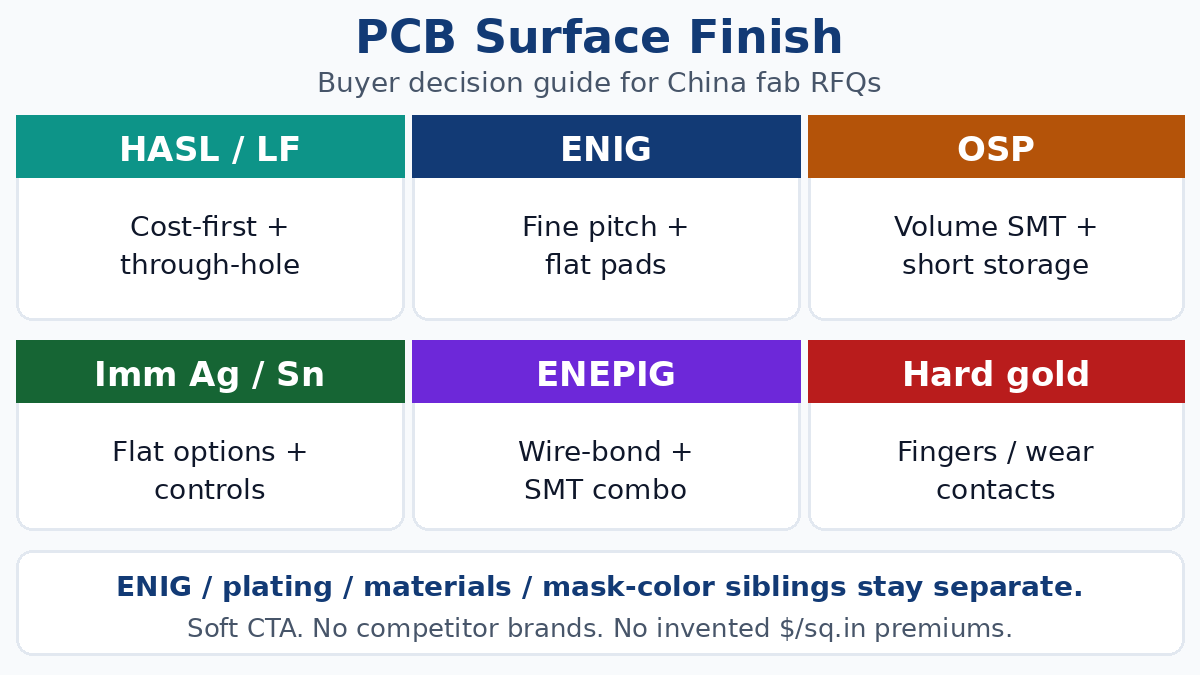
What a surface finish must do on an export RFQ
After solder mask, exposed copper needs a finish that keeps pads solderable through storage and shipping, survives the planned reflow / wave / rework stack, and matches RoHS or legacy alloy rules. Finish is not a substitute for through-hole copper plating quality, and it is not the same decision as solder-mask color or laminate Tg. Treat finish as a solderability and contact gate you freeze before award.
What the award sheet should lock:
- Finish family (HASL / LF-HASL, ENIG, OSP, immersion silver, immersion tin, ENEPIG, electrolytic hard gold — named, not “gold”)
- Where it applies (entire board vs selective pads / fingers)
- Assembly plan (single reflow, multiple reflows, wave, press-fit, wire-bond, edge-finger wear)
- Storage plan (days vs months before first SMT; dry-pack / humidity expectations in plain language)
- Compliance (lead-free vs tin-lead HASL; RoHS documents as deliverables)
Keep plating barrel / wrap language and ENIG IPC thickness deep-dives on their own live posts. Here the only job is choosing and calling out the finish so China CAM cannot invent a house default.
Decision axes buyers actually use
Ignore brochure adjectives. Score each finish against the axes that change unit price and yield on PCB Manufacturing export lots:
- Pitch and coplanarity — Can the finish leave pads flat enough for fine-pitch QFN / BGA / 0.4 mm class landings?
- Shelf life before SMT — Will boards sit weeks or months between fab ship and first paste print?
- Reflow / rework count — One reflow, two reflows, selective rework, or wave after SMT?
- RoHS / alloy policy — Lead-free mandatory, or a documented tin-lead exception?
- Contact / wear / wire-bond — Edge fingers, keypads, or gold wire-bond that HASL cannot serve?
- Cost and lead-time pressure — Prototype spin vs volume panel; finish that forces extra process days?
Industry practice language (not XFPCB lab claims): OSP and immersion finishes are typically more handling- and shelf-sensitive than ENIG; HASL is robust for larger pads but can struggle on flatness for fine pitch; hard gold and ENEPIG sit at the high end for contact / wire-bond niches. Use those as buyer heuristics, then freeze the callout on the drawing — do not paste invented month counts as XFPCB lab data.
Finish-by-finish buyer map (China fab RFQ)
HASL and lead-free HASL
Hot air solder leveling coats exposed copper with solder and levels it with hot air. Classic tin-lead HASL remains common on legacy programs; lead-free HASL (LF-HASL) is the RoHS-facing variant for many cost-sensitive volumes.
Pick when: through-hole heavy boards, larger SMT pads, cost-first consumer / industrial lots where coplanarity is not the limiting risk, and you want a durable solderable surface that tolerates handling.
Avoid or escalate when: fine-pitch BGA / dense QFN where HASL thickness variation hurts paste volume; or when the program already mandates a flat electroless finish for mixed-technology yield.
RFQ note: say LF-HASL or SnPb HASL explicitly. “HASL” alone leaves lead content ambiguous on export paperwork. Pair LF-HASL awards with Lead-Free Assembly alloy expectations so fab finish and paste family do not fight each other.
ENIG
Electroless nickel immersion gold is the default flat finish on many China export fine-pitch and mixed SMT lots. It is not electrolytic hard gold. Depth on Ni/Au thickness, XRF language, and black-pad bath control already lives on XFPCB’s ENIG deep-dive — prose pointer only; do not rewrite that stack here.
Pick when: fine pitch, BGA / QFN density, longer storage than OSP typically tolerates in industry practice, multiple reflow cycles, or when you need a flat pad for consistent paste print.
Buyer caution: “ENIG” with no thickness / acceptance language invites house defaults. Point CAM at the ENIG sibling for IPC-style callouts; on this page, your job is deciding ENIG vs alternatives, not rewriting Ni/Au microns.
Natural fit: BGA PCB and dense SMT packages where coplanarity and pad flatness dominate the award.
OSP
Organic solderability preservative is a thin organic film over copper. It is usually the lowest-cost flat option and friendly to fine pitch, but industry practice treats it as more shelf- and handling-sensitive than ENIG.
Pick when: high-volume consumer SMT with short fab-to-line intervals, controlled dry storage, and limited rework cycles.
Avoid when: boards may sit months before SMT, multiple heat cycles are planned, or the supply chain cannot protect against fingerprint / humidity abuse.
RFQ note: state maximum storage expectation in buyer language (“assemble within the plant’s stated OSP window; dry-pack required”) without inventing XFPCB lab months. Ask how the fab marks OSP lots and whether a second OSP cycle is allowed after delay — written, not chat.
Immersion silver (Imm Ag)
Immersion silver deposits a thin silver layer for flat, solderable pads. It can suit fine-pitch SMT and some controlled-impedance or high-frequency adjacent work where HASL topography is unwanted.
Pick when: flat pads matter, cost sits between OSP and ENIG on many quotes, and the logistics path can control sulfur / tarnish exposure.
Avoid when: long open-air storage, aggressive handling, or when the bidder cannot show packaging and shelf discipline for silver.
RFQ note: require packaging / tarnish-control language and incoming visual criteria. Do not treat Imm Ag as a free ENIG substitute without checking reflow count and storage.
Immersion tin (Imm Sn)
Immersion tin gives a flat tin surface useful for press-fit and some SMT lots. Industry practice flags whisker and shelf-life concerns that buyers should raise on long-storage programs.
Pick when: press-fit connectors, certain automotive-adjacent or industrial specs that call tin by name, or when the drawing already freezes Imm Sn.
Avoid when: long shelf before assembly without a documented control plan, or when the team has no appetite for tin-whisker risk discussion.
RFQ note: name Imm Sn on the fab note; ask for the plant’s whisker / storage controls as paperwork, not marketing adjectives.
ENEPIG
Electroless nickel electroless palladium immersion gold adds a palladium layer between nickel and gold. Buyers reach for it when they need wire-bondability and robust solderability on the same finish, or when ENIG alone is not enough for the bonding plan.
Pick when: gold or aluminum wire-bond plus SMT on one board, or a customer spec that names ENEPIG.
Avoid when: cost-sensitive consumer volume with no bond requirement — ENEPIG is usually a premium lane.
RFQ note: say ENEPIG explicitly; do not write “gold” and hope. Bond-wire type and solder alloy still belong in the assembly package.
Electrolytic hard gold (and soft bondable gold)
Electrolytic hard gold (often over nickel) serves edge fingers, wear contacts, and keypads. Soft bondable gold is a different call for wire-bond pads. Neither is “ENIG.”
Pick when: repeated mating cycles on fingers, or a drawing that specifies hard-gold thickness for contact wear.
Avoid when: you only needed solderable SMT pads — hard gold on every pad is an expensive mis-award.
RFQ note: selective hard gold on fingers + a solderable finish elsewhere is common. State areas, thicknesses by drawing note, and which finish covers SMT lands.
Pitch, HDI, and when flat finishes win
As soon as landings shrink into fine-pitch and HDI PCB territory, HASL’s topography becomes the usual first disqualifier. Prefer ENIG, OSP, Imm Ag, or Imm Sn (per storage and rework plan) when pad flatness drives SPI / AOI yield. Keep HDI stackup and microvia depth on their own capability lanes; here finish only means do not award wavy HASL against a dense HDI / BGA paste plan.
Prototype spins on Quick Turn PCB calendars still need the same finish honesty: a two-day fab promise does not excuse an OSP board that will sit six weeks on a dock. Match finish to the real fab-to-line interval, not the optimistic ship date.
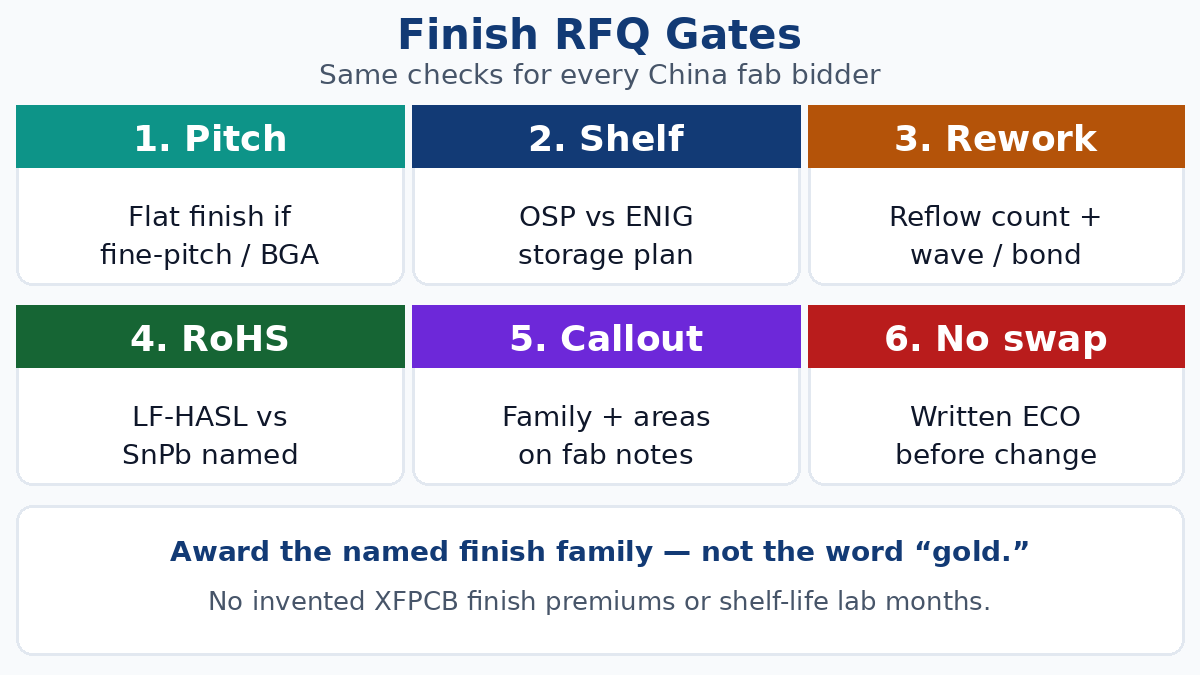
How to write the finish callout on fab notes
Vague notes create EQ loops and silent house defaults. Put finish beside solder mask and legend in the fabrication notes — and keep Gerber / ODB++ / stackup packages aligned via Manufacturing Files.
Paste-ready patterns (adapt thicknesses only when your drawing already owns them; do not invent XFPCB premiums):
- Whole-board LF-HASL:
Surface finish: Lead-free HASL (LF-HASL). RoHS documents required with shipment. - Whole-board ENIG:
Surface finish: ENIG. Ni/Au thickness and XRF acceptance per drawing / IPC callout referenced on sheet 1. Not electrolytic hard gold. - OSP with storage discipline:
Surface finish: OSP. Dry-pack. Assemble within buyer-approved OSP window; notify before any second OSP cycle. - Imm Ag:
Surface finish: Immersion silver. Tarnish-control packaging required. Incoming visual criteria per drawing note. - Imm Sn:
Surface finish: Immersion tin. Storage / whisker controls per plant procedure attached to PO. - ENEPIG:
Surface finish: ENEPIG on all exposed SMT / bond pads as drawn. Wire-bond alloy noted on assembly drawing. - Selective hard gold fingers + ENIG lands:
Edge fingers: electrolytic hard gold over Ni per drawing thickness. All other exposed copper: ENIG. Mask openings define selective areas.
Also state what is not allowed: “No silent substitution to HASL / OSP / ENIG without written ECO.” Capability context that is not a finish lecture lives on Technical Capabilities.
Common award mistakes on China fab RFQs
- Writing “gold” or “nickel gold.” Could mean ENIG, ENEPIG, soft bondable gold, or hard gold fingers. Name the family.
- Awarding cheapest HASL against fine-pitch BGA. Coplanarity debt shows up at SPI / first reflow, not on the unit-price cell.
- OSP on a long logistics path. Industry practice treats OSP as storage-sensitive; if the board may wait, pick a more durable finish or freeze dry-pack + assemble-by discipline.
- Ignoring RoHS vs SnPb HASL. Export paperwork and lead-free assembly paste families must match the finish lead policy — do not discover the mismatch at customs or at the stencil.
- Hard gold everywhere. Wear-finger gold on SMT pads burns cost without buying solderability you already had from ENIG / OSP.
- Finish changed after Prototype PCB Assembly bring-up. First articles on ENIG and volume on OSP (or the reverse) invalidate solderability lessons. Freeze finish across NPI and volume unless an ECO says otherwise.
- No selective-area map. Fingers, press-fit, and SMT lands need different finishes stated by area — not one word in the title block.
- Assuming finish fixes plating. Barrel copper and wrap failures are plating-lane problems; finish will not rescue a thin knee.
Soft next step
If your next China fab award needs the finish family, selective areas, RoHS / alloy match, and storage discipline written into a real RFQ package, start from How to Place an Order and attach the callout patterns above. Soft CTA only: no invented XFPCB finish $/sq.in tables, no fake shelf-life lab months, and no competitor brands. Keep ENIG depth, plating chemistry, materials selection, and solder-mask color in their own live lanes — this page only decides which finish wins the award and how to write it so CAM cannot guess.