
Automated optical inspection earns its keep when a buyer can name where it sits on the traveler, what defect class it owns, and how false calls and escapes will be handled — not when a quote simply says “AOI included.” Bare-board fabs and SMT lines both use cameras; they answer different questions. Overseas RFQs that treat AOI as a universal certificate often inherit house defaults on stage, coverage, and disposition. This guide is for procurement and manufacturing engineers who need factory language: fab versus assembly placement, catch versus escape, rule-based versus CAD-compare as buyer terms, what optical inspection cannot replace, and China PCBA RFQ questions that lock coverage without cloning a full methods encyclopedia or an X-ray mandate page.
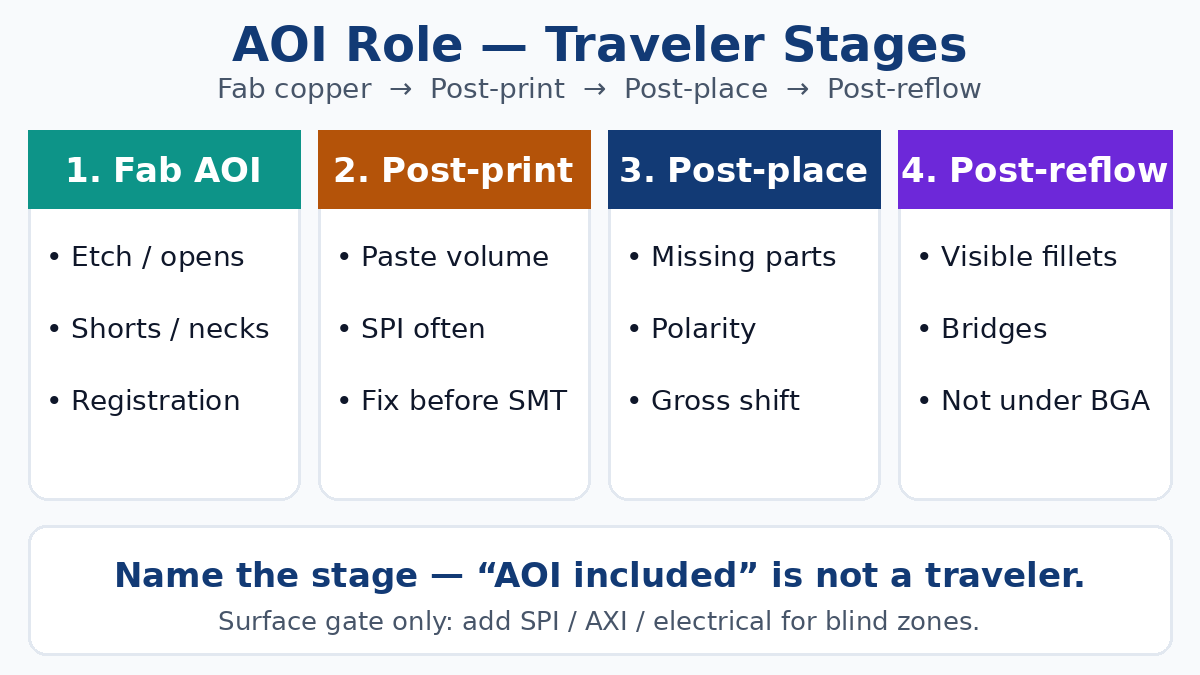
Where AOI sits: fab traveler vs assembly traveler
AOI is not one machine slot. It is a family of camera gates that appear at different process stages. Buyers who write only “AOI” leave the shop free to pick the cheapest stage that still prints the word on the traveler.
Bare-board fab AOI. After etch (and often after solder mask or legend, depending on the line), optical inspection looks for opens, shorts, neckdowns, copper residual, missing features, and registration problems on the copper pattern. The reference is usually Gerber/ODB++ or a golden panel. This gate protects the fabricated board before it ever reaches SMT. It does not inspect solder joints or component polarity — those defects do not exist yet.
Assembly post-print (paste) gate. Some lines run optical review after stencil print; many use dedicated solder paste inspection (SPI) for height and volume. If the traveler says “AOI after print,” clarify whether you mean true paste metrology or a 2D presence/alignment check. Paste defects fixed before placement are cheap; the same defects after reflow are scrap or rework.
Assembly post-place / pre-reflow. Cameras catch missing parts, wrong polarity marks, gross shifts, and tombstone risk before solder freezes the mistake. Pre-reflow AOI is strongest for placement and polarity. It is weaker as a finished-joint judge because fillets have not formed.
Assembly post-reflow. The most common PCBA AOI slot. Systems judge visible fillets, bridges on exposed leads, missing or shifted parts after reflow, polarity, and many insufficient-solder conditions on gull-wing and chip packages. This is the stage buyers usually mean when they say “AOI on the assembly.” 2D programs run fast for placement and many bridge defects; 3D height data helps on fillet volume and coplanarity as pitches shrink. Neither mode sees under a package body.
Double-sided and selective coverage. On double-sided SMT, ask which side and which pass get optical gates after each reflow. Selective AOI on only “critical” ref dens must list those dens on the assembly drawing — otherwise the line inspects whatever is convenient. Panelized boards need a clear rule: every unit in the array, or a sample map that purchasing can audit.
Write the stage on the drawing or quality plan: fab copper AOI, post-print, post-place, post-reflow — or an explicit combination. “AOI somewhere on the line” is how two China quotes look identical until first article.
What AOI catches vs what still escapes
Optical inspection owns visible geometry under controlled lighting. Typical catches on assembly:
- Missing, skewed, or rotated parts within the program window
- Polarity and orientation errors when marks are readable
- Solder bridges on exposed leads and chip packages
- Many insufficient fillets and tombstones on visible joints
- Foreign material, lifted leads that cameras can see, obvious mask or copper damage on accessible surfaces
Bare-board AOI similarly owns etch and pattern defects that cameras can resolve against the design data.
Escapes that buyers still underprice. Joints under BGA, CSP, QFN, and LGA bodies are outside reflected-light view. Head-in-pillow, ball voids, and bridges under the package body pass optical gates and fail later under vibration or thermal cycling. Wrong-value parts that look identical photograph as good. High-resistance joints and intermittent opens may look wet enough to pass image thresholds. Firmware and interface timing never appear in an AOI recipe. A clean AOI traveler is not a functional certificate.
Cosmetic versus acceptance. Some programs ask AOI to flag silk defects, scratched mask, or connector seating that still need human judgment. That is fine if disposition rules say so. Mixing cosmetic stops with hard solder fails without a severity code is how operators clear real scrap as “appearance only.”
Name the escape class on the quality plan when risk is real: hidden-joint packages need X-ray or electrical coverage; value and polarity nets that matter need probe or functional gates. Do not ask AOI to own what light cannot reach.
Rule-based (DRC-style) vs CAD-compare — buyer language, not brochure talk
Shops describe two common programming philosophies. Buyers should treat them as setup and risk language, not as machine brand features.
Rule-based / constraint AOI. The program encodes simple geometric rules: minimum spacing, pad coverage windows, polarity mark presence, bridge width thresholds. Setup is often faster. Coverage depends on how complete and current the rule set is. Weak rules miss novel defects; overly tight rules flood the line with false calls.
CAD / Gerber comparison. The system compares the live image to design data (or a CAD-derived model) rather than only to a short rule list. Accuracy on complex layouts is often higher when the data revision matches the board. Setup and processing cost more time. Stale CAD after an ECO is a classic false-call or escape source — revision lock belongs next to the AOI recipe ID.
Golden-board teaching sits beside both methods: a verified first-article board teaches acceptable process variation. After an ECO, silkscreen change, or mask color change, the golden reference and recipe need the same revision discipline as Gerber. Buyers do not need to dictate camera models. They do need to ask whether the program is rule-based, CAD-compare, or hybrid; how ECO revisions update the recipe; and who signs disposition when the image disagrees with the drawing.
False calls vs escapes — the buyer questions that matter
Two failure modes look opposite on the yield chart and both burn money.
False calls. The machine stops or flags a good board. Causes include stale golden boards, lighting never tuned for a new mask color, thresholds set too tight for normal process variation, and recipes that were never updated after an ECO. High false-call rates slow the line and, worse, train operators to clear alarms without looking. Ask for an expected false-call handling method: who reviews images, how thresholds are changed, and whether recipe edits require a signed revision like Gerber.
Escapes. A real defect ships. Causes include thresholds loosened to kill false calls, stages skipped on the traveler, packages whose critical joints are invisible, and coverage that is sample-only when risk demanded 100%. Ask how escapes from AOI are caught downstream (SPI upstream, X-ray on hidden joints, electrical or functional test) and what happens when a customer return matches an AOI-blind defect class.
A useful RFQ line is not “AOI with low false calls.” It is: stage named, coverage (sample vs 100%), recipe/ECO revision control, disposition owner for fails, and the complementary gates for AOI-blind defects. Soft claims that “AOI guarantees quality” are marketing; the traveler matrix is the contract.
What AOI cannot replace (and when to add SPI, AXI, or electrical)
Stack complementary gates by defect family — briefly — without turning this page into a full inspection-methods catalog or an X-ray decision tree.
SPI (paste). When fine pitch, bottom-terminated packages, or unstable first-article paste windows drive yield, paste metrology before placement earns its keep. AOI after reflow cannot cheaply undo a starved or bridged print.
AXI / X-ray. When acceptance-critical joints hide under BGA, CSP, QFN, LGA, or selected barrels, optical inspection is the wrong sole gate. Mandate X-ray with packages, method, coverage, and accept criteria written — that decision belongs on the X-ray buyer page, not as a vague “also check solder” note here.
Electrical test (flying probe / ICT) and functional test. Wrong values, opens/shorts that look soldered, and product behavior need probes and powered checks. AOI does not measure ohms or boot firmware.
Manual visual. Still useful for cosmetics, connectors, labels, hardware, and coating judgment that automation mishandles. It is a support gate, not a substitute for programmed AOI on dense SMT.
Class and cost. Higher reliability and Class 3 style acceptance usually expand hidden-joint and electrical coverage, not just “more AOI cameras.” Optical inspection remains surface-visible. Paying for deeper AXI or fixture test is a risk and volume calculation — write the classes and package list so quotes price the same bar. Medical, aerospace, and safety-critical buyers often keep 100% post-reflow AOI on visible SMT and add selective or full X-ray on hidden joints; consumer prototypes with coarse pitch may sample AOI after process window prove-out. The difference is written risk, not a moral slogan about “always inspect everything.”
If the BOM is coarse visible SMT with no bottom-terminated packages and strong electrical coverage, post-reflow AOI plus fab copper AOI may be enough. If the BOM carries fine-pitch area-array parts, AOI alone is theater. NPI lots often run 100% optical on both sides until yield stabilizes, then move to a documented sample plan — say so on the RFQ so production pricing does not silently assume prototype coverage forever.
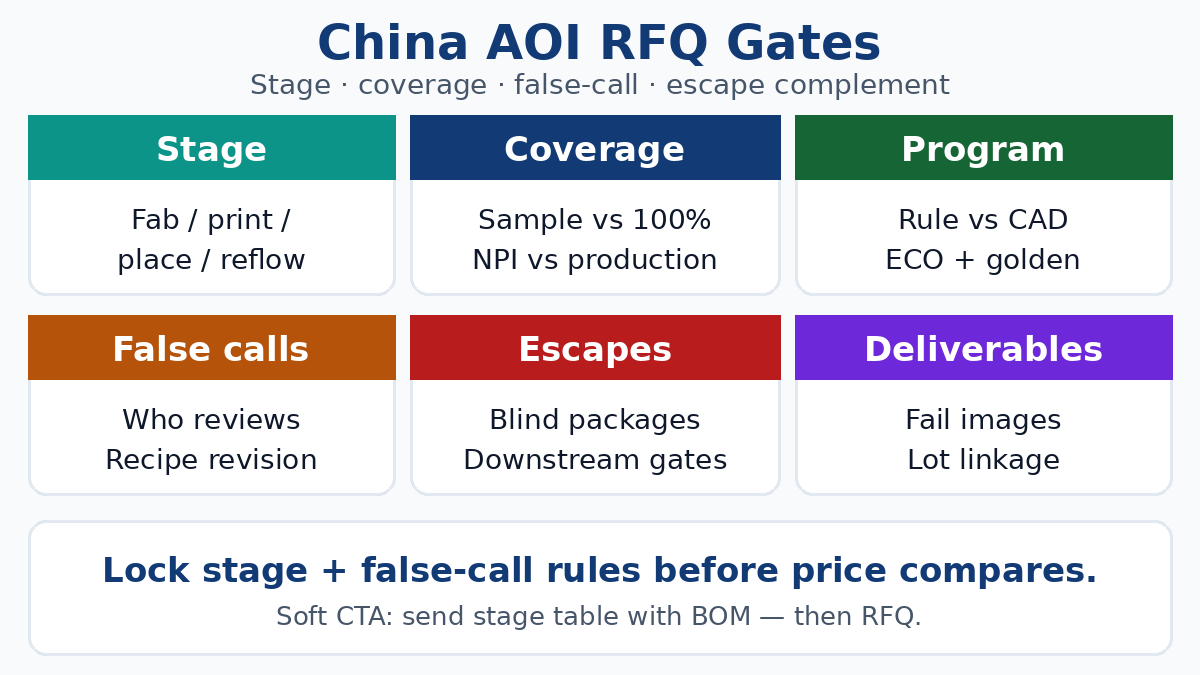
China fab / PCBA RFQ: how to ask for AOI coverage
Overseas RFQs that say “AOI included” inherit silent defaults. Normalize these fields so quotes and travelers match:
| RFQ field | Why it matters |
|---|---|
| Stage | Fab copper AOI and/or post-print / post-place / post-reflow — name each |
| Coverage | Sample plan vs 100%; NPI vs production split |
| Program type | Rule-based, CAD-compare, or hybrid; golden-board / ECO revision rule |
| Defect classes owned | Missing/polarity/bridge/visible fillet — and explicit “not under BGA/QFN” |
| False-call handling | Who reviews, how thresholds change, recipe revision control |
| Escape complement | SPI, X-ray packages, electrical/FCT called out for AOI-blind risk |
| Deliverables | Image retain on fails, first-article AOI report, lot linkage |
| No silent downgrade | No drop from 100% to sample or stage skip without signed EQ |
Do not invent dollar tables or claim a specific camera brand on the RFQ cover. Ask for process capability and documented stage coverage that matches the drawing you will freeze. Soft next step: send the stage table and package risk list with the BOM so manufacturing engineering and the China shop argue about the same traveler before first article locks.
Soft close — when optical inspection earns its keep
AOI earns its keep when the traveler names the stage (fab copper, post-print, post-place, post-reflow), the defect classes light can actually see, and the complementary gates for everything else. Rule-based versus CAD-compare is buyer setup language tied to ECO and golden-board discipline. False-call floods and silent escapes are both quote risks — write disposition and downstream coverage. On China fab and PCBA RFQs, replace “AOI included” with stage, coverage %, program/revision control, and escape complements. Optical inspection is a fast, repeatable surface gate. It is not a substitute for paste control, hidden-joint X-ray, or electrical proof. Share that matrix with manufacturing engineering before the fine-pitch lot prices — the right AOI line is a quality-plan contract, not a brochure checkbox.