
Quick-turn PCB prototypes are sold as speed. Buyers and layout owners who live through NPI spins know the real purchase is different: schedule risk reduction when the next design loop, BOM surprise, or SMT slot matters more than waiting on a standard queue. Soft marketing leans on “24-hour” tags and prestige quality labels. Factory practice asks a harder set of questions — when does the clock start, what must freeze, which constructions still sit on stocked laminate, and what China fab RFQ grammar keeps a rush lot honest. This guide is the why/when page for quick-turn prototypes. Definition, DFM-hold reality, and fast-queue file packages live on the primer. Production OTD and JIT program clocks live on their own buyer guide. Here the job is iteration economics, freeze gates, calendar vs working-day math, and RFQ fields that buy real schedule insurance without invented plant TAT menus.
When speed beats waiting
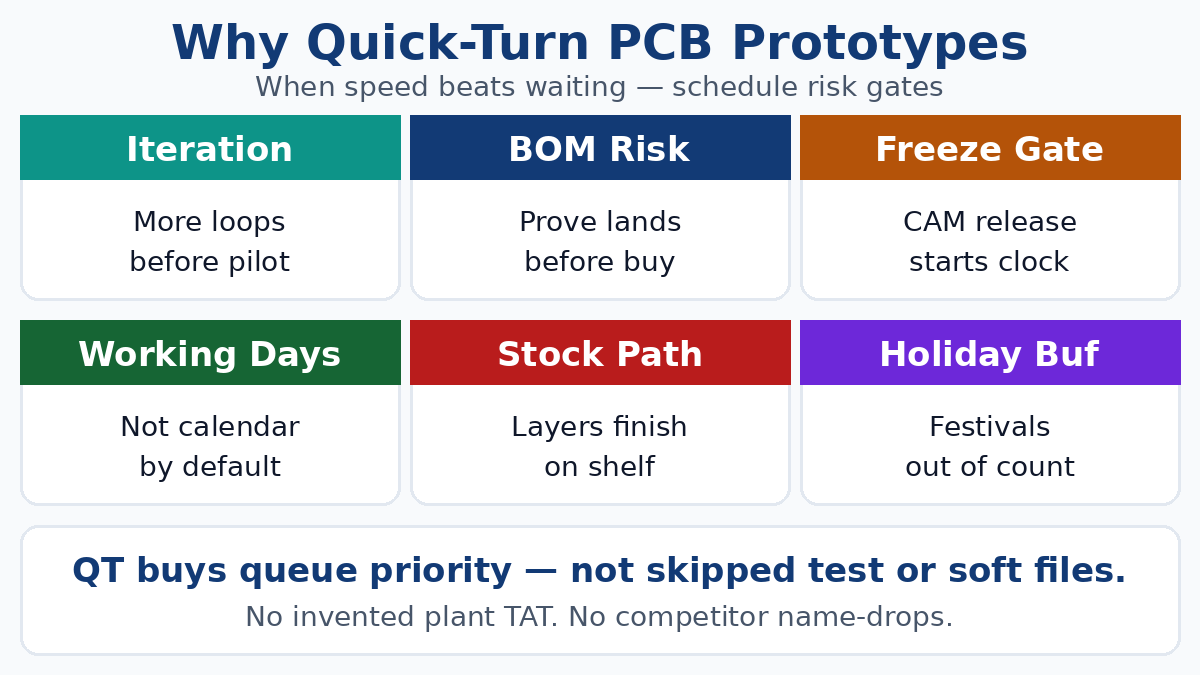
Not every board needs an expedite panel. Waiting is the right call when the design is frozen, materials are exotic or on buy, the next SMT date is soft, or the lot is already a pilot/volume problem dressed as a prototype. Quick-turn earns money when the calendar cost of delay exceeds the expedite premium — and when the buyer can actually freeze inputs so the premium buys queue position instead of CAM email ping-pong.
Typical buyer situations where QT prototypes beat a standard queue:
- Open iteration loops. First silicon bring-up, RF matching spins, thermal or mechanical fits that fail on the bench. Each day without boards freezes the next layout change. A short fab window that starts after CAM release can cut weeks of “waiting to learn.”
- BOM and AVL risk. Long-lead connectors, unique PMICs, or last-time-buy parts force early board spins so procurement and layout can co-validate footprints before volume kits lock. QT bare boards are cheaper schedule insurance than discovering a land pattern error after a six-week buy.
- Bridge builds into a hard SMT or customer dock. A small rush lot can keep a pilot line moving while a larger standard lot catches up — only if the revision and finish match what pilot will later use.
- Soft competitor claims vs real risk. Marketing that sells “instant aerospace-grade boards” without naming clock start, material stock, or test depth is not a schedule plan. Treat prestige adjectives as noise; treat freeze gates and working-day grammar as the product.
If none of those pressures exist, a standard queue with honest working days often wastes less money and less CAM attention. Speed for its own brochure is not schedule risk reduction.
What quick-turn prototypes actually buy
Strip the tagline and QT usually buys three things: queue priority, dedicated or pooled fast capacity, and a compressed path through the same process physics (imaging, lamination, drill, plate, finish, electrical test, inspection). Reputable shops do not invent a parallel chemistry that skips AOI or continuity checks because the PO said “rush.” The premium pays for when the lot enters the line — not for skipping etch, plate, or test gates.
What QT does not automatically buy:
- A free pass on incomplete Gerbers, mismatched drill vs copper, or unnamed stackup Tg.
- Stock availability for every laminate, copper weight, or specialty finish.
- “Aerospace quality” as a silent upgrade when the RFQ never stated IPC class, coupon depth, or traveler controls.
- Calendar days equal to the marketing day count. Many fabs quote working days after CAM freeze or material-ready, excluding weekends and public holidays.
Iteration value is the honest ROI story. Two or three short prototype loops that catch pad, impedance, or mechanical errors before pilot tooling often cost less than one late ECO on a large panel. BOM risk reduction is the sibling story: prove the land pattern and keep-out while long-lead parts are still on order. Neither story works if revision churn resets CAM after every “almost final” upload.
File freeze gates before the clock
The schedule risk QT is supposed to cut reappears the moment files stay soft. Treat freeze as a buyer gate, not a fab favor.
Revision lock. One Gerber/ODB++ set, one fab-note revision ID covering stackup, copper weights, via plan, mask color/type, surface finish, impedance targets or an explicit waiver, IPC class, and electrical-test depth. “Rev almost-R3” is still NPI chaos.
Clock-start event named on the RFQ. Common industry options: PO cut-in, file upload, or CAM release after DFM clearance. Upload-before-cutoff marketing only helps if CAM questions are already closed. Ambiguous “from order” language lets two shops quote the same day count with different start events.
Material and finish decided. Stocked FR-4 and common finishes (HASL, standard ENIG) tend to stay on fast lines. Controlled-impedance coupons, thick copper, Rogers/PTFE-class laminates, and made-to-order dielectrics often sit on buy lead time before any panel books. Ask whether the quoted window assumes stock on hand or includes procurement.
Panel and quantity rules. Shared/pooled panels can make single-board economics work; they do not erase minimum process steps or holiday gaps. State quantity, array ownership, and whether the lot must ride a dedicated panel vs a multi-customer pool.
Open EQ policy. Design-for-manufacturability questions that pull the lot out of the evening expedite queue are how a quoted one-day story becomes a four-day calendar story. Require a named revision owner on both sides and a rule for whether EQ answers reset the promised date.
Freeze first. Then buy speed. The reverse order is how expedite premiums fund inbox latency.
Fab calendar vs promised working days
Three clocks collide on rush prototype RFQs the same way they collide on production OTD — but the stakes show up faster because marketing day counts are shorter.
Required date is when you need boards for bring-up, a customer demo, or an SMT slot. It is demand, not a fab promise.
Promised date is what the shop commits after files, materials, capacity, and freight. Manage risk against the promised date, not against an aspirational required date nobody accepted.
Working days vs calendar days is the quiet failure mode. A “2–3 day” quote that means working days from CAM freeze can become a full calendar week when upload lands Thursday afternoon, CAM holds overnight, and a public holiday sits in the middle. Spring Festival, National Day, and other multi-day China fab shutdowns erase floor time even when the sales string still says “X days.” Add your own cushion on critical SMT or demo gates rather than assuming the factory absorbs every festival.
Also separate production-complete from deliver-to-dock. Express freight compresses transit; it does not invent missing laminate or unfinished plating. Write whether freight days sit inside or outside the fab window, and which Incoterms define “done.”
Date grammar worth pasting onto every QT RFQ:
- Clock start (PO / CAM freeze / material-ready — pick one primary).
- Working-day vs calendar-day basis.
- Holiday exclusion ownership (fab-stated vs buyer buffer).
- Production-complete vs dock date.
- Early-ship / late-grace rules for tiny prototype lots.
Shops that cannot restate those five fields in their own words will struggle to meet a soft “24-hour” badge under load.
Soft marketing to push back — without chasing brands
Thin quick-turn pages often over-promise. Challenge the claim in RFQ language, not in vendor-name drama:
- “24-hour boards” without clock start. Ask: after upload, after CAM release, or after material-ready? Incomplete files do not get a free day.
- “Aerospace quality at prototype speed.” Quality is class, test depth, and process control written on the traveler — not a prestige noun bolted onto a rush SKU. If Class 3 coupons, microsections, or special FA are required, say so before award; adding them after award resets both scope and calendar.
- “Any layer, any finish, same day.” Layer count, blind/buried vias, sequential lamination, and non-stock finishes move industry windows. Simple 1–2 layer stocked FR-4 is not the same buying problem as an impedance-controlled HDI skin.
- Speed that implies skipped inspection. At reputable fabs, rush buys schedule priority. AOI and electrical test still apply. Treat pitches that sell speed by skipping inspection as a sourcing red flag.
Pushback is buyer hygiene. It keeps the premium attached to real risk reduction instead of brochure adjectives.
China fab RFQ grammar for quick-turn prototypes
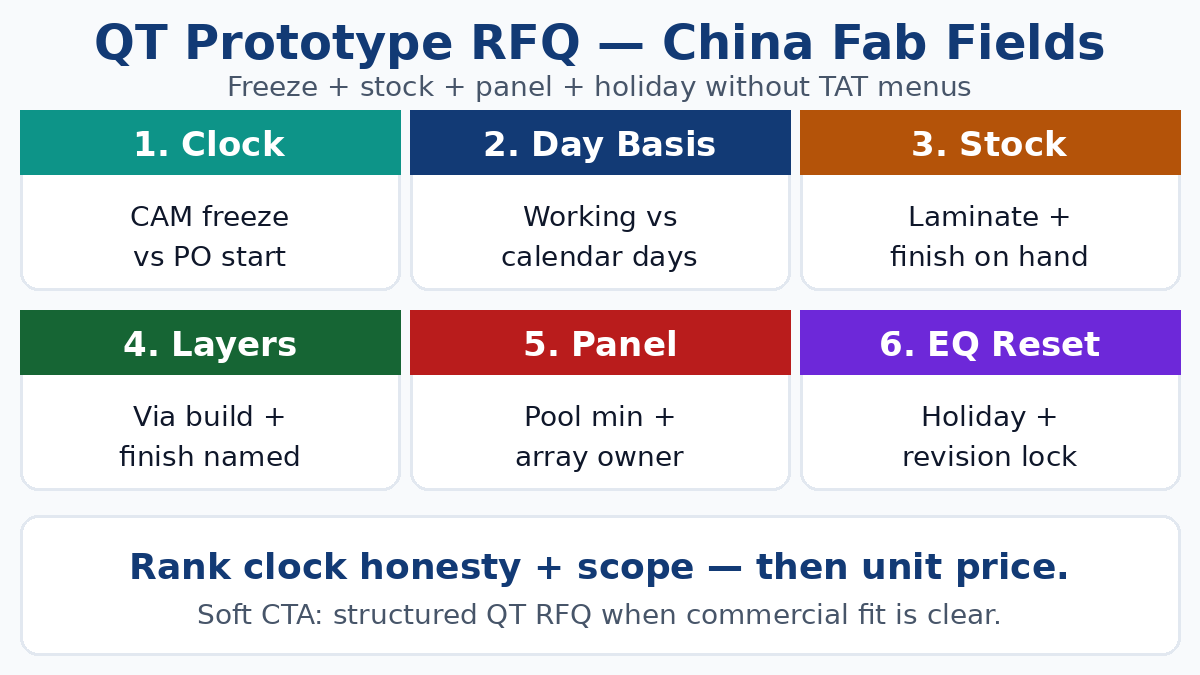
Use a field table. Compare bidders on the same rows. Do not invent XFPCB turnaround-day menus — process risk, stack, finish, and capacity differ by lot.
1. Layers / via construction. Through-via FR-4 on a common stack stays nearer the fast line. Blind/buried, sequential lamination, and high layer counts need explicit windows after CAM sees the build.
2. Surface finish and solder mask. HASL and standard ENIG on stocked cores usually keep pace; specialty finishes and uncommon mask systems can fall off the rush line. Name finish and mask once.
3. Material stock vs buy. Ask whether the quote assumes in-stock laminate/copper weight/Tg or includes procurement. AVL-locked brands and glass styles can reset both schedule and impedance risk if substituted silently.
4. Panel minimum and pooling. Confirm whether single boards ride a shared panel, what the practical minimum is for a dedicated array, and who owns array design. Pooling helps economics; it does not forgive missing fab notes.
5. Holiday and shutdown buffers. Require the fab to state whether multi-day holidays are excluded from the working-day count. Add buyer cushion on demo or SMT-critical spins.
6. Test and class depth. Flying probe vs fixture, sample vs 100% electrical, coupon expectations — written before the clock. Adding depth after award is a calendar change dressed as quality.
7. Freight and Incoterms. Default mode on the RFQ; expedite freight as a priced option with a new promised dock date. Moisture-barrier packing matters when boards go straight to assembly.
8. Revision / EQ reset rule. State whether mid-lot copper, via, mask, or test changes restart the window. Open EQs are NPI work; they are not free QT.
Rank clock honesty and scope match first; unit price second. A slightly longer promised window that names working days, stock assumptions, and holiday exclusions usually beats a short badge that starts on an undefined “order date.”
Soft next step
If the design can freeze, the stack and finish sit on a real fast path, and the next iteration or SMT gate justifies an expedite premium, send a structured quick-turn prototype RFQ: clock start, working-day basis, holiday treatment, material stock vs buy, layer/finish notes, panel rules, test depth, freight/Incoterms, and EQ reset language. XFPCB can respond on that field table when commercial fit is clear — without brochure day tags standing in for a promised date on your traveler.