

Moisture-sensitive devices are one of the few PCBA risks that can pass every inspection on the line and still fail in the field. A plastic package absorbs water vapor from the air. During reflow the water turns to steam within seconds, and the pressure can crack the mold compound, delaminate the die from its paddle, or lift bond wires. Sometimes the damage is dramatic enough to see as a bulge, the so-called popcorn effect. More often it is internal and only shows up later as an intermittent or early failure.
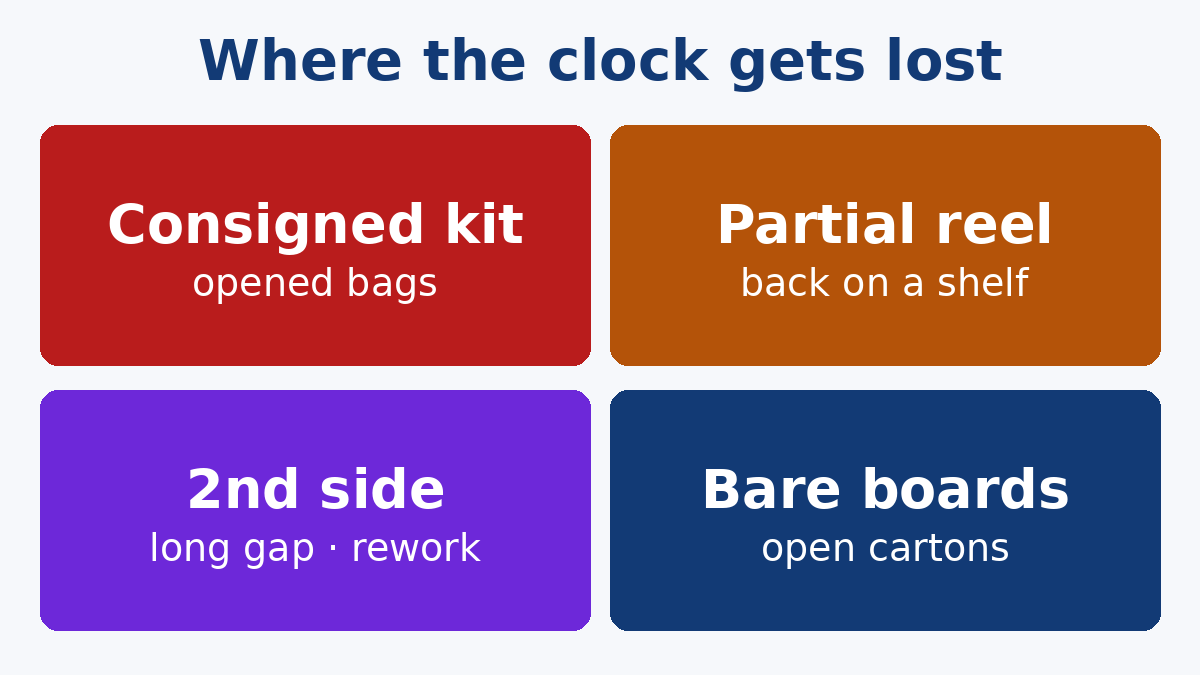
The rules for handling these parts are well established. IPC/JEDEC J-STD-020 defines how component makers classify moisture sensitivity, and J-STD-033 tells users how to pack, store, handle and bake them. What goes wrong in practice is rarely ignorance of the standard. It is the places where parts leave controlled conditions without anyone noticing: a consigned kit with opened bags, a half-used reel put back on a shelf, a board that goes through reflow three times instead of once.
This article is written from the stores and SMT floor of our Shenzhen factory. It covers the basics briefly, then focuses on where moisture control breaks down and what buyers should require, whether the factory buys the parts or you supply them.
MSL and floor life in one table
Each moisture-sensitive part carries a moisture sensitivity level (MSL) on its dry-pack label. The level tells you the floor life: how long the part can be out of its dry pack, in factory conditions of up to 30 °C and 60% relative humidity, before it must be reflowed or re-dried.
| MSL | Floor life after opening (at ≤30 °C / 60% RH) |
|---|---|
| 1 | Unlimited (at ≤30 °C / 85% RH) |
| 2 | 1 year |
| 2a | 4 weeks |
| 3 | 168 hours |
| 4 | 72 hours |
| 5 | 48 hours |
| 5a | 24 hours |
| 6 | Must be baked before use; reflow within the time on the label |
Two details matter more than the table itself. First, floor life shortens if the factory is hotter or more humid than those reference conditions, which is relevant in a humid climate like southern China's in summer, and why storage and line humidity must be controlled rather than assumed. Second, the classification is tied to a peak reflow temperature. A part classified at a lower peak temperature may need different handling when it goes through a hotter lead-free profile, so check the label's classification temperature against your process.
Many common parts, including a large share of BGAs, QFNs and larger plastic ICs, are MSL 3. That means about a week of cumulative exposure. It sounds generous until you add up how a part actually spends its time.
Where the floor-life clock gets lost
Consigned kits
When customers supply their own parts, the kit often arrives with a mix of sealed dry packs, opened bags resealed with tape, loose trays and cut tape strips. The factory cannot know how long an opened bag has been exposed. The conservative answer is to treat any part with unknown exposure history as having exceeded its floor life and bake it before use, which adds time and, for some packaging, is not straightforward (see below).
What helps: ship moisture-sensitive parts in their original sealed moisture barrier bags, or, if you have opened them, reseal them with fresh desiccant and a humidity indicator card, and write the date and cumulative exposure on the bag.
Partial reels and trays
A job may use a few hundred parts from a reel of several thousand. The rest goes back into storage, and the next job may be weeks later. If the partial reel is simply put back on a shelf, its exposure keeps accumulating. Good practice is to record the exposure time at the point the part leaves the line, then return it to a dry cabinet or reseal it in a moisture barrier bag with fresh desiccant, so the clock is paused or reset according to J-STD-033's rules.
This is one of the areas where you can learn a lot about a factory by asking to see how partial reels are tracked: a label with the opening time, or a system entry, and a dry cabinet with humidity displayed.
Double-sided assembly and rework
The standard's floor life is about exposure before reflow, but each additional reflow is another thermal shock to a package that may have absorbed moisture in the meantime. A component on the first side of a double-sided board sees reflow twice. If there is a long gap between the two sides, the parts already soldered continue to absorb moisture. The same applies to rework: removing and replacing a BGA on a board that has been sitting on a shelf exposes the neighbors, and the board itself, to localized high heat.
Practical rules: keep the time between the first and second side short, and for rework on boards that have been stored, consider baking the assembly before applying rework heat, within the limits of the other parts on the board.
Bare boards
The PCB laminate absorbs moisture too. Boards stored for a long time or in poor packaging can delaminate or blister in reflow, or contribute to warpage. IPC-1601 gives guidance on handling and storage of bare boards, including packaging and baking. Vacuum-packed boards with desiccant and a humidity indicator, stored in a controlled area, rarely need baking. Boards stored in open cartons for months often do.
Baking is not free
Baking drives moisture out and resets the floor life, but it has costs that make it a correction rather than a routine.
Packaging limits temperature. Most plastic reels and tubes cannot survive high-temperature bakes. Parts on tape and reel usually have to be baked at low temperature, which takes much longer, often days rather than hours depending on package thickness, or be moved into baking-rated trays first.
Solderability can suffer. Extended or repeated baking promotes oxidation of leads and terminations and growth of intermetallic layers on some finishes. J-STD-033 cautions about cumulative bake time for this reason. A part baked several times is not as good as a fresh one.
Time. A bake that takes days in a low-temperature oven can become the critical path of a job, especially for consigned kits that arrive with unknown exposure.
The better strategy is to avoid the need for baking by keeping parts dry from the start.
Reading the dry pack on arrival
When a moisture barrier bag arrives, a few checks tell you whether the contents are still dry:
- The bag. It should be intact, sealed, and carry a moisture-sensitive caution label with the MSL, the peak classification temperature and the seal date. Shelf life in a sealed bag is limited, typically stated on the label.
- The humidity indicator card. Read it immediately after opening, according to the instructions on the card and J-STD-033. If the indicated spots have changed color, the parts need baking before use.
- The desiccant. Present, and in the quantity appropriate to the bag.
Incoming inspection should record these checks. If a bag arrives punctured or with a saturated indicator card, that should be reported to whoever supplied it, not quietly baked away.
What a controlled factory does
On our side, moisture control comes down to a few routines:
- Incoming inspection records MSL, seal date and indicator status for every moisture-sensitive part.
- Parts go into dry cabinets or remain sealed until the job is kitted.
- When a bag is opened, the time is recorded and the floor-life clock starts, visibly, on the reel or tray label or in the system.
- The line checks remaining floor life before loading.
- Partial reels and trays go back into dry storage or are resealed with fresh desiccant, with exposure recorded.
- Parts that exceed floor life, or arrive with unknown history, are baked by a defined procedure matched to their packaging, and the bake is recorded.
- Storage and line humidity are monitored.
None of this is exotic. The difference between factories is whether it is done every time, including on the small prototype job with a consigned kit that arrived on a Friday evening.
What buyers should require
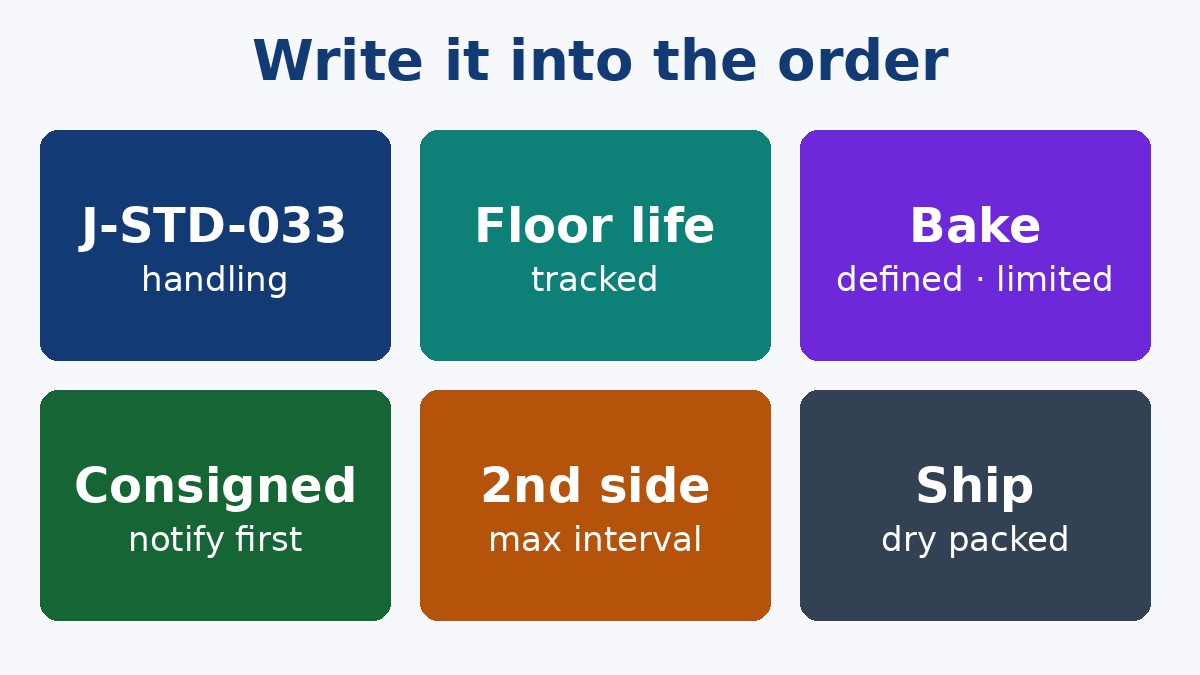
Whether you use Turnkey PCB Assembly or supply parts yourself, a few lines in the quality agreement or order make moisture control explicit:
- Handling of moisture-sensitive devices per J-STD-033, and of bare boards per IPC-1601 or your own storage requirement.
- Recorded floor-life tracking for opened parts, including partial reels.
- A defined bake procedure, and a limit on the number of bakes a part may receive.
- For consigned parts: notification if any moisture-sensitive parts arrive with damaged bags, saturated indicators or unknown exposure, before they are baked or used.
- A maximum interval between first-side and second-side reflow on double-sided boards, if your design has many sensitive parts.
- Finished assemblies packed dry if they will be stored before final integration or conformal coating.
If you consign parts, your side of the bargain is to send them sealed and labeled. If the factory buys them through its Component Sourcing service, ask how moisture-sensitive parts are received, stored and tracked; the answer should sound like a routine, not an improvisation.
When damage is suspected
If assemblies show symptoms that could be moisture damage, such as intermittent failures on specific packages, visible package bulging, or delamination, the non-destructive tool of choice for the component is scanning acoustic microscopy, which shows internal delamination and cracks that X-ray cannot. Cross-sectioning confirms. Check the handling records for the affected parts first: dry-pack history, floor-life records, bake records and the number of reflow cycles. More often than not, the answer is in the paperwork before it is in the lab.
Moisture control is unglamorous, and it rarely appears in capability brochures. It is also one of the clearest indicators of whether a PCBA line is disciplined. If you would like to see how we track moisture-sensitive parts from dock to reflow, ask us during your next quote or visit.