
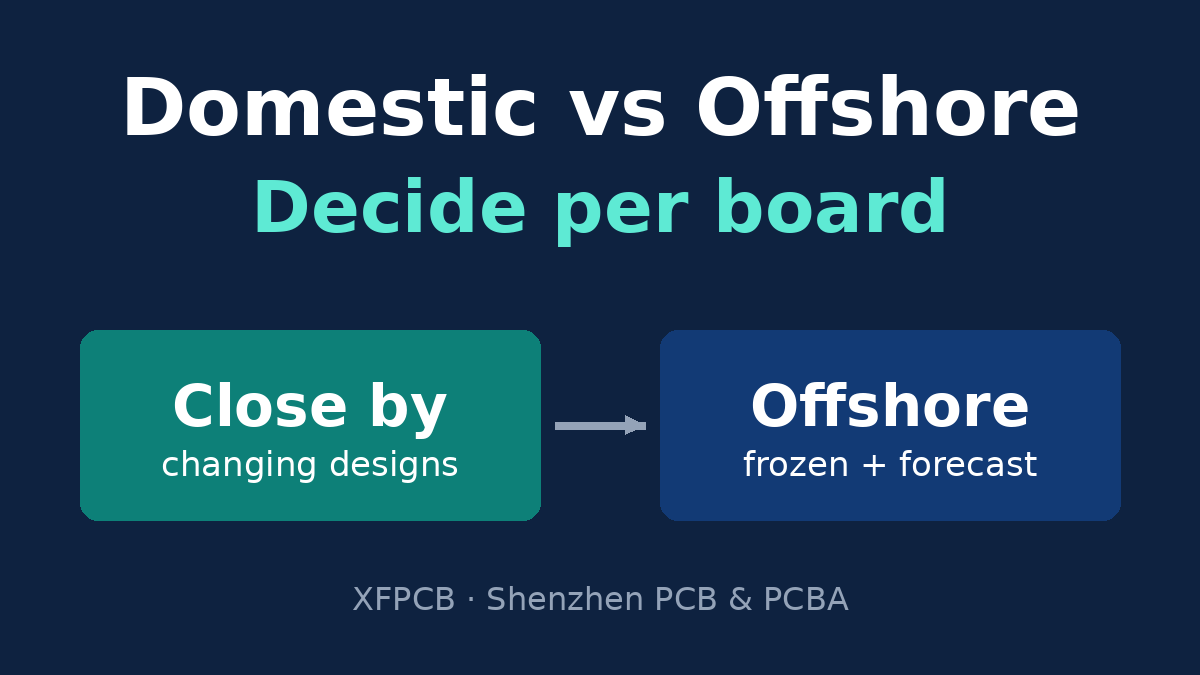
The domestic-versus-offshore question usually gets asked as if a company makes one choice for all of its boards. In practice, the teams that source well make it per part number, and they revisit it as each board matures. A controller board still changing every two weeks and a power board that has not changed in a year are different sourcing problems, even if they ship in the same enclosure.
We see this from the receiving end. As a Shenzhen PCB and PCBA factory, many of the jobs we quote are boards that were prototyped near the customer and are now moving to us for volume, or boards that are being split so that one source handles quick changes and another handles steady production. When those transfers go smoothly, it is rarely luck. When they go badly, the cause is almost always the same: the design moved, but the knowledge that made it work at the first shop did not.
This article is about both halves of that: how to decide which boards belong where, and how to move a board between a domestic and an offshore source without paying for the same qualification twice.
Decide per part number, not per company
A useful way to sort boards is by how often they change and how much each change costs you in time.
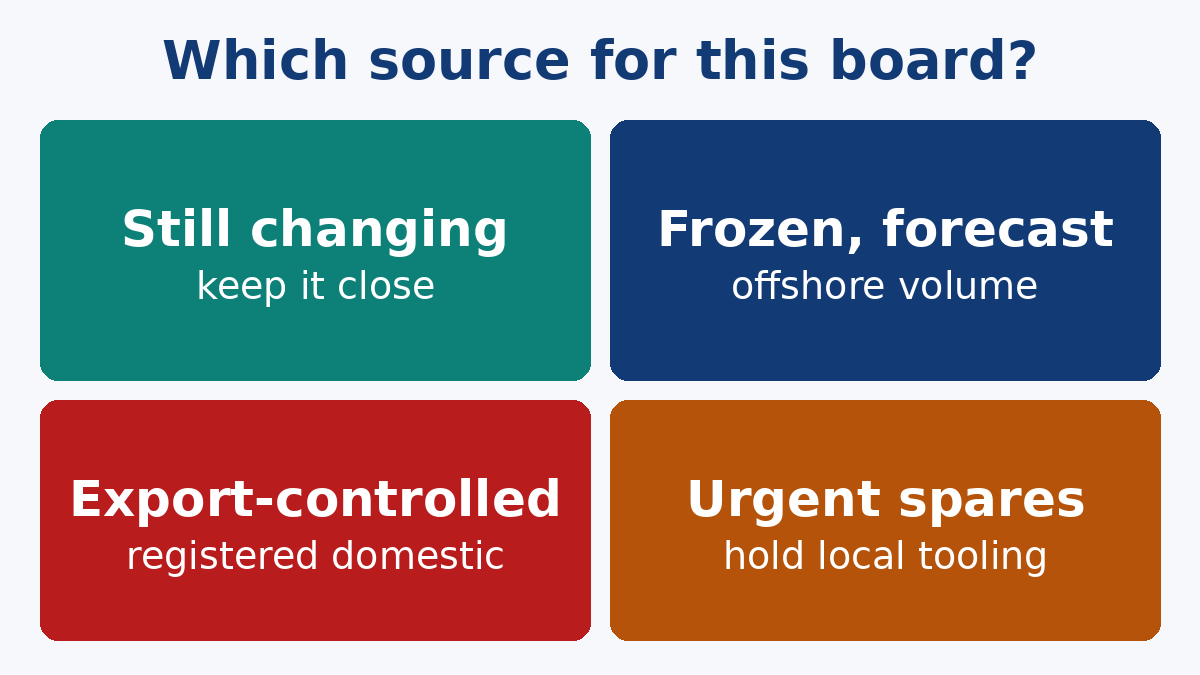
Boards still in active development. Layout, BOM and firmware interfaces are moving. Here the dominant cost is the length of the loop between "we found a problem" and "we have a corrected board on the bench." A nearby shop that can turn a small lot quickly and take a phone call in your working hours often wins, even at a higher board price, because the engineering hours saved dwarf the board cost.
Boards that are frozen and running. The design has not changed through several lots, the BOM is stable, and demand can be forecast a few weeks or months ahead. Here the dominant cost is unit price, yield and delivery reliability, and a longer but predictable shipping leg can be planned around. This is where an offshore factory with volume lines usually makes sense.
Boards with restrictions. Some designs cannot legally be built outside the country: defense articles and technical data controlled under export regulations, for example, and some government contracts carry their own sourcing clauses. These decisions are not commercial. If a board falls here, it stays with an appropriately registered domestic source, whatever the price comparison says. Check with your export compliance function before any files leave the building.
Boards with an urgent-replacement risk. If a field failure or a line-down situation would require boards within days, you may want a domestic source that holds qualified tooling, even if routine production is offshore.
Most product lines contain boards in more than one of these groups. That is why a single "we are an offshore company" or "we buy local" policy tends to overpay on some boards and take unnecessary risk on others.
What actually differs between the two options
Buyers have heard the headline trade-offs many times: offshore unit price versus domestic speed and proximity. The more useful comparison is where each option is exposed.
Engineering loop time. An offshore factory can build as fast as a local one once files are clear, but questions cross time zones and boards cross borders. A single unanswered engineering query can cost a day. The fix is not only geography; it is a data package that does not generate questions, and a named engineer on your side who answers within the factory's working day.
Landed cost, not board price. Freight, duties, brokerage, inventory held in transit, incoming inspection and the cost of a rejected lot all belong in the comparison. Duty depends on the classification and country of origin of the specific product and changes with trade policy, so calculate it for your actual order rather than using a rule of thumb. We will not quote you a generic percentage, and you should be wary of anyone who does.
Recovery time. If a lot is rejected, a domestic replacement can arrive quickly. An offshore replacement has to be rebuilt and shipped again. For stable designs with good first-lot evidence this risk is small; for a new design going straight to offshore volume, it is the risk that matters most.
Oversight. You can drive to a local supplier. For an offshore one, oversight has to be designed in: first-article reports, inspection records, photos of critical features, cross-section reports where relevant, and perhaps an audit visit or a third-party inspection. None of this is exotic, but it has to be asked for.
IP handling. Sharing Gerbers, drawings and BOMs is unavoidable in any outsourced build. The practical protections are the same everywhere: an NDA, sharing only what the build needs (fab data does not need your schematics or firmware source), controlled revisions, and a supplier who can tell you who has access to your data.
Why transfers go wrong
When a board that worked at shop A fails, or suddenly behaves differently, at shop B, the Gerbers are rarely the cause. The cause is usually something that was never written down.
Material equivalence by name only. "FR-4" on a drawing is not a material specification. Two shops can use different laminate systems with different glass styles, resin content and Tg, and both call it FR-4. Specify the IPC-4101 slash sheet, Tg and any Dk requirement, and if a specific laminate family was qualified, say whether equivalents are allowed.
Impedance built by one shop's stackup. If the first shop tuned trace widths to its own prepreg choices and hit the impedance targets, the next shop's stackup will be different. If your drawing only says "50 ohm single-ended," the new shop will adjust widths within an agreed tolerance to hit the target with its materials, which is the correct approach for impedance control PCB work, but only if you allowed that adjustment and asked for coupon test reports. If you did not, you get either a hold for questions or a board that does not match.
Tribal-knowledge fixes. The first shop may have quietly added thieving copper, adjusted a solder mask dam, changed a panel layout to control warp, or baked boards before assembly. None of that appears in your data. Ask the outgoing supplier, if the relationship allows it, what they changed or compensated for on your part number.
Assembly details that live in the machine, not the file. Stencil aperture modifications, reflow profiles, AOI tolerances, selective-solder programs and hand-solder instructions are often the reason a PCBA had good yield. The new assembler will build its own. Expect to repeat first article, and send whatever notes you have about known problem areas.
Panelization and outline. Different shops panelize differently. If your assembly process or test fixture depends on a particular panel, rail, fiducial or tooling hole location, put a panel drawing in the package.
The transfer package
A board that moves between sources should move with more than its Gerbers. This is the package we ask for when a customer transfers a part number to us, and it applies in either direction:
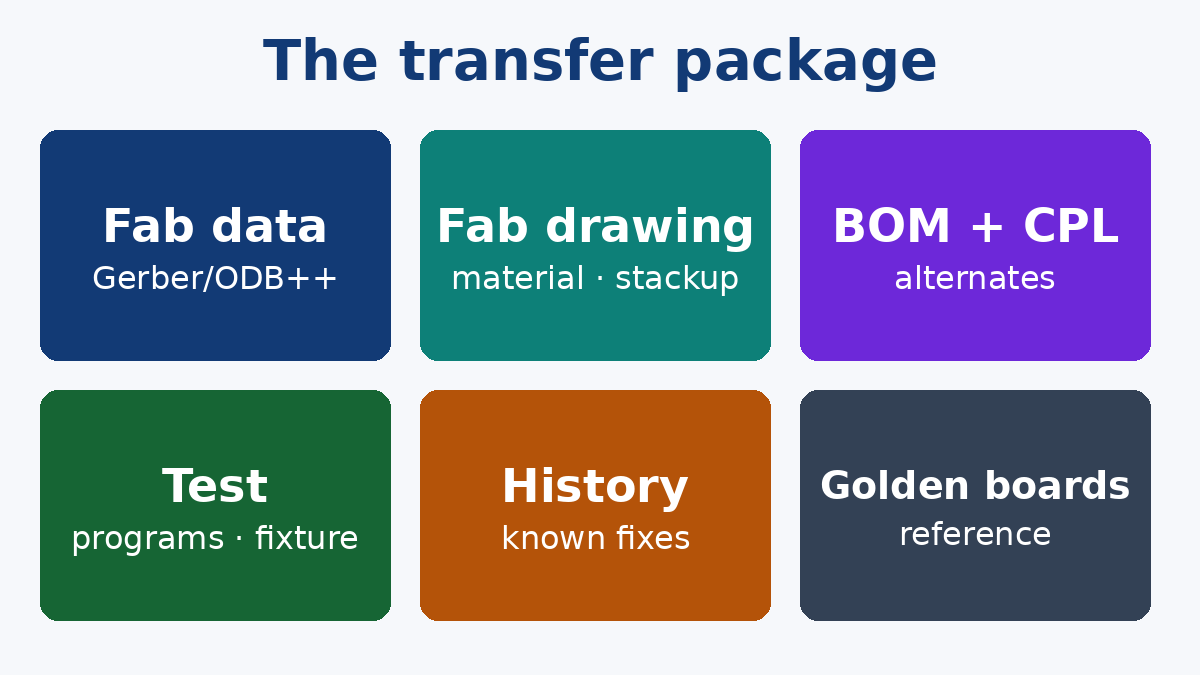
- Fabrication data in one consistent format (Gerber X2 or ODB++ or IPC-2581), with a drill file and a board outline that agree with each other.
- A fabrication drawing: material by IPC-4101 slash sheet, Tg, thickness and tolerance, copper weights, stackup and impedance table with tolerance, surface finish, solder mask and legend colours, IPC-6012 performance class, and any special requirements such as via filling or edge plating.
- Panel drawing if the panel matters to assembly or test.
- For assembly: BOM with manufacturer part numbers and approved alternates, centroid file, assembly drawing with polarity marks, and the IPC-A-610 class.
- Test requirements: bare-board electrical test, ICT or flying probe program source if you own it, functional test fixture and procedure.
- The history: known issues, deviations accepted from the previous source, and any process notes the previous source shared.
- Golden samples where possible: a few good boards from the previous source give the new one a physical reference for inspection and fit.
You can see how we expect files to arrive on our Manufacturing Files page. The point here is that the package should be self-sufficient: a competent factory should be able to build it without a phone call.
Qualify once, then correlate
Transfers get expensive when the new source is treated as if the design were brand new, or, at the other extreme, when nobody checks anything and the first production lot becomes the qualification lot.
A proportionate path looks like this:
- Correlation build. A small lot from the new source, built to the transfer package, with a first-article report, impedance coupon results, cross-sections if the board has demanding plating or microvias, and electrical test data.
- Compare against the golden reference. Dimensions, fit in the enclosure, impedance, solderability, and for PCBA, functional test results side by side with boards from the previous source.
- Close deviations formally. Anything the new source had to change (a width adjustment for impedance, a mask opening tweak) gets written into the data package so both sources are building the same thing.
- Release to production with the first lots monitored. Watch incoming inspection and field results closely for the first few lots rather than assuming equivalence forever.
This is less work than a full design qualification, because the design has already been proven. What you are proving is that the new factory builds the same board.
Running two sources at once
Many buyers end up with a hybrid: a domestic shop for prototypes, urgent lots and restricted boards, and an offshore factory for volume. That works well when both sources build from the same controlled data.
The discipline that keeps a dual-source setup healthy is simple to describe and easy to let slip. There is one revision-controlled data package, owned by you, not two versions that drift. Engineering changes are released to both sources at the same time, with an effective date or lot. Material and finish requirements are written as specifications, not as whatever the first shop happened to stock. And each source knows the other exists, so that nobody assumes their own undocumented fix is part of the design.
A comparison between USA vs China PCB suppliers makes more sense on these terms: not which country is better in general, but which source is qualified for which part numbers, and whether both are building the same revision.
A short decision checklist
Before choosing a source for a given board, answer these:
- Is the board, or any of its technical data, subject to export control or a contract sourcing restriction? If yes, that decides it.
- How many revisions has it had in the last few builds, and how many do you expect next quarter?
- What does a one-week delay cost you on this board, and what does a rejected lot cost?
- Is demand forecastable far enough ahead to plan around shipping?
- Is the data package self-sufficient, including material specifications, stackup and impedance tolerances, and assembly notes?
- Do you have golden samples and first-lot evidence to correlate against?
- Who on your side answers engineering questions within the factory's working day?
If most answers point toward a stable, forecastable, unrestricted board with a complete package, an offshore factory is a reasonable home for it. If the design is still moving or a delay is expensive, keep it close until it settles, and plan the transfer as a project rather than a purchase order.
If you are considering moving a stable part number to Shenzhen, we are happy to review the transfer package with you before any order is placed, flag anything we would need to ask about, and propose a correlation build sized to your risk.