
Brochure posts that walk PCB anatomy (prepreg, foil, laminate, mask, silkscreen) and then name FR-4, polyimide, PTFE, and flex films — often ending with a house stock list of named laminate brands — still leave buyers awarding China fab lots without buyer gates: Tg / Td / CTE windows, Dk / Df for the actual frequency band, FR4-family vs polyimide vs PTFE vs flex films vs metal-core routing, and RFQ stackup callouts that stop silent “equivalent” swaps. Treat competitor industry overviews as outside orientation, not XFPCB plant inventory. This page owns a different frame: material selection as China-fab RFQ grammar — thermal and electrical gates, family routing (without cloning the FR4 deep dive), and paste-ready stackup locks (stackup note, Tg class, CAF notes, brand/type lock vs equivalent). Soft CTA only. Sibling XFPCB lanes already own when to use FR4 depth, the PCB materials hub brochure, and product pages for High Tg PCB, High Frequency PCB, Flexible PCB, and Metal Core PCB — link them; do not rewrite. A later insulating-materials / dielectrics guide stays separate — do not merge.
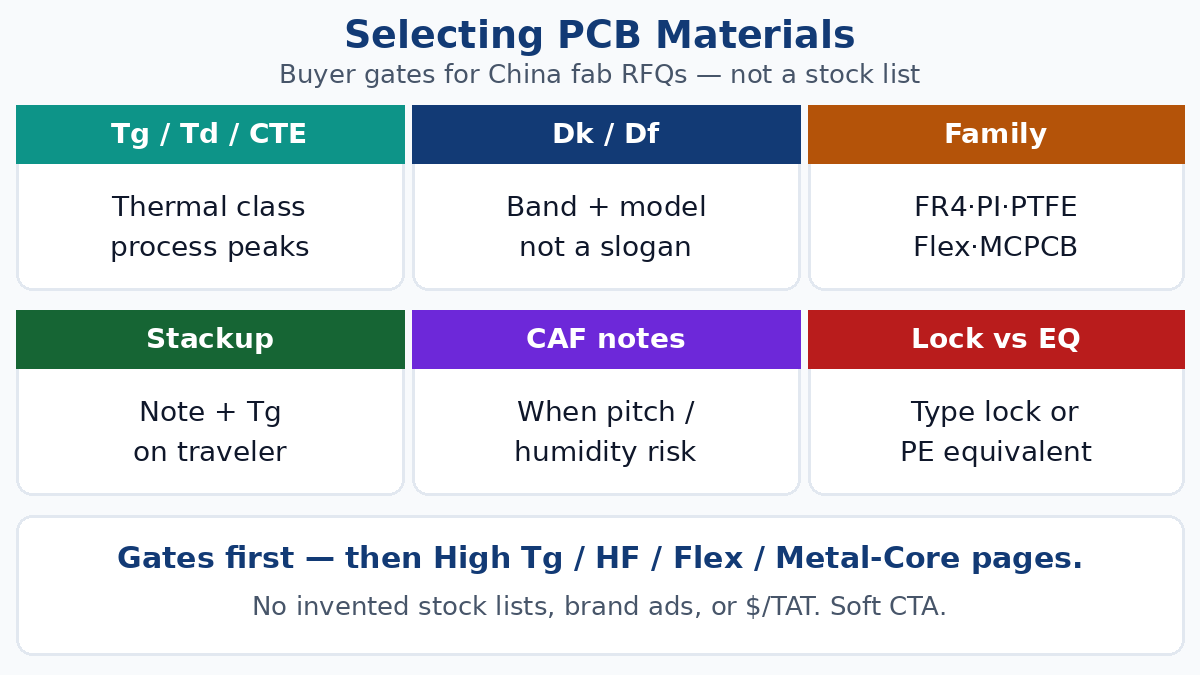
What “selecting materials” should mean on a buyer RFQ
Material selection is not a catalog browse. It is a set of locks that make two quotes comparable: which dielectric family, which thermal class, which electrical gates, and whether the fab may substitute an “equivalent” without a signed EQ. Anatomy (prepreg, copper foil, core/prepreg laminate, solder mask, legend) matters for DFM — but buyers award on gates, not on a textbook cross-section.
Useful RFQ questions on this page:
- Thermal: Tg class, Td / reflow exposure risk, CTE mismatch risk on PTH and BGA.
- Electrical: Dk and Df at the frequencies that matter — not a single datasheet headline.
- Family: FR4-family default vs polyimide vs PTFE / HF laminates vs flex films vs metal-core / aluminum constructions.
- Stackup callouts: written stackup note, Tg class, CAF notes when pitch / humidity risk is real, and brand/type lock vs equivalent language.
- Files: frozen Gerbers/ODB++ and stack notes via Manufacturing Files before “material TBD” quotes are treated as comparable.
Capability depth that is not a material essay lives on product and process pages (High Tg, HF, flex, metal-core, HDI). This guide stays on selection grammar + RFQ paste language.
Thermal gates — Tg, Td, CTE (buyer language)
Thermal language fails when “high Tg” is a slogan without a number and without the process that will hit the board.
Glass transition temperature (Tg). Below Tg the resin system behaves as a rigid solid for most fab and assembly planning; above Tg it softens and dimensional control degrades. Buyer practice: size the operating and process peaks against the Tg class you write on the traveler (common FR4-family classes such as ~130 °C vs ~150 °C vs ~170 °C+). Do not invent a universal “keep ambient 20 °C below Tg” rule as XFPCB process law — write the peaks you actually see (lead-free reflow, multiple thermal cycles, burn-in) and the Tg class that covers them. When the program is truly high-Tg driven, route capability questions to High Tg PCB rather than cloning FR4 pedagogy here.
Decomposition temperature (Td). Td marks irreversible resin mass loss / degradation under enough heat-time. Buyers care when multiple reflow passes, rework, or high peak profiles stack. Ask whether the quoted system’s Td / thermal endurance is compatible with your reflow count — not whether a brochure says “high heat.”
Coefficient of thermal expansion (CTE). Z-axis CTE drives PTH barrel stress; in-plane CTE interacts with packages and metal cores. Mismatched CTE across copper, dielectric, and attached metals shows up as barrel cracks, warpage, and solder-joint fatigue — especially on thick boards, Heavy Copper builds, and metal-core constructions. Write CTE risk as a stackup + process note when BGA pitch, thick copper, or aluminum / MCPCB is in play — not as a single datasheet cell pasted without context.
**What thermal gates do not buy:** IPC Class, impedance coupons, or automatic CAF immunity. Those stay separate PO lines.
Electrical gates — Dk, Df, and when FR4 stops being enough
Electrical selection is about the band you ship, not the flattest marketing curve on a datasheet.
Dielectric constant (Dk). Controls impedance geometry and delay. For controlled-impedance work, lock Dk (and the frequency / condition the fab models) with the stackup — then pair process ownership with Impedance Control. A “Dk ~4.5 FR4” slogan without stack thickness, glass style, and modeling frequency is not an RFQ lock.
Dissipation factor (Df / loss tangent). Dominates insertion loss as edge rates and GHz content rise. Low-loss / PTFE-family systems earn their keep when loss budgets fail on FR4-family glass-epoxy — not when a marketing page prefers “Teflon.” Route microwave / mmWave and specialty HF constructions to High Frequency PCB; keep this page on when to open that gate.
Flatness vs frequency. Competitors often summarize “flatter Dk vs frequency + lower loss ⇒ high GHz.” Buyer translation: if your channel is multi-GHz with tight loss / skew budgets, ask for material family + modeled Dk/Df at named frequencies and coupon / test ownership — do not accept “HF capable” without numbers.
**What electrical gates do not buy: automatic HDI microvia process windows, or a free upgrade from FR4-family to PTFE. Family upgrades are priced and scheduled** as process changes; write them explicitly.
Family routing — FR4 vs polyimide vs PTFE vs flex films vs metal-core
Route by job, then deepen on the owning page. Do not turn this section into an FR4 encyclopedia — that lane is already live.
| Family | Typical buyer job | Open this gate when… | Own the depth on… |
|---|---|---|---|
| FR4-family (glass-epoxy) | Default rigid digital / mixed-signal at cost and availability | Standard Tg class covers reflow + ambient; loss / Dk budgets fit FR4 | When to use FR4 + materials hub |
| High-Tg FR4-family | Lead-free multi-reflow, thicker / higher layer stress | Traveler needs explicit Tg class above commodity | High Tg PCB |
| Polyimide (rigid laminates) | Higher continuous temp / toughness vs commodity FR4 | Thermal endurance or CTE behavior FR4-family cannot hold | Quote as polyimide type — not “better FR4” |
| PTFE / low-loss HF laminates | RF / microwave loss and stable Dk | Channel loss or phase budgets fail on FR4-family | High Frequency PCB |
| Flex films (PI / PET / LCP-class films) | Dynamic or static bend, space, wearables | Geometry needs flex or rigid-flex, not rigid only | Flexible PCB, Rigid-Flex |
| Metal-core / aluminum | LED / power heat spreading | Thermal path needs MCPCB / Al construction | Aluminum PCB, Metal Core PCB |
Polyimide (rigid) is not the same sentence as polyimide flex film. Rigid polyimide laminates compete with high-temp FR4-family on thermal endurance; flex films compete on bend life and stack construction. Say which you mean on the RFQ.
PTFE / HF systems often need specialized drilling, plating, and bonding process windows. Buyer failure mode: awarding “PTFE equivalent” without process notes, then discovering schedule and yield shock. Lock family + type and ask what process deltas the fab assumes.
Flex films omit woven-glass cores by design in many constructions; coverlay, adhesiveless vs adhesive systems, and bend radius belong on flex / rigid-flex pages — here only the gate: open flex when the form factor demands it, then freeze film type and stack notes.
Metal-core / aluminum change CTE, dielectric thickness above the metal, and thermal path language. Do not paste “FR4 Tg” alone onto an MCPCB traveler.
Hub brochure tables and step-by-step RFQ flow remain on PCB materials. This blog adds gates + stackup callout grammar, not a second brochure.
RFQ stackup callouts that stop silent swaps
Export quotes diverge when material language stays soft (“FR4 or equivalent,” “HF material,” “flex OK”). Paste comparable callouts:
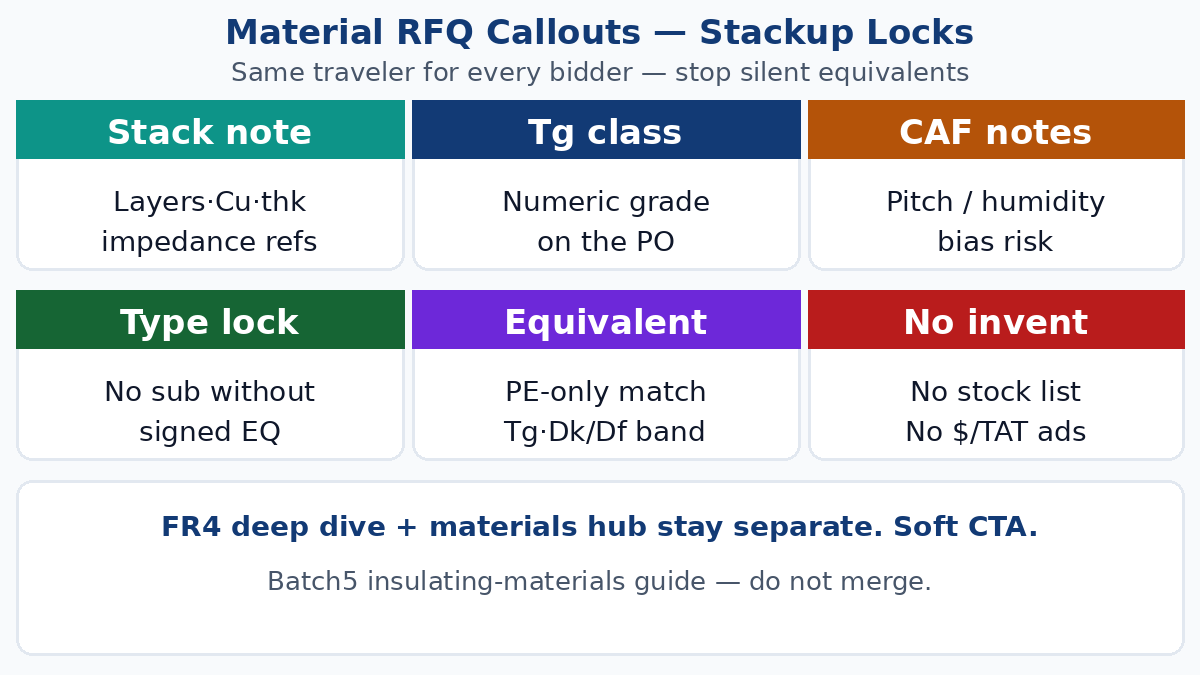
- Stackup note — layer count, core/prepreg intent, copper weights, overall thickness target, and impedance reference layers when relevant. Attach the note with Manufacturing Files; do not leave stack “fab standard” when impedance or Tg class is critical.
- Tg class — numeric class or named thermal grade on the traveler (e.g. Tg 150 / Tg 170 class — as your lock, not a stock boast). Point High Tg process questions to the High Tg product page.
- CAF notes — when fine pitch, high humidity, high voltage bias, or CAF-sensitive constructions are in scope, ask for CAF-oriented resin / glass expectations and any lot evidence the program needs. Do not invent XFPCB CAF test menus or pass counts.
- Material brand/type lock vs equivalent — choose one:
- Lock: named generic type / datasheet family (e.g. “FR4-family Tg170 class, halogen-free if required”) or a customer-specified type — no substitute without signed EQ.
- Equivalent allowed: state who approves equivalents (buyer PE only), what properties must match (Tg class, Dk/Df band, flammability, halogen status), and that silent brand swaps are refused.
- Finish / copper / mask — still separate fields; material family does not freeze ENIG thickness or mask type.
- No silent downgrade — Tg class, HF family, flex film type, or metal-core dielectric changes need EQ before build.
- HDI / via structure — when microvias or sequential lamination appear, material must be compatible with the HDI process window you actually buy — write via type beside the dielectric family.
Do not paste competitor laminate brand ads or invent XFPCB warehouse stock lists, unit prices, or turnaround times. Generic FR4 / polyimide / PTFE / flex-film / metal-core language is enough for comparable RFQs; named brands belong only when your controlled document already specifies them.
China fab honesty — availability, equivalents, and files
China export fabs routinely run strong FR4-family and high-Tg FR4-family programs, plus flex, aluminum / MCPCB, and selective HF constructions. That does not mean every named global laminate SKU sits on a shelf for next-day release — and this page will not invent such a list.
Honest buyer practice:
- Prefer property locks (Tg class, Dk/Df band, halogen / flammability, CAF notes) when the design allows equivalents under PE approval.
- Prefer type locks when a qualification already froze a construction — then expect longer confirm cycles if the exact type is constrained.
- Freeze files early: stackup PDF / notes, Gerbers or ODB++, drill, and impedance tables. Soft “material TBD” quotes are not comparable awards.
- Route award logistics through How to Place an Order only after material gates and files are frozen — not after a brand name reopens the stack post-PO.
Soft next step
Write thermal and electrical gates first, route the family to the owning product page, then paste stackup / Tg / CAF / lock-vs-equivalent language so every bidder answers the same traveler. Soft next step when the stack and material callouts are clear: send the RFQ through your normal path via How to Place an Order with Manufacturing Files attached — after gates are written, not after an “or equivalent” slogan reopens Tg class and Dk/Df post-award.