
Solder mask color is often treated as a brochure choice — green looks “standard,” black looks premium, white suits LEDs. For factory buyers placing China fab RFQs, color is sometimes only cosmetic. Other times it changes Liquid Photoimageable (LPI) process windows, silkscreen contrast, AOI and rework visibility, LED reflectance goals, and whether the shop runs a stocked ink or a special that adds setup and calendar time. This factory buyer guide separates when color is branding from when it hits inspection and RFQ fields, what China fabs commonly stock versus specials, and what to write on the fab drawing so quotes stay comparable — without inventing dollar tables or naming competitor brands.
What solder mask color actually does (and does not)
Solder mask (solder resist) is a polymer layer that protects copper from oxidation and reduces solder bridging on SMT pads. Color is a pigment choice inside that polymer system. From a circuit-function view, copper geometry, dielectric, finish, and assembly process usually dominate electrical behavior far more than whether the mask is green or blue. Buyers who assume “color never matters” still miss three practical factory effects:
- Visual and optical contrast for human rework, AOI lighting models, and first-article inspection of opens, shorts, and mask defects.
- Optical side effects that product teams care about — reflectance under LEDs, glare behind displays, heat absorption of very dark surfaces — with caveats, not absolute rules.
- Process and logistics — stocked LPI colors versus special inks, matte versus gloss finish of the mask, dam capability the line has proven on that ink, and lead-time deltas when the color is not on the shop’s daily menu.
Color does not replace good pad design, adequate mask clearance, or a correct finish callout. It also does not magically fix AOI if lighting and golden samples were never tuned. Treat color as a named process input, not as decoration you change after CAM freeze.
Cosmetic vs inspection-critical — when buyers should care
Mostly cosmetic. Closed enclosures where no one will see the board, mature green-mask programs with proven AOI recipes, and low-mix volume where the assembler already runs the same color family. Here, switching to a “pretty” color for marketing samples can still annoy the fab if the color is a special — but the electrical traveler may not change.
Inspection and rework matter. Prototype and NPI lots, dense BGA/QFN neighborhoods, fine mask dams, mixed technology (SMT + selective through-hole), and any program where field service or contract manufacturing will hand-rework under a microscope. Trace-to-plane contrast and pad edge visibility change how fast technicians find solder bridges, insufficient solder, or lifted pads. AOI systems can be trained on many colors, but dark low-contrast masks and dirty white masks raise false-call risk if the library and lighting were built for green stock.
Product optics matter. LED modules and light engines often specify white or high-reflectance mask so the board does not swallow lumen output. Display-adjacent boards may prefer low-glare or darker cosmetics behind translucent housings. These are product requirements — write reflectance or appearance notes when they are real, and do not overclaim that “black always runs hotter” or “white always fails AOI.” Heat absorption of black surfaces is a physics tendency, not a substitute for thermal design; white can show dirt and fingerprint contrast that hurts visual QC over time.
Decide early: is the color a brand decision, an LED reflectance decision, or an inspection decision? Put that reason on the RFQ so CAM does not treat a special ink as a casual preference change mid-lot.
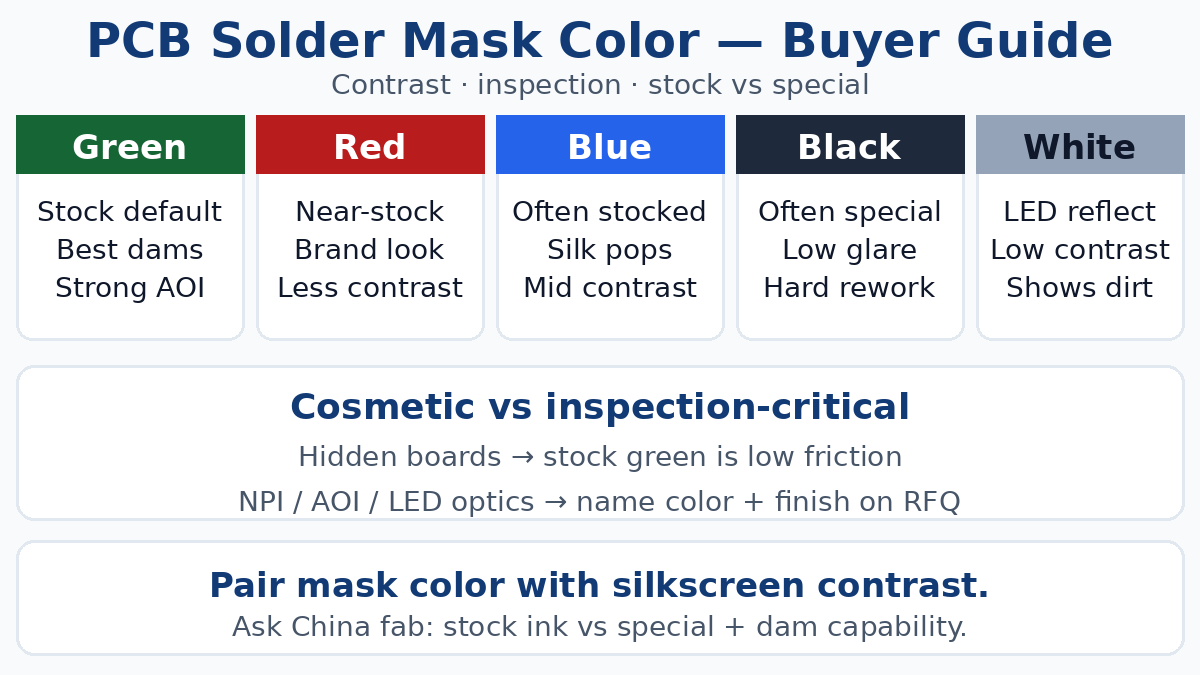
Green, red, blue, black, white — factory-practical pros and cons
Market color brochures list aesthetics. Buyers need process and inspection notes.
Green. Default stock at most China rigid fabs. Highest familiarity for LPI process windows, thin coats, and fine solder-mask dams on proven menus. Strong plane/trace contrast for many AOI and rework setups. White or yellow legend usually reads well. Lowest friction on lead time when the lot is otherwise standard. Choose green when you have no product reason to leave it.
Red. Common alternate stock or near-stock at many shops. Strong visual brand cue for open-frame or hobbyist aesthetics. Contrast is often lower than green for fine copper features — technicians may need more magnification. Treat as an aesthetic pick unless your CM already runs red AOI libraries. Confirm legend color (often white) and dam capability on your pitch.
Blue. Frequently stocked as a second common color. Silkscreen (especially white) often pops well; popular for open hardware aesthetics and some display-adjacent cosmetics. Contrast for copper inspection is typically behind green. Confirm whether the shop’s blue is gloss or matte — glare changes AOI and camera photos used for FA.
Black. Often a special or limited-stock ink rather than the daily green line. Excellent legend contrast with white silk; low light reflection helps some optical products. Copper and pad contrast for visual rework and AOI is weak unless lighting and algorithms are tuned. Dark surfaces absorb more radiant heat in some environments — note the caveat for high-power or poorly ventilated enclosures, then still design copper and thermal paths properly. Expect possible setup or schedule friction versus green; ask before you freeze a marketing black for a dense NPI without AOI buy-in.
White. Favored for LED boards when high reflectance is specified. Lowest copper contrast for visual inspection among common colors; dirt and flux residues show readily. Not every “white” ink meets photometric reflectance goals — if LEDs drive the choice, write reflectance or approved ink family language, not only “white.” Dam and registration capability can differ from green stock; confirm for fine-pitch LED arrays.
Yellow and other niche colors exist; treat them as specials unless your fab lists them on the standard menu. Do not assume every color family supports the same minimum dam width or the same matte/gloss option.
Silkscreen contrast and legend — pick the pair, not only the mask
Legend (silkscreen) is a separate ink pass. White legend on green, blue, red, and black is the usual high-contrast default. Black legend on white or yellow mask is common when the mask is light. Poor pairs — pale yellow on green, white on pale blue under harsh lighting — waste assembly and QC time.
Write both sides if you use double-sided silk. Call font height and polarity marks that matter for hand assembly. Dense decorative silk rarely dominates fab cost, but it adds a pass and can interfere with test pads if artwork is careless. If you need no silk, say so explicitly so quotes do not assume a legend pass.
China fab stock colors vs specials
Common stock (typical, not universal). Green LPI is nearly always on the shelf. Blue, red, black, and white appear often on China fab capability lists — availability still varies by plant, ink vendor, and whether the line keeps matte and gloss for each. “Listed on the website” is not the same as “ready on the next panel without setup.”
Specials. Non-menu Pantone-like matches, unusual yellows/purples, ultra-matte or textured finishes, dual-color mask on one board, and high-reflectance whites tied to optical specs. Specials invite ink changeover, first-article color checks, and possible longer lead time. They may also change which dam widths the shop will sign — green process capability does not automatically transfer to a rarely run ink.
Ask the fab: which colors are daily stock for your layer count and finish menu? Which need confirmation? Is matte or gloss the default for that color? What is the proven minimum dam for that ink on your copper weight? Soft cost language only: stock green usually avoids special setup; specials can move schedule and quote structure without needing invented unit-price tables.
What to write on the RFQ (color, mask finish, silk, dams, AOI)
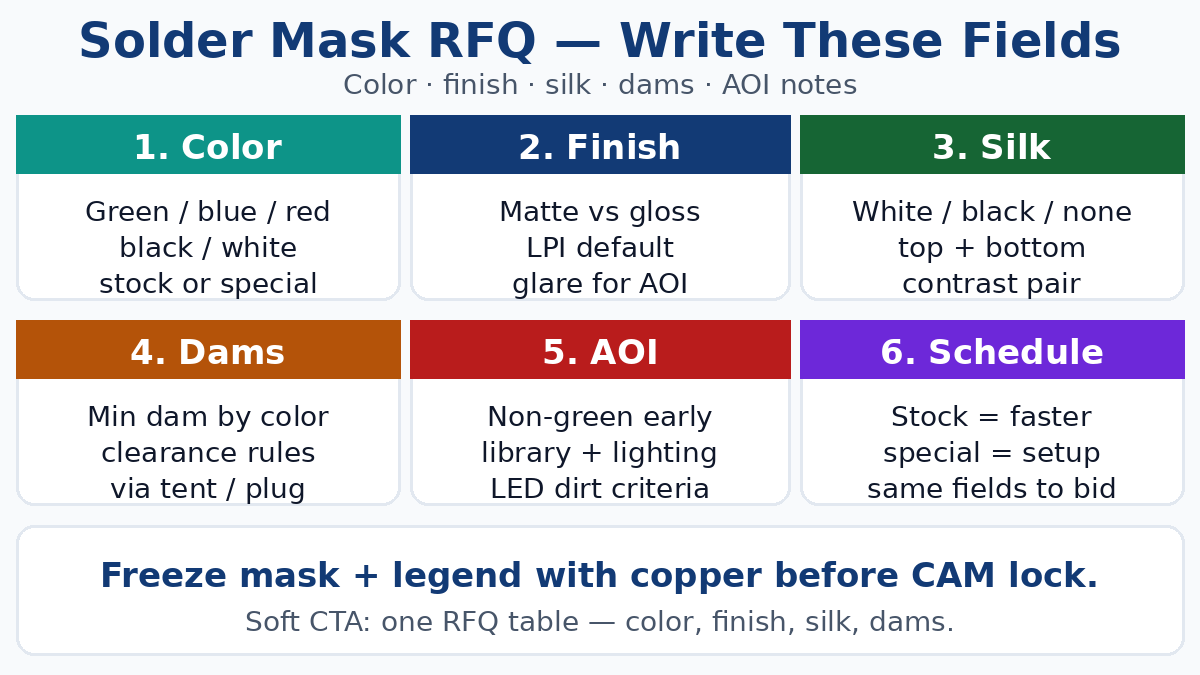
Vague “green PCB” notes produce green boards and still leave EQ room. Name the fields buyers control:
Mask color. Exact color name the fab uses (e.g., green / matte green / blue / black / white). If brand Pantone matching matters for cosmetics, say so and expect a special path.
Mask type. LPI photoimageable resist is the rigid default for most China fab menus. Do not confuse mask color with legend color. Coverlay on flex is a different stack — this guide is for rigid LPI color choices unless you explicitly call flex coverlay.
Mask finish. Matte vs gloss. Gloss increases specular glare for cameras and human inspection; matte reduces glare but can look “less premium” in open products. If AOI or photo FA matters, prefer the finish your CM already lights for.
Silkscreen / legend color. White, black, or none; top, bottom, or both. Contrast against the chosen mask.
Openings and dams. Mask expansion / clearance rules, tented vs plugged vs open vias, and minimum dam between pads. Dam capability is ink- and process-dependent — ask for the color you chose, not only the green datasheet number.
AOI / inspection notes. If the CM or fab runs AOI on bare boards or after SMT, flag non-green colors early so libraries and lighting can be prepared. For white LED boards, separate cosmetic dirt sensitivity from true defect criteria.
Lead-time and cost deltas (without inventing $). Ask whether the color is stock or special; whether matte/gloss adds a setup; whether first-article color approval is required. Compare quotes with the same color, finish, and silk callouts. Stock green on a standard traveler is usually the lowest-friction path; specials can add calendar and engineering review even when unit lines look similar.
Freeze mask and silk Gerbers with the copper at one revision. Changing black to green after stencil and AOI golden samples are built is an ECO, not a free preference tweak.
LED reflectance and heat — useful caveats, not myths
LEDs. White or high-reflectance mask can improve optical efficiency when the board is part of the light path. Confirm the ink’s reflectance class if the optic designer cares; “white” alone is incomplete. Green or black under high-brightness LEDs can absorb more light — sometimes intentional for glare control, sometimes a lumen loss. Write the optical intent.
Heat. Darker masks absorb more visible/IR in some lighting and sun-load cases. That does not mean black PCBs are unfit for power electronics if copper pours, thermal vias, and heatsinking are designed correctly. It does mean buyers should not pick black solely for cosmetics on a thermally marginal open-frame LED driver without a thermal review. Prefer measured temperature rise and copper design over color folklore.
Displays and cameras. Low-reflection masks help when boards sit behind translucent bezels or near optical sensors. Blue and black cosmetics are common for that reason — still verify silk and inspection.
Soft next step
Start from product visibility and inspection needs, not from a color brochure alone. If the board is hidden and AOI/rework run on proven green libraries, stay on stock green unless branding forces a change. If LEDs, open chassis, or camera glare drive the choice, name color, matte/gloss, silk color, dam rules, and any reflectance note on the same RFQ package as finish and copper. Ask the China fab which colors are stock versus special for your construction, and whether AOI or FA needs a color-specific golden sample.
When those fields are clear, the shop can price and schedule a real traveler instead of padding an unnamed ink change. Share fab notes and volume band early, freeze mask and legend with copper before CAM lock, and treat solder mask color as a manufacturing input you can audit — not as a last-minute paint swap.