
China fab quote desks do not hear “types of PCB” the way brochure pages list them. A buyer who writes “multi-layer flex aluminum high-frequency board” on one line has named four axes at once — layer count, form factor, thermal metal, and dielectric specialty — and two plants will price different constructions against the same Gerber. Catalog posts walk single / double / multi, rigid / flex / rigid-flex, aluminum, and high-frequency, then append a generic benefits list and a soft CTA. Factory buyers still need a selection map: which axis is primary on the RFQ, when a type is overkill, and how to name construction so layer count, form, and material do not collide in CAM.
This guide classifies boards the way a China traveler does — by layers, rigidity, thermal/metal core, and frequency duty — then shows RFQ naming conventions that keep bids comparable. Deep dives on flex, HDI, aluminum uses, multilayer cost/design, and FR4 defaults live on their own XFPCB notes; here you get taxonomy and pointers only.
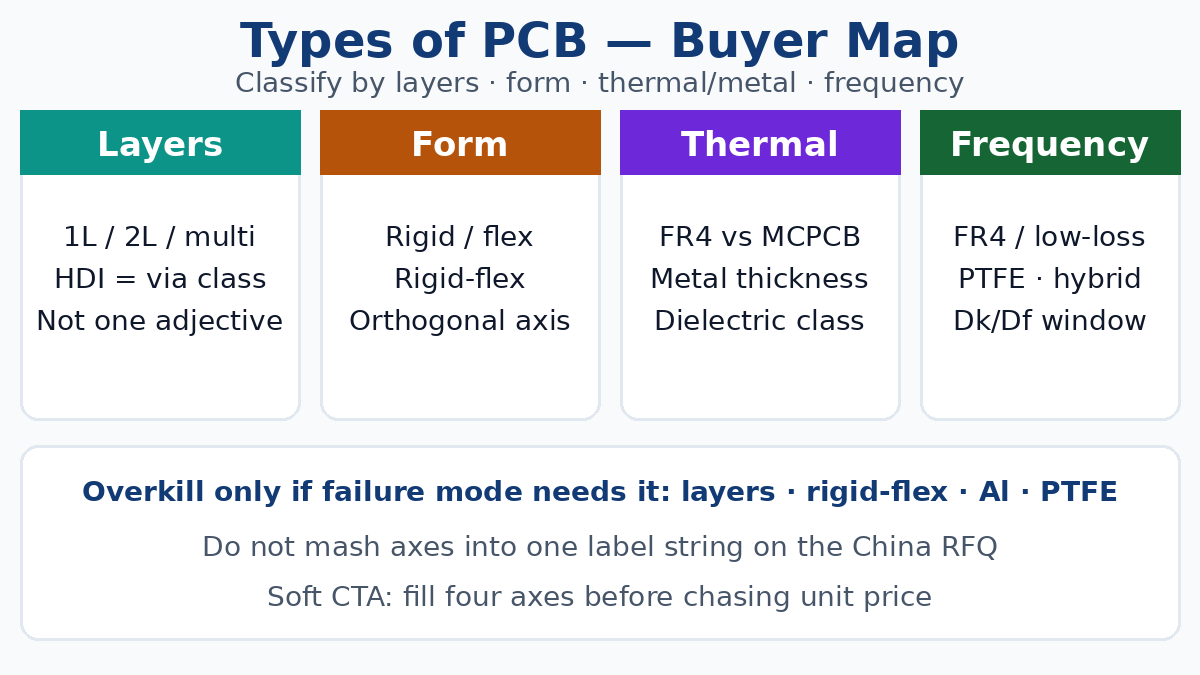
How fabs hear “type” (four axes, not one list)
Brochure taxonomies look flat: eight boxes in one chapter. On the floor, each box sits on a different traveler field.
| Axis | What you are naming | Typical RFQ words | Collision risk |
|---|---|---|---|
| Layer count | How many copper layers | 1L / 2L / 4L / 6L / 8L+ | Calling a 2L board “multi” or a 4L “double” |
| Form factor | Mechanical construction | Rigid, flex, rigid-flex | “Flex” when you mean thin rigid that forms once |
| Thermal / metal | Heat-spreading architecture | FR4, aluminum MCPCB, copper coin / IMS | “Aluminum PCB” without dielectric class or metal thickness |
| Frequency / dielectric | Signal / RF laminate family | FR4, mid/low-loss, PTFE / ceramic-filled RF | “High-frequency PCB” with no Dk/Df or freq window |
Buyer rule: pick a primary axis for the line item title, then attach the others as locked fields. Example pattern: “4-layer rigid FR4, Tg ≥ ___, 1.6 mm, controlled impedance on L1/L2” — not “multi PCB high speed.” The second string invites house stock and silent stack choices.
HDI is a density / via architecture variant inside multilayer work (microvias, sequential lamination), not a fifth brochure box that replaces layer count. When via type owns the quote, say so — do not bury it under “multi-layer PCB.”
By layer count: single, double, multi (and when multi is overkill)
Single-sided (1L). One copper face on a substrate. Lowest process complexity: etch, mask, finish, no plated through-holes for interlayer connection. Fits simple controllers, LED strips on commodity FR4 or metal-core singles, calculators-class logic, and high-volume cost-sensitive panels. Overkill to skip: almost never — under-specifying is the risk. Overkill to upgrade from: jumping to 4L because a competitor brochure listed multilayer as “better” when your netlist still fits one face with jumpers or a small redesign.
Double-sided (2L). Copper on both faces, usually with plated through-holes so nets can hop. The workhorse for industrial I/O, power supplies of modest complexity, meter boards, and many appliance controllers. Buyer trap: writing “double-sided” without hole-size, annular-ring, and copper-weight notes — plants still diverge on plating and etch. Overkill: forcing 4L for EMI when a clean 2L ground pour, short loops, and enclosure bonding would pass.
Multilayer (3L+; typically 4L and up). Stacked cores and prepregs with inner copper. Density, controlled impedance, power/ground planes, and routing escape for fine-pitch BGAs drive the step. Size and weight can drop versus several 2L boards cabled together — that brochure point is real — but so do lamination cycles, registration risk, and stackup documentation burden. Overkill: 8L for a spare-of-the-moment “future expansion” that never uses the inner planes; pay for the layers you route and the planes SI actually needs.
Live XFPCB notes on multilayer manufacturing, design, and cost cover stack economics in depth. This page only flags the RFQ naming habit: state finished layer count and attach a stack table when impedance or plane strategy matters. “Multi-layer” alone is a category, not a construction.
HDI pointer (brief). When microvias, via-in-pad, or sequential build-up own density, name HDI class / via architecture on the RFQ. Do not treat “HDI” as a synonym for “expensive multilayer.” The dedicated HDI overview is the place for process depth; here, only: layer count ≠ HDI class.
By form factor: rigid, flex, rigid-flex
Rigid. The default mechanical story — glass-epoxy (usually FR4 family) or other rigid laminates that hold shape. Motherboards, industrial controllers, and most consumer main boards live here. Maintenance and fixture friendliness are real advantages: parts stay mapped to a fixed outline. Rigid can be 1L, 2L, or multilayer; form and layer count are orthogonal on the traveler.
Flex. Polyimide (or similar film) constructions that bend for install or dynamic flex life. Benefits that brochure pages stress — wrapping around structure, saving connectors/cables, surviving some harsh environments — only hold when bend radius, coverlay, copper type, and static-vs-dynamic duty are written down. Buyer trap: calling a thin rigid board that tolerates a one-time form “flex.” Overkill: full dynamic flex film when a one-time install bend or a short rigid-flex hinge would do.
Rigid-flex. Rigid sections for components and connectors, flexible sections as integral interconnect. Phones, cameras, and many medical handhelds use the pattern because the “cable” is the board. Cost and panelization complexity jump; yield and bookbinder/bend rules matter. Overkill: rigid-flex to eliminate one board-to-board connector on a cost-sensitive industrial panel where a short FFC and two connectors already meet reliability.
Live XFPCB flex overview notes cover materials and use cases in depth. This taxonomy only asks buyers to name form on its own field — rigid / flex / rigid-flex — separate from layer count and laminate family.
By thermal / metal: aluminum and metal-core
Aluminum-backed and other metal-core PCBs (MCPCB / IMS) put a thin dielectric on a metal plate so heat spreads under LEDs, motor drivers, and power stages. Construction often looks like single or double copper on the circuit side, but the thermal architecture is the type — not “just FR4 with more copper.”
Brochure claims (durable, recyclable, relatively accessible metal cost) do not replace traveler fields: metal type and thickness, dielectric thermal conductivity class, copper weight, and whether the metal is electrical ground or isolated. Overkill: aluminum MCPCB for a low-power digital board whose copper pours and vias already meet thermal rise — you pay metal-core process and bending/fixture constraints without needing the spreader. Under-spec: FR4 with huge copper pours when the LED or FET hotspot still needs a plate.
Live XFPCB aluminum PCB uses notes cover application patterns. Here: put metal-core yes/no + metal thickness + dielectric class on the RFQ as their own axis, not as a footnote under “single-sided.”
By frequency: high-frequency / RF constructions
“High-frequency PCB” in catalog language usually means boards asked to carry signals in the hundreds of MHz to GHz+ range with controlled loss and stable Dk — not a unique drill/etch species. Materials shift toward mid/low-loss FR4 variants, PTFE, ceramic-filled, or hybrid stacks (RF laminate on critical layers, FR4 elsewhere).
Buyer traps:
- Writing “HF PCB” with no frequency window, Dk/Df target, or foil type (tooth matters at speed)
- Assuming commodity FR4 is free RF laminate because a short trace “worked in the lab”
- Ordering full PTFE everywhere when only the RF front-end needs it (hybrid stacks exist for a reason)
Overkill: specialty RF laminate on every layer of a mostly-digital industrial controller. Under-spec: FR4-only when SI or RF compliance already failed on the previous spin. Lock frequency intent and dielectric identity; do not invent XFPCB Dk catalogs or unit prices on the RFQ — attach datasheet slash sheets or approved alternates.
Default laminate: FR4 as family, not a SKU
Most rigid work still starts in the FR4 family — glass-epoxy stocked on mainstream China lines. “FR4” on a PO is a routing bucket, not a single Tg, halogen-free state, or Dk. When the question is only “is standard glass-epoxy enough, or do we step to high-Tg / halogen-free / CTI / RF / flex / metal-core,” use the dedicated when-to-use-FR4 buyer note. This types guide only reminds you: laminate family is an axis parallel to layer count and form — write all three.
Selection map: pick the axis, then stop escalating
Use this as a factory buyer decision tree — not a marketing scoreboard.
- Start with function failure modes. Density / planes → layer count (and HDI if microvias own it). Bend / cable elimination → form (flex or rigid-flex). Hotspot heat under power/LED → metal-core. GHz loss / stable Dk → RF dielectric. Mild digital rigid → FR4 family defaults.
- Name the minimum construction that survives those modes. Do not stack brochure “premium” boxes for status.
- Ask where each upgrade is overkill. Extra layers with unused planes; rigid-flex for one connector; aluminum under low-watt LEDs; PTFE on digital-only layers; HDI when standard through-vias and a modest layer add would escape the BGA.
- Separate axes on the RFQ line. Layer count · form · laminate/metal · frequency notes · finish / class / impedance as required.
- Point specialists at deep posts, keep this page as the map. Flex, HDI, aluminum uses, multilayer cost/design, and FR4 selection each deserve their own traveler language — cloning them here would only dilute the taxonomy.
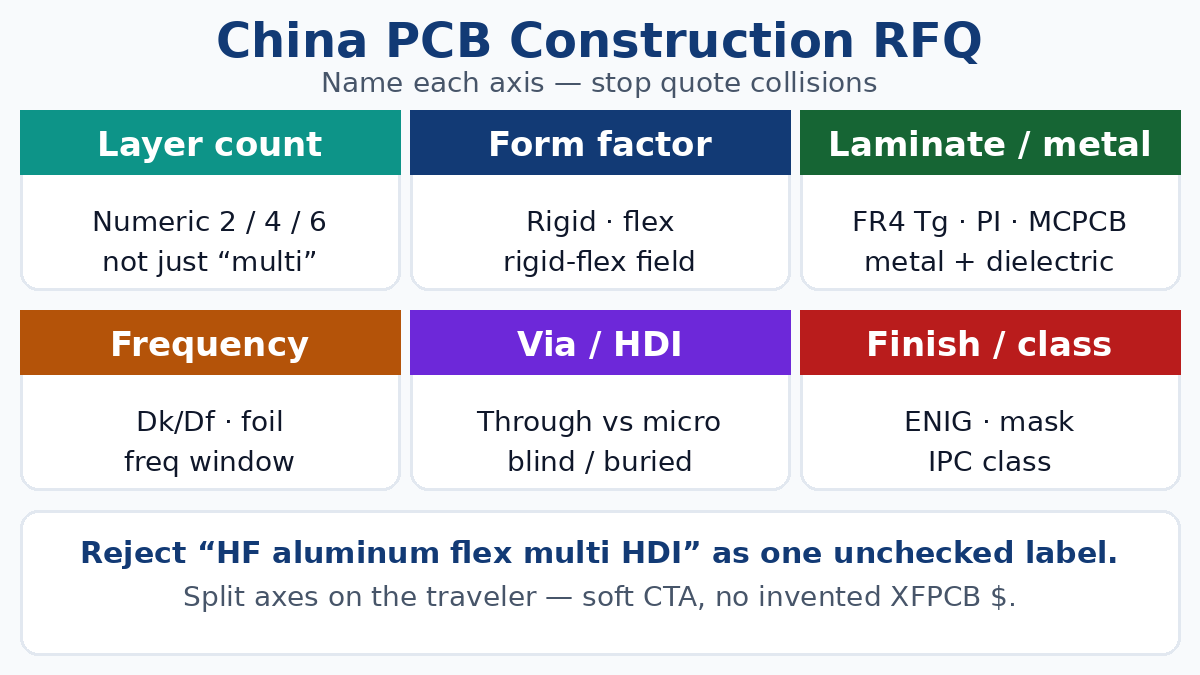
China fab RFQ: how to name construction without collisions
Silent or mashed fields create non-comparable quotes. Put these on the drawing note block and the RFQ — as requirements, not as invented XFPCB catalog prices.
1. Finished layer count. Numeric (2, 4, 6…). “Multi” is not a number.
2. Form factor. Rigid / flex / rigid-flex as an explicit field. If flex: static install vs dynamic life, bend radius notes. If rigid-flex: count of rigid sections and flex regions at a high level.
3. Laminate or metal-core family. FR4 (with Tg / halogen-free / CTI as needed), polyimide flex film, aluminum or other MCPCB with metal thickness and dielectric class, or named RF laminate / hybrid intent. “Standard material” is not a lock.
4. Copper weight and foil intent per critical layer. Ounce weight plus foil type when etch or HF loss matters.
5. Finished thickness and tolerance. Mechanical envelope and connector stack depend on it.
6. Via / HDI architecture when non-standard. Through-via only vs blind/buried / microvia — say it; do not hide under “HDI-ish multi.”
7. Controlled impedance or RF notes. Targets, reference layers, coupon expectations, frequency window if RF.
8. Surface finish, solder mask, IPC class. These are not “types of PCB,” but leaving them blank still breaks quote parity.
9. What not to mash into one adjective string. Avoid “high-frequency aluminum flex multi HDI” as a single unchecked label. Split axes; let CAM price the construction you meant.
A soft CTA for sourcing teams: send the fab a one-page construction summary with the four axes filled before you chase unit price. Plants return cleaner questions — and you stop comparing a 2L aluminum single to a 4L rigid FR4 because both were filed under “LED board.”
What brochure “PCB benefits” still mean on a traveler
Generic lists (easier troubleshooting than point-to-point wiring, repeatable assembly, lower crosstalk when laid out well, soldered joints that stay put under vibration) remain true for printed boards as a class. They do not tell you which type to buy. Reliability and noise performance track your stack, spacing, return paths, and process controls — not the brochure category name. Use benefits language to justify PCB assembly over flying wire; use the axes above to justify which PCB.
Soft close for factory buyers
Types of PCB are a taxonomy for RFQs, not a trophy shelf. Classify by layers, form, thermal/metal, and frequency; name each axis so China quotes stay comparable; escalate only when a failure mode forces it; and keep deep process notes on the dedicated flex, HDI, aluminum, multilayer, and FR4 pages. When the construction summary is honest, unit price talks get shorter — and you stop paying for overkill types that never addressed the real constraint.