
FR4 is the default laminate family for most rigid boards that leave a China fab — glass-reinforced epoxy is stocked, drilled, etched, and laminated on every mainstream line. Buyers who write only “FR4” on an RFQ still get incompatible quotes: Plant A prices mid-Tg commodity stock, Plant B prices a high-Tg lead-free slash sheet, and Plant C assumes halogen-free without saying so. This factory buyer guide treats FR4 as a family, not a single SKU. It covers when standard FR4 is enough, what to ask for high-Tg / halogen-free / CTI grades, which design factors belong on the traveler, when RF / flex / metal-core is the next step, and the China RFQ fields (Tg, Td, CAF, stackup dielectric, copper foil type, halogen-free yes/no) that stop silent swaps — without inventing XFPCB stock lists or market prices.
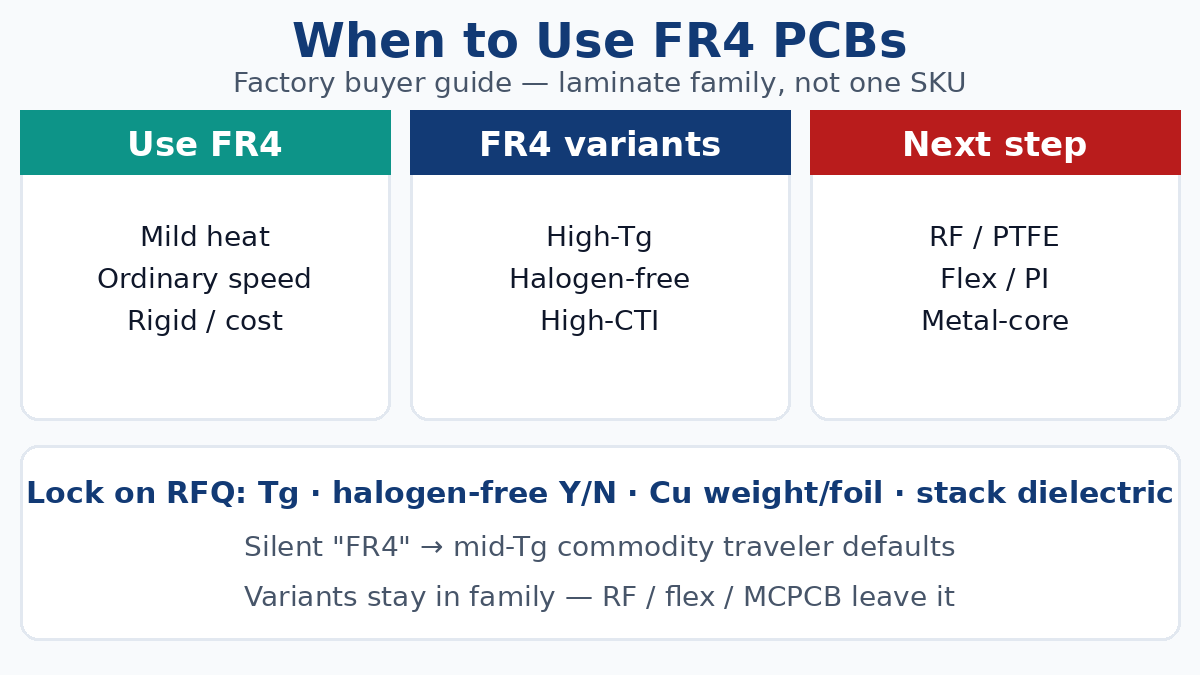
What FR4 means on a fab traveler
FR4 (often styled FR-4) is a flame-retardant glass-epoxy class. The letters point at a flammability rating family used across the industry; they do not name one resin recipe, one glass style, or one Tg. A finished board called “FR4” is typically woven glass cloth impregnated with epoxy resin, clad with copper, then processed through the usual rigid fab sequence.
What buyers actually buy on the PO is closer to:
| Traveler term | Factory meaning | Why a vague “FR4” fails |
|---|---|---|
| Laminate / CCL | Copper-clad core stock (and matched prepregs) | Plants stock many “FR4” grades under one label |
| Tg (glass transition) | Temperature where resin softens sharply | Mid-Tg vs high-Tg changes reflow and warp risk |
| Td (decomposition) | Temperature where resin chemically breaks down | Matters for lead-free and high thermal stress |
| Dk / Df | Dielectric constant / dissipation factor | Impedance and loss at speed; not one FR4 number |
| CTI | Comparative tracking index | High-voltage / pollution tracking resistance |
| Halogen-free | Flame system without common halogenated retardants | Environment / OEM restricted-substance rules |
Buyer rule: treat “FR4” as a routing bucket for the quote desk, then lock identity with Tg (and slash sheet or named grade when you care), copper weight, finished thickness, and any halogen-free or CTI note. The brochure claim “industry standard FR4” is not a material lock.
Mechanical strength, electrical insulation, modest moisture uptake, and flame resistance are why the family stays the default for consumer, industrial, and many networking boards. Cost efficiency follows from volume stock and known process windows — not from a universal unit price you can paste into a spreadsheet.
When FR4 is the right default
Use FR4 when the design lives inside ordinary temperature, frequency, and mechanical envelopes and you want predictable China fab capacity.
Good default when:
- Operating and storage temperatures sit well below the Tg you specify, with margin for lead-free reflow if that is on the assembly path
- Speeds are ordinary digital / mixed-signal — not RF or microwave where Df and Dk stability dominate the stack choice
- The board is rigid (or only needs one-time form), not dynamic flex
- Heat is managed by copper, vias, and enclosure airflow — not by a metal-core plate under every LED or power device
- Cost, lead time, and multi-source laminate availability matter more than specialty dielectric performance
Typical buckets that stay on FR4 when the stack is honest: consumer electronics, industrial controls, medical non-implant boards in mild environments, networking and IoT hardware, and many automotive cabin boards — moderate heat, no ultra-high-frequency SI mandate, scalable panel pricing.
If engineering has not named a failure mode that commodity FR4 cannot survive, start here. Escalate the family only when a real constraint appears — thermal, RF, flex, or tracking — not because a competitor brochure listed a premium laminate.
Standard vs high-Tg vs halogen-free vs CTI — buyer asks
Not every FR4 line item is interchangeable. Variants stay inside the glass-epoxy family but change what CAM may substitute.
Standard / mid-Tg FR4. General-purpose stock for many consumer and commercial builds. Ask for a numeric Tg (not “standard”) and finished thickness. If assembly is lead-free multilayer with multiple reflows, confirm the mid-Tg grade still has margin — many buyers step to high-Tg without leaving FR4.
High-Tg FR4. Higher glass-transition grades (commonly discussed in the 150 °C / 170 °C+ conversation — lock the number you need, do not invent a plant default). Better suited to lead-free soldering stress, multilayer lamination heat, and warmer operating envelopes. Buyer ask: “Tg ≥ ___ °C, lead-free process compatible, state Td if available on the datasheet.” Vague “high Tg” invites the cheapest label that marketing still calls high.
Halogen-free FR4. Meets OEM or regional restricted-substance preferences by changing the flame-retardant system. Buyer ask: “Halogen-free: yes/no” as an explicit field — silence is not a yes. Confirm Tg and process notes still match the assembly profile; do not assume halogen-free automatically equals high-Tg.
High-CTI FR4. Improved resistance to electrical tracking for higher-voltage or polluted environments. Buyer ask: “CTI class / minimum per drawing” when creepage and pollution degree drive the safety file. CTI is not a substitute for spacing rules on the layout.
Stay inside FR4 when a variant fixes the constraint. Leave the family when glass-epoxy physics cannot deliver — RF loss, dynamic bend, or metal-backed heat spreading.
Factory callout: Plant A’s “FR4 1.6 mm” and Plant B’s named high-Tg halogen-free sheet are not the same bid even when Gerbers match. Force Tg, halogen-free yes/no, and laminate identity (or approved alternates) onto the same line as thickness and copper.
Design factors that change FR4 behavior
Material grade is half the story. Stack and copper choices move electrical and mechanical results even when the PO still says FR4.
Finished thickness and core/prepreg split. Thinner boards save weight and sometimes cost; they flex more and can complicate depanel and connector strain. Thicker boards add stiffness and thermal mass. For multilayer work, “1.6 mm FR4” without a core/PP table leaves CAM free to hit thickness with a stack that misses impedance or registration intent.
Layer count and stackup dielectric. Impedance, return paths, and EMI behavior track dielectric thickness and Dk far more than the word FR4. When controlled impedance is on the drawing, attach a stack table (core and prepreg identities or slash sheets, thicknesses, copper weights) and note the target impedance with coupon expectations.
Copper weight and foil type. Heavier copper carries current and heat but changes etch factor and min trace/space. Foil type (standard ED, RTF, VLP, and so on) affects peel, etch geometry, and high-frequency loss. Writing only “1 oz” leaves grade and tooth to stock CCL.
Dielectric properties at frequency. Commodity FR4 Dk/Df is “good enough” for many nets and poor for others. If SI owns the schedule, lock Dk/Df at the frequency you care about — or name a mid/low-loss FR4 family — instead of hoping brochure FR4 is controlled-loss FR4.
These factors interact. A well-specified mid-Tg stack with honest copper and impedance notes often outperforms a vaguely “premium” FR4 line with silent defaults.
When FR4 is the wrong family (next step)
FR4 stops being the right default when the failure mode sits outside glass-epoxy limits.
High sustained heat / repeated lead-free stress beyond your Tg margin. Softening, pad crater risk, and warp disputes show up first. High-Tg FR4 is the in-family step; beyond that, polyimide or other high-temp systems enter the conversation.
RF / microwave / very high-speed SI. Loss and Dk stability at GHz push toward PTFE, ceramic-filled, or other RF laminates — sometimes as hybrids with FR4 on non-critical layers. Commodity FR4 can carry some RF at short length and modest frequency; it is not a free substitute for a controlled-Dk RF sheet.
Dynamic flex or install-bend film constructions. Polyimide film flex (and rigid-flex) is the usual path. Thin FR4 can do limited one-time form; it is not dynamic flex film.
Concentrated LED / power heat that needs a metal spreader. Metal-core (often aluminum) constructions put a thin dielectric on a metal plate. That is a different thermal architecture than FR4 FR4-thickness copper pours.
Extreme chemical, vibration, or ceramic-power environments. Ceramic substrates and other specialty systems appear when FR4 and MCPCB both fail the thermal or hermetic story.
Do not punish a mild design with specialty laminate cost — and do not save pennies on FR4 when the first reflow lot already shows Tg or SI postmortems.
Alternatives list (routing, not a price sheet)
When you leave FR4, name the family and the constraint — not a folklore brand list.
| Next family | Typical trigger | What buyers still lock |
|---|---|---|
| High-Tg / CAF-resistant FR4 (still FR4 family) | Lead-free multilayer, warmer duty, humidity bias | Numeric Tg, CAF note, slash/grade or alternates |
| Mid/low-loss FR4 or specialty low-loss | Controlled impedance / higher digital rates | Dk/Df @ freq, glass notes, coupon |
| PTFE / RF laminates | RF, microwave, low-loss GHz paths | Named RF laminate, Dk tolerance, foil type |
| Polyimide (flex / rigid-flex / high-temp rigid) | Bend, space, high-temp film or rigid PI needs | Thickness, adhesiveless yes/no, Cu type |
| Metal-core (aluminum / copper) | LED and power heat spreading | Metal type/thickness, dielectric thermal class |
| Ceramic (Al₂O₃, AlN, …) | Extreme thermal / specialized RF-power | Ceramic type, metallization process |
Live XFPCB notes on aluminum PCB uses and multilayer manufacturing/design/cost cover those lanes in depth. This guide stays on when FR4 earns the PO and how to write the material line so China quotes match.
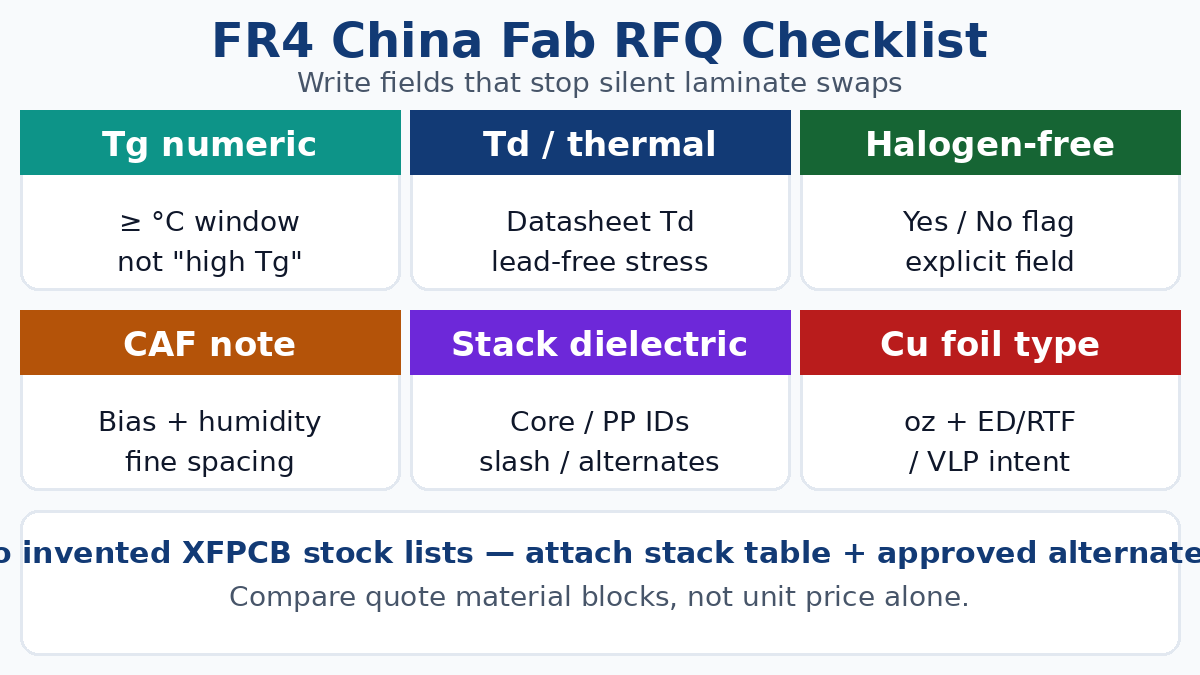
China fab RFQ: fields that stop silent FR4 swaps
Silent material fields become house stock. Put these on the drawing note block and the RFQ line — as requirements, not as invented XFPCB catalog SKUs.
1. Tg (numeric). Example pattern: “Tg ≥ 150 °C” or the exact window engineering owns. “High Tg” alone is marketing.
2. Td when thermal stress is real. If datasheets publish Td, asking for it (or for a datasheet attachment) clarifies lead-free and high-heat risk beyond Tg alone.
3. Halogen-free yes/no. Explicit boolean. Do not bury it in a general RoHS sentence unless your compliance team agrees that sentence forces the flame system you want.
4. CAF note when bias + humidity + fine spacing apply. “CAF-resistant laminate required” plus context beats hoping commodity FR4 survives a biased humidity test.
5. Stackup dielectric identity. Core/prepreg thicknesses and laminate identity or IPC-4101 slash sheet / approved alternate list. “4-layer FR4 1.6 mm” is a thickness request, not a dielectric lock.
6. Copper foil type and weight per layer. Ounce weight plus foil intent (ED / RTF / VLP as needed) on critical faces. Weight alone leaves tooth and grade to stock.
7. CTI / tracking class when the safety file needs it. Especially on high-voltage primary circuits.
8. Finished thickness and tolerance. Match mechanical envelope and connector stack.
9. Impedance / coupon notes when SI matters. Targets, reference layers, and whether the fab owns the stack proposal under your Dk window.
10. Approved alternates. List what may substitute. “Equivalent FR4 OK” without a window is permission to chase price.
How buyers write material on the traveler (without inventing stock lists)
You do not need a secret XFPCB warehouse list. You need language CAM can put on a traveler without guessing.
Weak line: “Material: FR4.”
Stronger line (pattern, fill your numbers): “Laminate: FR4 family, Tg ≥ ___ °C, halogen-free: Yes/No, finished thickness ___ mm ± ___, copper ___ oz (foil type ___ on outer / inner as noted). Stack per attached table (core/PP identities or IPC-4101 slash ___ / approved alternates: ___). CAF note: ___ . CTI: ___ if applicable. Impedance: ___.”
Attach the stack table as a file, not a chat screenshot. If engineering only knows “mid-Tg FR4 like the last spin,” carry forward the prior datasheet identity or slash sheet and mark approved alternates — that is how multi-plant supply stays honest without publishing a fake inventory.
When two plants bid, compare the material block on the quote, not only unit price. If one quote lists a named high-Tg sheet and another says “FR4,” they are not bidding the same reliability envelope. Ask the cheaper bidder to mirror the same Tg, halogen-free flag, and slash/grade window before you call it a win.
Soft next step
If your next China RFQ still says only “FR4,” add numeric Tg, halogen-free yes/no, copper weight and foil intent, and a one-page stack table before you chase another decimal on unit price. XFPCB can review whether standard FR4, high-Tg FR4, or a step to RF / flex / metal-core fits the failure mode — without inventing market dates, percentage markups, or a stock list that is not on the traveler. Clear laminate language beats a soft quote that silently assumes mid-Tg commodity when your assembly path needs more.