
Hybrid RF + FR-4 boards fail quotes and first articles for the same reasons: vague laminate names, bondply treated like FR-4 prepreg, impedance modeled on incoming core thickness, one drill/desmear recipe for a mixed hole wall, and silent material swaps. This note is the hybrid lamination process gate for overseas buyers and RF engineers RFQing a China fab — when hybrid earns money, how to name grades and bondply, pressed thickness vs impedance, CTE/registration, hole-wall prep by laminate family, failure map, and RFQ fields. It is not a material-family loss-budget tutorial, not an impedance-table mechanics guide, and not an antenna or radar-band materials brief.
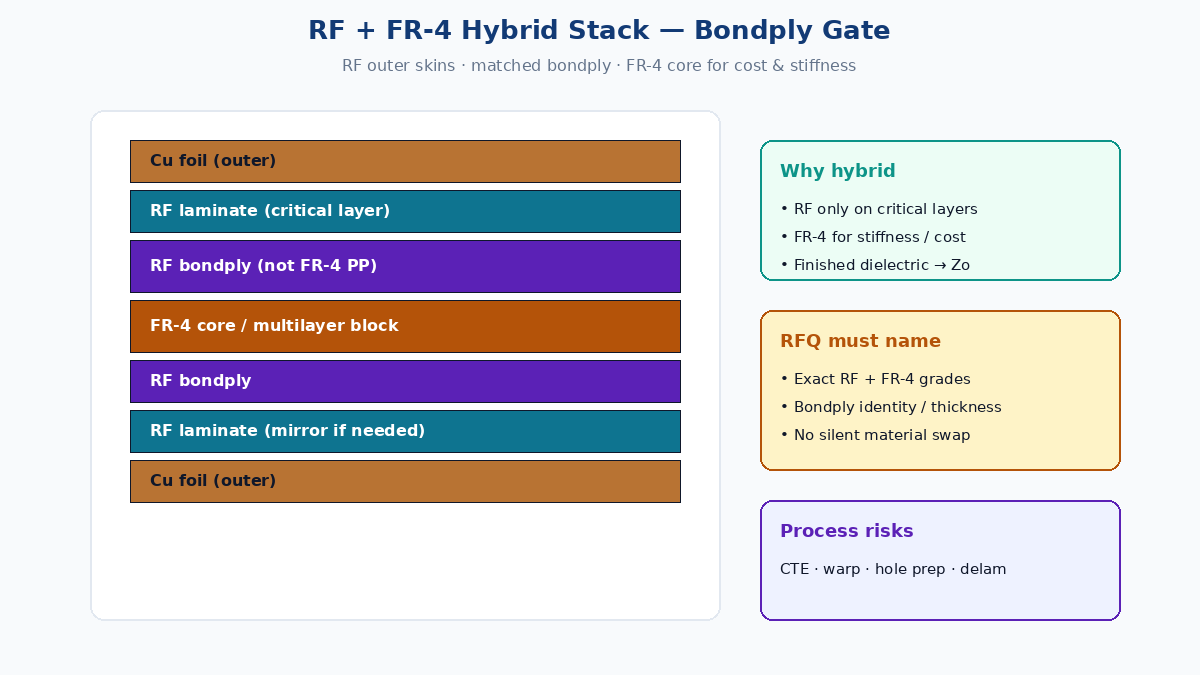
When hybrid earns money
All-RF multilayers burn budget on dielectric you never use for RF. All-FR-4 stacks fail loss, Dk stability, or dielectric thickness control on the few nets that actually carry microwave energy. Hybrid earns money when:
- Only one or two outer (or carefully placed inner) layers need low-loss RF dielectric; digital, power, and mechanical stiffness stay on FR-4.
- Enclosure and connector stiffness matter — thick FR-4 cores still dominate board modulus cheaper than matching all RF cores.
- Impedance-critical RF traces sit against a controlled RF dielectric while ground/power planes and non-RF routing stay on commodity FR-4.
- Prototype and volume quotes need to stay competitive without pretending every layer is RF-critical.
Hybrid does not earn money when the entire stack is loss-critical, when mixed CTE will blow registration at your hole density, or when the fab cannot qualify bondply + hole prep for the exact grades on the drawing. Cost savings vanish the moment you pay for scrap from delam, barrel crack, or impedance drift.
💡 Buyer check: List which layers are RF-critical and why. If the answer is “the whole board might be RF someday,” you are not ready for hybrid — quote all-RF or all-FR-4 first.
Name exact grades — family language, not brochure shortcuts
Writing “RF laminate” or a brand family alone on an RFQ is how China fabs substitute closest stock and you discover it on microsection. Lock exact core and bondply grade + thickness + copper type for every RF layer. Speak in process families so CAM and plating know what they are buying:
| Family (generic) | Process character | Hole-wall implication |
|---|---|---|
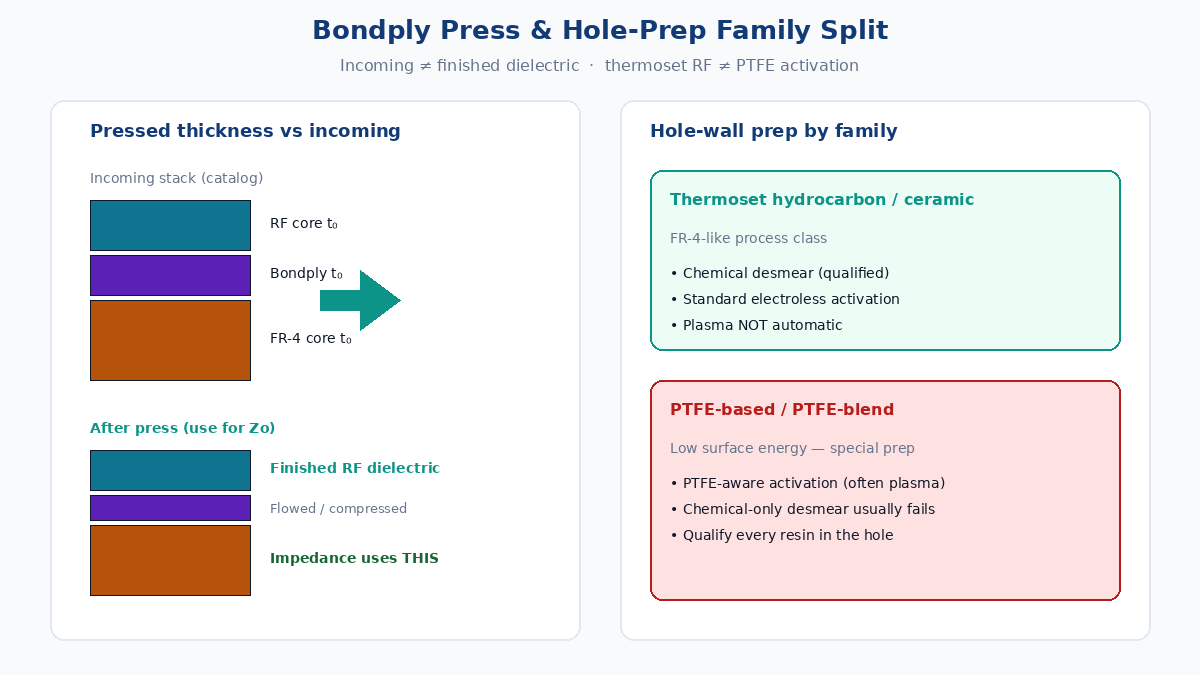
| Thermoset hydrocarbon / ceramic-filled (FR-4-like process class) | Standard multilayer press cadence; flows and drills closer to FR-4 than PTFE | Often chemical desmear + standard plating activation — still qualify on your grade |
| PTFE-based / PTFE-blend RF | Soft, smear-prone, low surface energy | Needs PTFE-aware activation (often plasma or specialty etch) — chemical desmear alone is usually wrong |
| FR-4 cores / FR-4 prepreg | Commodity multilayer | Standard FR-4 desmear; do not assume it cleans RF resin in the same hole |
Datasheet-typical Design Dk/Df bands differ by grade and frequency; treat published numbers as datasheet-typical, confirm-with-fab for the lot and copper foil you will actually press. Do not paste a competitor brochure Dk into the impedance model and call it released.
Avoid silent swaps: same “family,” different filler or glass style, different Z-CTE and pressed thickness. Put no-substitution language on the PO for RF cores and bondply.
Bondply vs FR-4 prepreg
Bondply is not “RF-colored prepreg.” Chemistry, resin content, flow window, and pressed thickness behavior differ from FR-4 PP:
- FR-4 prepreg is formulated to wet FR-4 cores and fill copper relief under familiar press profiles.
- RF bondply (or RF-compatible bonding film/prepreg matched to the RF core) is chosen for dielectric compatibility, adhesion to the RF surface, and controlled flow so RF dielectric thickness after press stays inside the impedance budget.
- Mixing an FR-4 PP against an RF core “because it was on the shelf” is a classic interfacial delam and thickness-scatter source.
Pressed thickness ≠ incoming thickness. Resin flows into copper relief; cores and bondply compress. Impedance and electrical length must use finished dielectric after lamination — the number CAM and the fab agree on from coupon or stack-up drawing — not the catalog core thickness you ordered. If the RFQ only lists incoming cores and omits finished dielectric targets, two fabs can both “meet the BOM” and ship different Zo.
On the RFQ, write bondply as a named line item with thickness, not as a vague “bonding material.” If the RF core vendor publishes a matched bondply, start there and still confirm the fab’s press book for that pair. If the fab proposes an alternate bond film, demand Dk/Df at your frequency (datasheet-typical, confirm-with-fab), flow/resin content, and a microsection from a similar hybrid before you accept the swap.
Copper foil on RF cores is part of the electrical stack. Low-profile or reverse-treat foils change insertion loss and sometimes peel; do not leave foil type blank and assume “1 oz electrodeposited” when the RF model used a specific foil. Call foil out next to the grade.
Press book and bake discipline
Hybrid panels often need a different press profile than the plant’s default FR-4 book: ramp, pressure, and cool-down affect bondply flow and residual stress. Ask whether the fab already has a qualified press recipe for your exact RF grade + bondply + FR-4 core combination. A first-article without a prior recipe is normal; a production PO that assumes FR-4 press parameters on PTFE-family skins is not.
Moisture and volatiles matter. RF and FR-4 cores may need separate bake before lay-up. Skipping bake to save a day shows up later as blistering or interfacial voids that electrical test will not catch on a dry panel.
Stack symmetry, copper balance, warpage, scale
Hybrid stacks amplify what FR-4 multilayers already punish:
- Symmetry: Mirror RF skins where possible (RF / FR-4 / RF) rather than a one-sided RF cap over a thick FR-4 brick unless the fab has a proven warp recipe for that asymmetric build.
- Copper balance: Heavy pours on one RF outer and sparse copper on the mate drive bow. Balance planes and pour density across the press package.
- Warpage: Mixed modulus and CTE show up after press, after bake, and after reflow. Spec flatness acceptance if the board must seat in a tight RF enclosure.
- Registration: FR-4 and RF laminates scale differently in X and Y through bake and press. Expect the fab to use separate scale compensation for mixed-material layers — not one global scale stolen from an all-FR-4 job. Call out critical pad-to-via and RF feature registration on the drawing.
If your design needs buried RF strip against FR-4 on one side only, say so early; CAM may propose copper balancing, dummy pours, or a press sequence change rather than hoping the panel stays flat.
Drilling a mixed stack
One drill program tuned for FR-4 often abuses RF layers:
- Smear on thermoset RF resins can exceed FR-4 expectations at the same chipload.
- Fibrillation / fuzz on PTFE-family materials leaves fibers that chemical desmear will not clear the way FR-4 smear clears.
- Tool wear jumps when the bit crosses hard ceramic-filled RF then soft PTFE then FR-4 in one stroke — hit count and feed need a hybrid recipe.
- Aspect ratio and stack height still matter; hybrid does not relax drill limits.
Ask CAM whether through-holes that expose both RF and FR-4 walls get one bit life table or a split process. Blind/buried vias that stop in only one family still need that family’s hole-prep note.
Hole-wall prep: the plasma myth
Not every RF hybrid needs plasma. Plasma (or other PTFE activation) is a tool for low-surface-energy PTFE-family walls. Thermoset hydrocarbon / ceramic-filled RF grades in the FR-4-like process class often run on chemical desmear + standard electroless activation once the grade is qualified — blasting every hybrid with plasma “because it is RF” wastes money and can over-etch the wrong resin.
Rules that keep plating honest:
- Identify every resin family exposed in the drilled hole.
- Qualify desmear / etchback / activation for all of them — FR-4 recipe alone is not a hybrid recipe.
- Use PTFE-aware activation when PTFE is in the wall; do not skip it because the outer foil looked like FR-4.
- Lock the hole-prep note on the traveler by laminate family, not by marketing phrase “high frequency PCB.”
Microsection should show clean resin, adequate etchback where specified, and continuous electroless/electrolytic copper on both FR-4 and RF portions of the barrel.
Failure map (what scrap usually is)
| Failure | Typical mechanism | What to lock / inspect |
|---|---|---|
| Interfacial delam | Wrong bondply, contaminated RF surface, press profile mismatch | Bondply identity, bake, peel/microsection at RF–bondply interface |
| Via barrel crack | Z-CTE mismatch RF vs FR-4 vs copper under thermal cycle | Via design, copper thickness, IST/thermal stress sample plan |
| Hole-wall adhesion fail | Wrong activation for PTFE or under-desmear on thermoset RF | Family-specific hole-prep note; tape/microsection adhesion |
| Warpage / misregistration | Asymmetric stack, copper imbalance, single scale for mixed CTE | Symmetry, copper balance, dual-scale CAM, flatness criteria |
| Impedance drift | Pressed-thickness scatter, foil/Dk lot vs model | Finished dielectric targets, impedance table + coupon, no silent core swap |
Electrical opens after reflow are often barrel crack or delam that passed bare-board netlist. Plan thermal stress or IST language when the hybrid sees lead-free profiles and high layer count.
RFQ checklist (China fab hybrid gate)
Put these on the RFQ or stack-up drawing before price comparison:
- Exact RF and FR-4 grades — manufacturer + grade + thickness + copper foil type for every core; no “RF laminate TBD.”
- Bondply / prepreg identity — RF bondply vs FR-4 PP called out by layer; resin system and thickness.
- Layer order — which layers are RF-critical; mirror intent if any.
- Finished dielectric targets — post-press thickness (and tolerance) for impedance-critical dielectrics; do not stop at incoming catalog thickness.
- Copper weights and pour balance notes for warp-sensitive panels.
- Impedance table + coupon — nets, Zo, single-ended/diff, reference planes, coupon location; modeling uses finished dielectric (table mechanics live in your impedance process doc — keep numbers here).
- Hole-prep note by laminate family — thermoset RF vs PTFE vs FR-4 exposed in hole; plasma only where the family needs it.
- Microsection criteria — interfaces to photograph, etchback/adhesion expectations, barrel copper.
- No silent material swap — written substitution ban for RF cores and bondply; require written approval for any alternate.
- Registration / scale — call out mixed-material scale compensation and critical RF feature tolerances.
For buyers comparing quotes: two China fabs can both claim “hybrid RF capability” while one has a qualified thermoset-hydrocarbon + FR-4 book and the other only runs PTFE skins with plasma. Capability is grade + bondply + hole-prep + press recipe, not a website keyword. Ask for a traveler outline or a prior microsection of a similar mixed stack when the build is new to that plant.
Closing
Hybrid RF/FR-4 is a process and paperwork problem more than a Dk brochure problem. Name the grades, name the bondply, design to finished dielectric, balance the press package, drill and activate for every resin in the hole, and refuse silent swaps. Do that on the RFQ and a China fab can price and build a comparable stack; skip it and you are shopping anecdotes, not laminations.