
Aerospace electronics still fail on copper, laminate, and solder joints — not on brochure adjectives. Older EMS pages talk mil-spec versus commercial tolerance, aspect ratio, and a soft “call us” close. Factory buyers need a sharper map: how flight, orbit, and ground-support environments change what you lock on the traveler; where denser HDI and flex earn their keep when mass and volume matter; how IPC Class 3 workmanship differs from an AS9100 organization ask; and which China fab RFQ fields stop “aerospace-ish” quotes from drifting into Class 2 house defaults.
This note is a factory buyer guide to evolving aerospace PCB requirements. It is not a layout textbook, not a certificate sales sheet, and not a clone of a design-rules or HDI-certificate deep-dive. Program qualification and flight acceptance stay with the design authority. Manufacturing class, materials, coupons, genealogy, and vibration or thermal notes stay on the drawing and the purchase order.
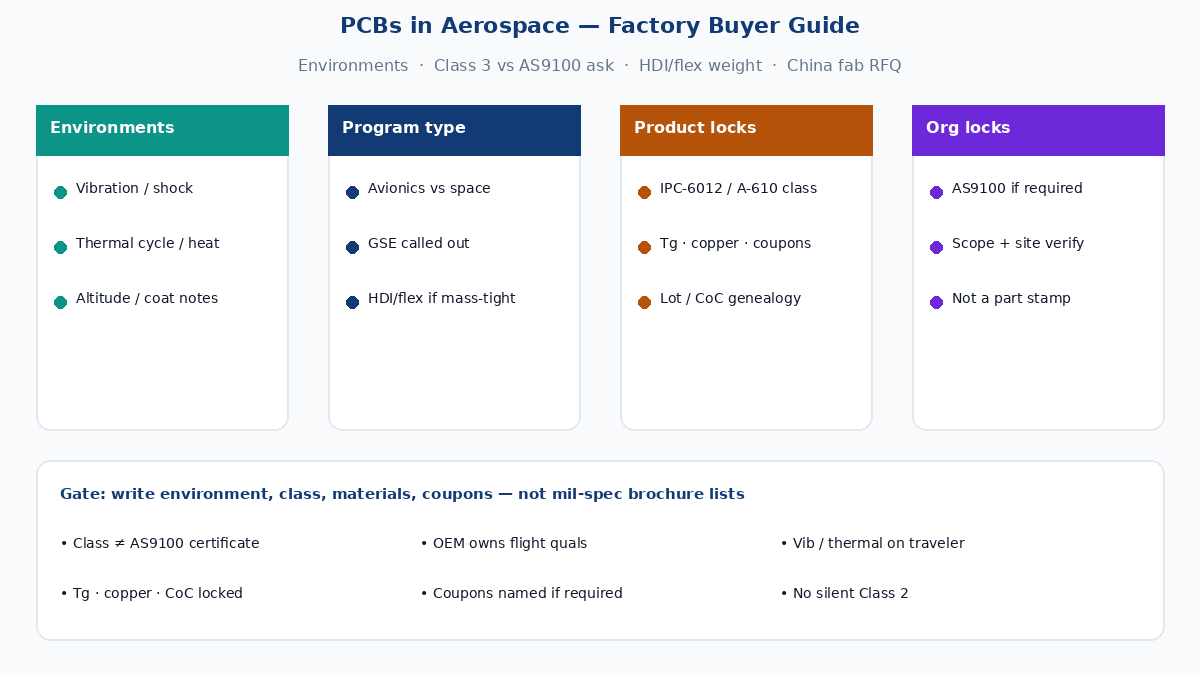
Environments that change the traveler — vibration, thermal cycle, altitude
Treat the environment list as risk buckets that force written locks, not as a marketing checklist of “harsh.”
Vibration and mechanical shock. Avionics bays, rotorcraft, launch vehicles, and munitions trays shake boards long after the assembly looks fine under a microscope. Buyers should ask whether the program expects conformal coat, underfill on selected packages, stake or adhesive for tall parts, and any vibration or shock test notes that the CMS must respect after build. Bare-board side: annular ring, hole-wall copper, and via reliability matter more when the product will live in a vibrating chassis. “High reliability” without a vibration note still prices like a quiet office board.
Thermal cycle and sustained heat. Cabin avionics, engine-adjacent sensors, satellite payloads, and power converters see temperature swings and hot spots that commercial FR-4 habits may not survive. Lock laminate family and Tg (or named material), copper weights, and any thermal-via or heavy-copper construction the design already chose. Ask for coupon or microsection evidence when the program flows it. Do not assume “aerospace FR-4” is a special laminate — write the material.
Altitude, pressure, and outgassing-adjacent asks. High-altitude and space-adjacent assemblies care about creepage, partial discharge risk at altitude, and sometimes material outgassing or vacuum preferences when the design authority flows them. Most China commodity RFQs never see those notes. If your program needs them, put them on the fab notes early so CAM does not quote a sealed-office default.
Humidity, condensation, and coat. Condensing environments and long storage push coat type, keep-outs, and cleanliness. Name no-clean versus aqueous clean, coat chemistry, and inspection of coverage. Soft “protect as needed” language is how two bidders price different armor.
Across environments, the fab and CMS execute manufacturing locks. They do not invent DO-160 or customer environmental qualification for a bare board unless that work is separately scoped. Write the environment notes that affect materials, stackup, coat, and inspection — leave system qualification with the OEM.
Avionics, space, and weight-driven density — what buyers should separate
Aerospace is not one stack. Quoting every job as “flight electronics” hides different acceptance depth.
Commercial and military avionics (airborne electronics). Cabin, cockpit, and bay electronics often mix multilayer digital, power, and RF or sensor sections. Product lives are long; BOM freezes matter. Buyers commonly lock IPC-6012 / IPC-A-610 class and revision, finish, impedance coupons when clocks and links need them, and lot traceability. Some programs flow AS9100 as a supplier filter. That filter is not a substitute for class and material locks.
Space and launch-adjacent. Orbit and launch environments raise thermal-vacuum, radiation-adjacent, and outgassing concerns that usually come with deeper documentation: named materials, possible IPC-6012FS when the design authority requires it, thicker coupon or microsection evidence, and stricter change control. Class 3 alone is usually not full space qualification. If the RFQ is only for a ground-support or GSE board, say so — so the plant does not over-claim or under-control.
Defence-adjacent and ground support. Ruggedized ground radios, test sets, and support equipment may share Class 3 and coat habits with airborne gear without carrying the same flight paper trail. Name the use context so process assumptions stay honest.
Where HDI and flex earn weight and volume. Fine-pitch BGAs, short critical nets, and thin envelopes push sequential build-up, microvias, and sometimes rigid-flex or flex tails instead of cable harness mass. That is a real aerospace interest — not a brochure word. Buyer locks that belong here: via architecture (staggered versus stacked), capture pads, dielectric thickness windows, coverlay or stiffener notes on flex, and whether impedance still needs coupons. Do not treat “HDI capable” as a reliability stamp. Architecture and acceptance still sit on the drawing.
This page stays thin on via-stack DFM and certificate theater on purpose. Those belong in dedicated design-rules and QMS-HDI discussions. Here the point is the buyer split: environment and program type first, then density construction, then product locks versus organization locks.
IPC Class 3 vs AS9100 — buyer questions without certificate theater
Two locks get mashed into one marketing sentence. Keep them apart.
| Lock | Answers | Does not auto-provide |
|---|---|---|
| IPC-A-610 Class (assembly) | Workmanship acceptance for solder joints and assembly criteria you cite | Org certification or flight approval |
| IPC-6012 Class (bare board) | Fabrication acceptance for the PCB you cite | Assembly class or QMS scope |
| IPC-6012FS (when flowed) | Space / military avionics addendum criteria when the program cites it | Automatic invoke just because the word “aerospace” appears |
| AS9100 (org QMS) | How the plant runs an aviation / space / defence-oriented QMS under a defined scope and site | Product class, stackup, microvia reliability, or “AS9100 certified PCB” as a part stamp |
| ISO 9001 (org QMS) | General quality-system discipline | Automatic aerospace QMS equivalence |
IPC Class 3 is a product acceptance callout on drawings and POs. It raises fabrication or assembly criteria for high-reliability electronics when you cite the class and revision. It does not mean the supplier’s QMS is aerospace-scoped, and it does not invent flight qualification.
AS9100 is an organization certificate under a scope and manufacturing site. It disciplines document control, risk, configuration, and supplier process for aviation, space, and defence-related manufacturing. It does not stamp your part number as flight-qualified, and it does not invent Class 3 if the traveler never said Class 3.
Buyers should ask:
- Is AS9100 program-required for this build? If yes, request the current certificate and verify scope wording and site address match the plant quoting the job.
- What IPC-6012 and IPC-A-610 class and revision will appear on the traveler? Is 6012FS flowed down or not?
- Which laminate / Tg / copper and finish locks are frozen — with no silent swap?
- What coupon, microsection, and electrical test depth applies, and will results travel with the lot?
- How are ECO, NCR, and rework recorded so WIP cannot mix revisions or quietly touch up escapes?
Do not treat “aerospace experience” as a substitute for those answers. Do not treat a QMS PDF as a substitute for class, materials, and coupons. Programs that need both product locks and an organization filter should buy both — and still own system-level qualification themselves.
This guide does not invent plant-level aerospace certificate claims for any named fabricator. Treat AS9100 as a buyer ask and a supplier filter when the program flows it; verify paper against the quoting site; keep product acceptance on the drawing.
China fab RFQ fields that gate aerospace-intent boards
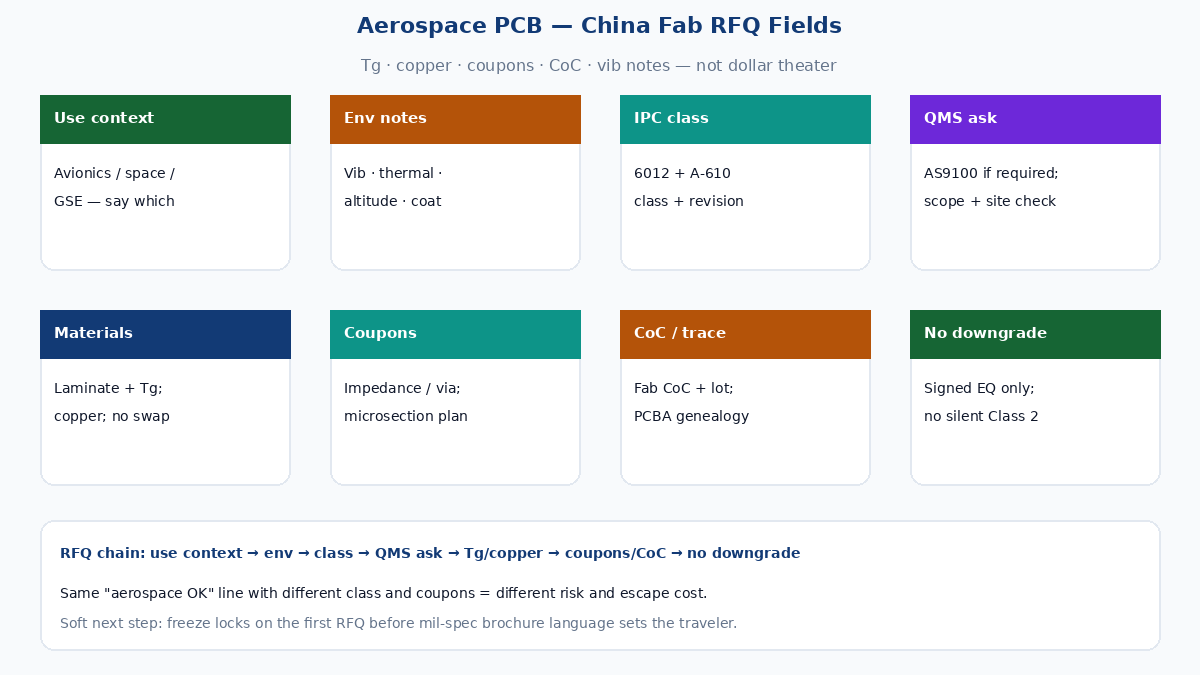
Overseas quotes that say “aerospace PCB OK” inherit house defaults. Normalize fields so every bidder prices the same risk:
| RFQ field | What to write | Fail mode if missing |
|---|---|---|
| Program / use context | Avionics / space / GSE / defence-adjacent — say which | Wrong process and paper assumptions |
| Environment notes | Vibration, thermal cycle, altitude, coat intent | Quiet-office traveler under harsh use |
| IPC class | IPC-6012 and/or IPC-A-610 class + revision; FS if flowed | Silent Class 2 default |
| QMS ask | AS9100 required or not; if yes, scope + site verify | Cert shopping without product locks |
| Materials / Tg / copper | Named laminate family + Tg; copper weights; no silent swap | FR-4 habit under thermal risk |
| Coupons / microsection | Impedance and/or via coupons; microsection plan | Ship with no evidence trail |
| CoC / documentation | Fab CoC, lot ID, inspection reports; FAI/AS9102 if flowed | Dock with no paper |
| Lot traceability | PCB lot → materials → (if PCBA) parts → assembly → test/rework | Complaint with no genealogy |
| HDI / flex notes | Via architecture; flex coverlay/stiffener if used | “HDI capable” priced as through-hole multilayer |
| No silent downgrade | No class / material / test cut without signed EQ | Traveler quietly de-scopes |
Reject incomplete replies before price negotiation. A cheap “aerospace experience” Class 2 visual ship is not comparable to Class 3 + named materials + coupons + genealogy on a scope-matched plant when the program actually requires those locks.
What a workable aerospace-intent lot looks like on the floor
A workable lot is boring in the best way: the traveler matches the quote, materials match the freeze, and inspection rows produce records someone can retrieve months later.
Incoming bare boards. Fab CoC and lot ID land with the panels. Material certificates or lot ties exist when the program asked for them. Incoming checks catch obvious copper or solder-mask issues before SMT loads a wrong rev. Coupon results travel with the lot or sit in a linked report the buyer can request.
SMT and through-hole. Approved MPNs only when assembling. Moisture-sensitive parts follow bake and floor-life rules. Fine-pitch and bottom-terminated packages get the SPI / AOI / X-ray attention the risk file asked for — not a random sample of “nice looking” boards. Stake, underfill, or coat steps run when the assembly drawing named them.
Thermal and vibration-aware process discipline. If the traveler called coat before vib exposure, coat happens and is inspected. If microsection of critical vias was required, samples are cut and retained per the plan — not promised in the quote and skipped on the dock.
Disposition discipline. NCR units segregate. Rework gets a recorded disposition and re-verification. Lots that fail class or coupon criteria do not ship under a softer story told at export packing.
If any of those steps are optional in the quote but mandatory in your quality plan, the RFQ was incomplete. Fix the paperwork before the first production wave, not after the first environmental failed unit.
Soft next step
Map the board to a program type and environment set, then write the manufacturing locks before you chase slogans. Decide IPC class for fab and assembly, whether an AS9100 filter is program-required, which laminate Tg and copper weights are frozen, what coupon and CoC pack must ship, and which vibration or thermal notes belong on the traveler. Put those fields on the first China fab RFQ so quotes stay comparable. Share Gerbers, stackup, finish, environment notes, and — when assembling — BOM and CPL under one revision conversation. System and flight qualification remain with the design authority; board and assembly quality become real when class, materials, coupons, traceability, and environment notes are written down — not when a brochure lists mil-spec tolerance percentages and a famous customer roster.