
Hospital and clinic equipment still runs on copper, laminate, and solder joints. Marketing pages list scanners, pumps, and wearables and then leap to miniaturization slogans. Factory buyers need a different map: which device classes drive which board expectations, what reliability and cleanliness look like on a traveler, how IPC Class 3 differs from a medical QMS ask, which EMC and biocompatibility-adjacent choices belong on the stackup and finish notes, and which China fab RFQ fields stop “medical-ish” quotes from drifting into Class 2 defaults.
This note is a factory buyer guide to PCBs and PCBA for medical devices. It is not a device-design textbook, not a certificate sales sheet, and not a clone of a QMS deep-dive. Device regulatory submissions stay with the device manufacturer. Manufacturing standards, workmanship class, cleanliness, genealogy, and inspection scope stay on the drawing and the purchase order.
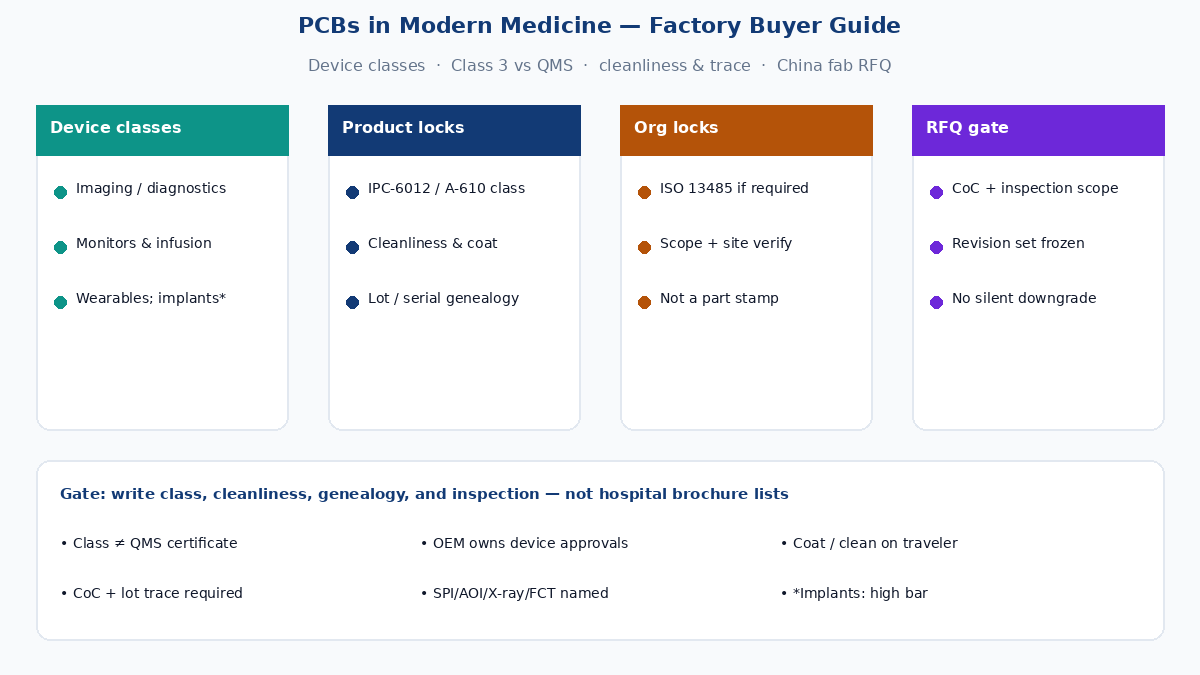
Device classes at a high level — what changes on the board
Treat the list as risk and environment buckets, not as a brochure checklist.
Imaging and heavy diagnostic instruments. CT, MRI-adjacent electronics, ultrasound front-ends, and X-ray control boards often combine dense digital sections, careful analog paths, and long product lives. Expect multilayer or HDI where routing density rises, controlled impedance where clocks and high-speed links matter, and documentation that survives multi-year BOM freezes. Thermal and EMI are design problems first; the fab’s job is to hold the stackup, registration, and finish you froze.
Patient monitors and bedside modules. ECG, SpO2, multi-parameter monitors, and bedside displays need stable sensing front-ends, clean power distribution, and assemblies that endure hospital EMI and cleaning routines. Boards are often mid-complexity FR-4 with ENIG or similar finishes for fine-pitch connectors. Reliability shows up as low escape rates and clear revision identity — not as a slogan on a landing page.
Infusion, fluidic, and therapy control. Pumps and fluid-control instruments mix motor or actuator drive, sensors, and safety-related logic. Buyers should call out critical nets early, decide Class and inspection depth by risk, and keep firmware / programmed content on the same revision lock as the bare board and BOM when programming is in scope.
Wearables and portable point-of-care. Size and battery life push flex, rigid-flex, thin multilayer, and dense SMT. Bend regions, coverlay openings, and connector tails need DFM notes the shop can execute. Cleanliness and conformal coat decisions matter more when the enclosure is small and the environment is skin-adjacent or pocket-carried.
Implantables (high-level only). Pacemakers, neurostimulators, and similar programs sit at the far end of reliability, material, and process control. Most China commodity RFQs are the wrong tool for full implantable programs. If a buyer is only sourcing a non-implantable accessory or programmer board, say so explicitly so the plant does not over-promise or under-control. This guide does not invent sterile-pack or implantable-material claims.
Across classes, the board supplier does not “approve” the finished device. The supplier fabricates and assembles to the manufacturing locks you write. Confusing those jobs is how RFQs stay soft.
Reliability, cleanliness, and traceability expectations
Medical-adjacent PCBA fails in three quiet ways: joints that look fine until the field, ionic or residue problems that show up after cleaning cycles or humidity, and lots that cannot be reconstructed when a complaint arrives.
Reliability as traveler language. Prefer executable ask over adjectives. Cite IPC-A-610 class and revision for assembly workmanship, IPC-6012 class and revision for bare boards when justified, and any coupon or microsection plan your program flows. Name packages that need X-ray, SPI, or 100% AOI. “High reliability” without class and inspection rows is theater.
Cleanliness. Flux residue, white residue after wash, and no-clean process choices affect leakage, conformal coat adhesion, and sensor noise. Write whether the process is no-clean or aqueous/solvent clean, whether ionic cleanliness or ROSE-style checks are required, and whether coat is mandatory before ship. Finish choice (often ENIG for fine-pitch and contact pads) should match shelf life and bonding needs — not a default because it sounds premium.
Traceability. Ask for a genealogy chain that an auditor can follow: bare PCB lot / panel ID with fab CoC, component lots (and date codes where risk demands), PCBA lot or serial, inspection and test records linked to that identity, firmware version/checksum when programmed, and rework disposition that does not erase history. “We can look it up” is not traveler-grade. Lot-level genealogy is the minimum for many instrument programs; serial-level appears when complaint handling or field swap requires it.
Revision identity. Freeze Gerber or ODB++, BOM with approved MPNs, CPL, firmware, and test procedure revisions together. Mixed Rev B boards with a Rev C BOM and an unversioned fixture is a configuration failure dressed as schedule pressure.
IPC Class 3 vs medical QMS — what buyers should ask
Two different locks get mashed into one marketing sentence. Keep them apart.
| Lock | Answers | Does not auto-provide |
|---|---|---|
| IPC-A-610 Class (assembly) | Workmanship acceptance for solder joints and assembly criteria you cite | Org certification or device approval |
| IPC-6012 Class (bare board) | Fabrication acceptance for the PCB you cite | Assembly class or QMS scope |
| ISO 13485 (org QMS) | How the plant manages medical-device-related QMS under a defined scope and site | Product class, stackup, or “ISO 13485 certified PCB” as a part stamp |
| ISO 9001 (org QMS) | General quality-system discipline | Automatic medical QMS equivalence |
IPC Class 3 is a product acceptance callout on drawings and POs. It raises workmanship and acceptance criteria for high-reliability electronics when you cite the class and revision. It does not mean the supplier’s QMS is medical-device scoped.
ISO 13485 is an organization certificate under a scope and manufacturing site. It disciplines document control, risk, records, and supplier control for medical-device-related manufacturing. It does not stamp your part number as “ISO 13485 certified,” and it does not invent Class 3 if the traveler never said Class 3.
Buyers should ask suppliers:
- Is ISO 13485 program-required for this build? If yes, request the current certificate and verify scope wording and site address match the plant quoting the job.
- What IPC-6012 and IPC-A-610 class and revision will appear on the traveler?
- Will approved MPNs, substitution rules, and lot/date-code capture be enforced before SMT?
- What inspection matrix (SPI / AOI / X-ray / flying probe / FCT) and coverage intent apply?
- How are ECO, NCR, and rework recorded so WIP cannot mix revisions or quietly touch up escapes?
Do not treat “medical experience” as a substitute for those answers. Do not treat a QMS PDF as a substitute for class and genealogy. Programs that need both should buy both — and still own device-level regulatory work themselves.
This page stays thin on certificate theater on purpose. QMS scope, ECO, and genealogy mechanics belong in a dedicated supplier-qualification discussion; here the point is the buyer split: product locks versus organization locks.
EMC and biocompatibility-adjacent PCB choices
EMC and biocompatibility are device and system topics. PCB choices still sit next to them and should appear in RFQ notes when relevant.
EMC-adjacent stackup and layout notes. Ground plane continuity, return paths, filter placement, and shield-can footprints are design ownership. On the fab side, lock layer count, copper weights, impedance coupons when needed, and any metal-can or shield attach process the assembly drawing shows. Wireless modules (Bluetooth, Wi-Fi, cellular) on monitors and wearables need antenna keep-outs and RF notes the CAM engineer can see — not a vague “IoT ready” line.
Finish and materials near patient or cleaning chemistry. ENIG is common for fine-pitch and gold fingers; confirm shelf life and any wire-bond or contact needs. If cleaning agents, skin contact, or enclosure materials constrain finishes or coat chemistry, write the constraint. The fab and CMS execute material callouts; they do not run ISO 10993 biocompatibility studies unless that work is separately scoped — and most PCB RFQs should not pretend otherwise.
Coat, potting, and cleanliness as environmental armor. Conformal coat type, keep-outs, and thickness intent reduce moisture and contamination risk on portable and fluidic boards. Potting appears on selected modules. Name the process and inspection of coat coverage; “coat if needed” is how quotes diverge.
Thermal notes without fluff. Imaging power sections and motor drivers need copper, vias, and sometimes metal-backed or heavy-copper constructions. Call the construction; do not assume “medical FR-4” means a special laminate family.
China fab RFQ fields that gate medical PCBA
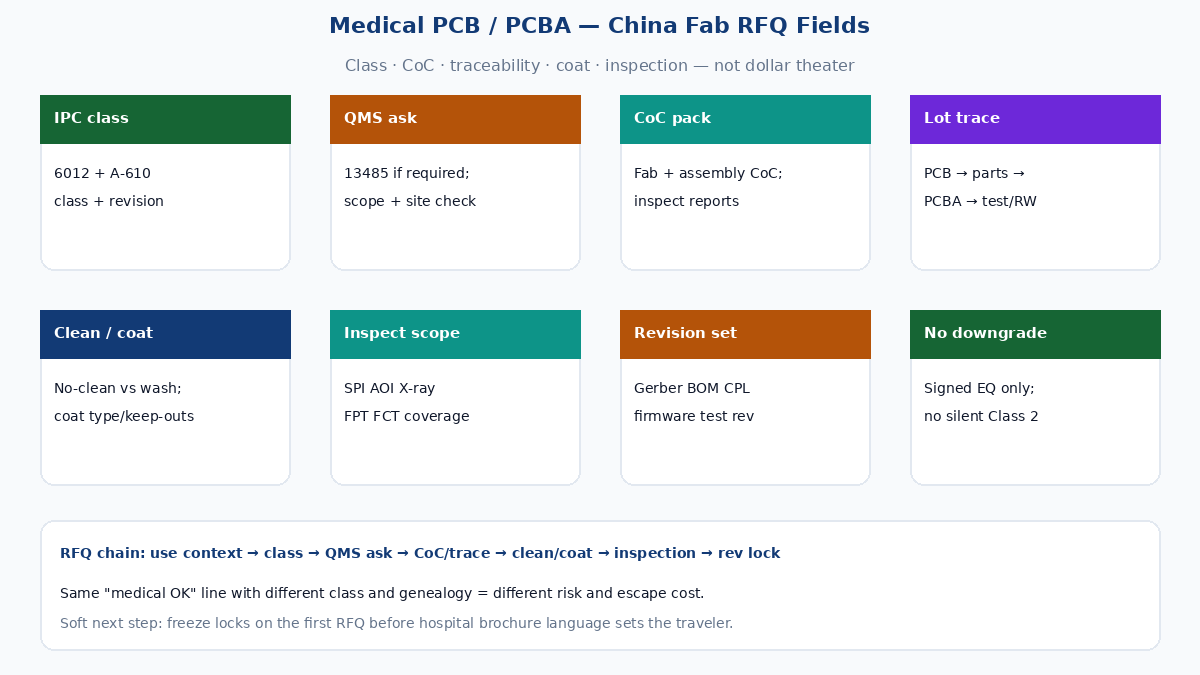
Overseas quotes that say “medical PCB OK” inherit house defaults. Normalize fields so every bidder prices the same risk:
| RFQ field | What to write | Fail mode if missing |
|---|---|---|
| Device / use context | Instrument / monitor / wearable / accessory — implantables called out separately | Wrong process assumptions |
| IPC class | IPC-6012 and/or IPC-A-610 class + revision | Silent Class 2 default |
| QMS ask | ISO 13485 required or not; if yes, scope + site verify | Cert shopping without product locks |
| CoC / documentation pack | Fab CoC, assembly CoC, inspection reports required? | Ship with no paper trail |
| Lot traceability | PCB lot → component lots → PCBA lot/serial → test/rework | Complaint with no genealogy |
| Cleanliness / coat | No-clean vs clean; ionic check if required; coat type/keep-outs | Residue or coat disputes after award |
| Inspection scope | SPI / AOI / X-ray / FPT / FCT coverage intent | Visual-only under fine-pitch risk |
| Revision set | Gerber + BOM (MPN) + CPL + firmware + test rev | Mixed-rev WIP |
| No silent downgrade | No class / MPN / test cut without signed EQ | Traveler quietly de-scopes |
Reject incomplete replies before price negotiation. A cheap “medical experience” Class 2 visual ship is not comparable to Class 3 + genealogy + named inspection on a scope-matched QMS plant.
What “good enough” medical PCBA looks like on the floor
A workable medical-adjacent lot is boring in the best way: the traveler matches the quote, the revision set is frozen, and inspection rows produce records someone can retrieve six months later.
Incoming bare boards. Fab CoC and lot ID land with the panels. Incoming checks catch obvious copper or solder-mask issues before SMT loads a wrong rev. If impedance coupons were required, coupon results travel with the lot or sit in a linked report the buyer can request.
SMT and through-hole. Approved MPNs only. Moisture-sensitive parts follow bake and floor-life rules. Paste and placement for fine-pitch and bottom-terminated packages get the SPI/AOI attention the risk file asked for — not a random sample of “nice looking” boards.
Coat and pack. When coat is specified, keep-outs around connectors and test points are respected, and coverage is inspected before pack. Export packing protects against humidity and handling damage without inventing sterile claims the program never bought.
Disposition discipline. NCR units segregate. Rework gets a recorded disposition and re-verification. Lots that fail class or cleanliness criteria do not ship under a softer story told at the dock.
If any of those steps are optional in the quote but mandatory in your quality plan, the RFQ was incomplete. Fix the paperwork before the first production wave, not after the first field complaint.
Soft next step
Map your product to a device class, then write the manufacturing locks before you chase slogans. Decide IPC class for fab and assembly, whether a medical QMS filter is program-required, what cleanliness and coat mean on the traveler, and which genealogy and inspection rows must ship with the lot. Put those fields on the first China fab RFQ so quotes stay comparable. Share Gerbers, stackup, finish, environment notes, and — when assembling — BOM and CPL under one revision conversation. Device approvals remain with the OEM; board and assembly quality become real when class, cleanliness, traceability, and inspection are written down — not when a brochure lists every machine in the hospital.