
Industry overviews that list raw materials, logistics, production inefficiencies, and quality control as the four pillars of PCB supply risk — then recommend “diversify suppliers,” “hold two months of epoxy,” and cite domestic semiconductor bills as comfort — still leave overseas buyers awarding China fab and PCBA lots without buyer buffers that survive a calendar. Treat those industry primers as outside orientation, not XFPCB plant inventory. This page owns a different frame: an overseas buyer playbook for PCB/PCBA supply risk — laminate / foil / chemistry exposure, logistics calendar math, dual-source buffers, BOM long-lead components versus bare-board fab, QC escapes as schedule killers, and RFQ clauses that lock buffers without soft marketing. Soft CTA only. Sibling XFPCB lanes already own OTD / JIT buyer grammar on the live just-in-time production post, supplier certification gates on certified PCB suppliers, material selection grammar on selecting PCB materials, and day-to-day buy work on Component Sourcing — link the service pages; do not clone the blogs. A later Batch5 environment / insulating-materials guide stays separate — do not merge.
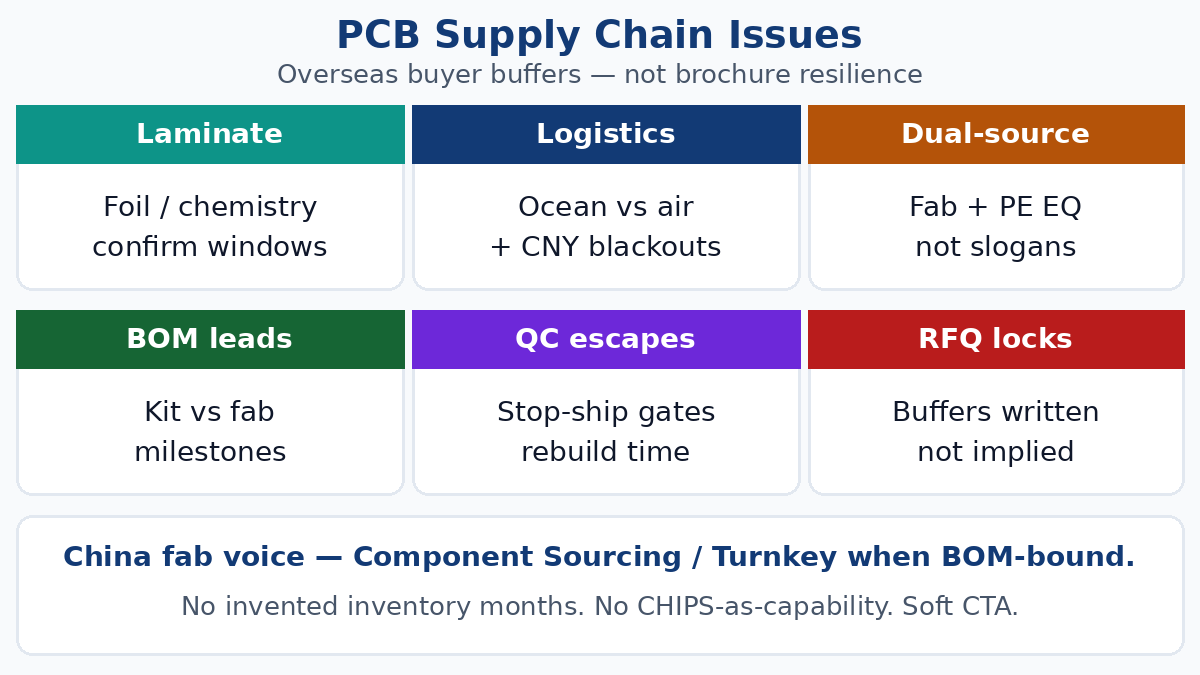
What “supply chain issues” should mean on a buyer RFQ
For an overseas buyer placing bare boards or turnkey PCBA with a China fab, “supply chain issues” is not a news headline. It is a set of schedule and substitution risks that either appear as explicit RFQ lines or show up as quiet slips after PO:
- Laminate / copper foil / process chemistry — cores, prepreg, foil weight, etch / plate baths, and specialty films that gate release when a type is constrained.
- Logistics calendar — factory exit → export docs → ocean / air → destination customs → your dock, plus Chinese New Year and other plant-calendar blackouts.
- Dual-source buffers — alternate fab or alternate material type under PE-approved EQ, not a slogan that “we have many suppliers.”
- BOM long-leads vs bare-board fab — ICs, connectors, and passives that outlast fab cycle time and sit on the critical path for Turnkey PCB Assembly.
- QC escapes as schedule killers — lots that fail AOI / electrical / FAI and force rebuilds that erase any buffer you thought you bought.
Capability depth that is not a buffer essay lives elsewhere: OTD / JIT grammar on the JIT sibling, material Tg / Dk gates on the materials selection post, certification evidence on the certified-suppliers post, and purchasing execution on Component Sourcing. This guide stays on risk grammar + RFQ paste language.
Laminate, foil, and chemistry — the fab-side exposures
Bare-board schedule risk starts inside the fab traveler, not at the airport.
Laminate and prepreg. Commodity FR4-family cores usually move; constrained Tg class, halogen-free locks, HF / PTFE-family, polyimide, or unusual thickness / glass styles do not. Buyer failure mode: awarding “FR4 or equivalent” then discovering the quoted Tg class or CAF-oriented resin is not on the shelf for the week you need. Lock property or type on the traveler (see the materials-selection lane for stackup / Tg / lock-vs-EQ paste) — then ask the fab which confirmation cycle applies when the exact type is tight. Do not invent XFPCB warehouse month counts or brand stock lists here.
Copper foil. Weight changes (½ oz vs 1 oz vs heavy copper), reverse-treat vs standard foil, and specialty foils for fine-line or HF stacks can stretch material confirm and process setup. Write foil weight and any special foil class beside the stack note in Manufacturing Files — soft “fab standard copper” is not a buffer.
Process chemistry. Etch, plate, strip, and surface-finish baths are plant operations, not buyer SKUs — but specialty finishes, thick gold, selective plating, or constrained mask systems still gate capacity. Ask what process deltas the fab assumes when you leave FR4-family commodity for HF, flex, or metal-core constructions. Chemistry shortages in industry news are real; buyer control is process window language on the RFQ, not a recycled-scrap slogan.
**What fab-side gates do not buy:** automatic dual-source, automatic air freight, or immunity from Chinese New Year. Those stay separate buffer lines.
Logistics calendar — buffers that survive export math
Ocean and air are not interchangeable “shipping options”; they are different calendars.
Useful buyer math (write your own numbers; do not treat these as XFPCB SLAs):
- Factory cycle — fab or PCBA process days after materials and files are frozen.
- Export exit — packing, docs, booking cutoffs.
- In-transit — ocean weeks vs air days, plus weekend / holiday idle.
- Destination — customs, last-mile, your receiving hold.
- Plant calendar — Chinese New Year and other regional blackouts that remove weeks from the year; ask for blackout weeks on the quote, not a verbal “we’ll try.”
JIT language is a different lane. On-time delivery definitions, pull signals, and kanban-style release grammar belong on the live just-in-time PCB production post — do not rewrite OTD math here. This page only asks: which calendar buffer sits between fab exit and your dock, and is it written on the PO?
Quick-turn vs mass. Quick Turn PCB shortens fab cycle for NPI and respins; it does not erase ocean transit or CNY. PCB Mass Production and High Volume PCB Assembly change panelization and capacity reservation — they still need logistics buffers written as days or weeks on the traveler, not as brochure “global logistics partners.”
Dual-source buffers — fab and material, not slogans
“Diversify suppliers” without an approved alternate is marketing. Buyer dual-source that works looks like:
- Alternate fab (same revision) — second China fab (or region) already quoted on the same frozen files, with known process deltas and lead-time offsets. Dual-source is worthless if only one house has ever built the panel.
- Alternate material type under PE EQ — property-matched FR4-family Tg class or approved HF / flex alternate with a signed equivalent rule. Silent brand swaps are not dual-source; they are QC risk.
- Split quantity rules — how first-article and early lots allocate between primary and alternate without two uncontrolled travelers.
- What dual-source is not — inventing XFPCB multi-plant month inventory, naming competitor fabs, or claiming CHIPS-Act / domestic bills as XFPCB capability. Legislative context may shape your regional strategy; it is not a line item this China fab page can promise.
When certification evidence (ISO / IATF / AS / IPC Class) is the gate for who may be primary or alternate, route that to the certified-suppliers lane — keep this page on buffer structure.
BOM long-leads vs bare-board fab
For turnkey or kitted PCBA, the critical path is often not the bare board.
| Risk class | Typical owner | Buyer buffer question |
|---|---|---|
| Bare board | Fab cycle + laminate confirm | Are stack / foil / finish locks frozen so fab can start? |
| Long-lead ICs / MCUs | Component Sourcing or buyer-consigned | Allocation, date-code, and authorized-channel rules on the RFQ? |
| Connectors / odd-forms | Same | Second source / footprint-compatible alternate under PE? |
| Passives / commons | EMS buy or kit | MoQ and reel leftovers accepted? |
| PCBA process | SMT / THT / test | Stencil, feeder, and test gates booked after kit complete? |
Buyer failure mode: locking a five-day quick-turn fab while a sixteen-week MCU sits unordered — then blaming “PCB supply chain” when the schedule was always BOM-bound. Separate fab release from kit complete on the PO. For full buy + build, use Turnkey PCB Assembly language with explicit long-lead callouts; for fab-only, do not pretend component markets are the fab’s silent problem.
Do not invent XFPCB component inventory months or allocation guarantees. Ask for honest confirm cycles and alternate PN rules under PE.
QC escapes as schedule killers
The quietest supply-chain failure is a lot that ships late because it should not ship.
Escapes that erase buffers:
- Soft AOI / electrical coverage that finds opens / shorts after panels left the building.
- First-article or FA delta ignored until volume panels are already in process.
- Material silent swap that invalidates impedance or CAF assumptions mid-lot.
- Incomplete Manufacturing Files (missing stack note, drill, or impedance table) that forces hold-and-clarify after PO.
Buyer practice: write stop-ship gates beside lead time — which inspections are 100% vs sample, when FA must clear before ramp, and that material / finish EQ needs PE signature before rebuild. Testing method depth lives on the testing hub and method posts; here only the schedule truth: a failed lot is a supply event, not a quality footnote.
RFQ clauses that lock buffers (paste-ready)
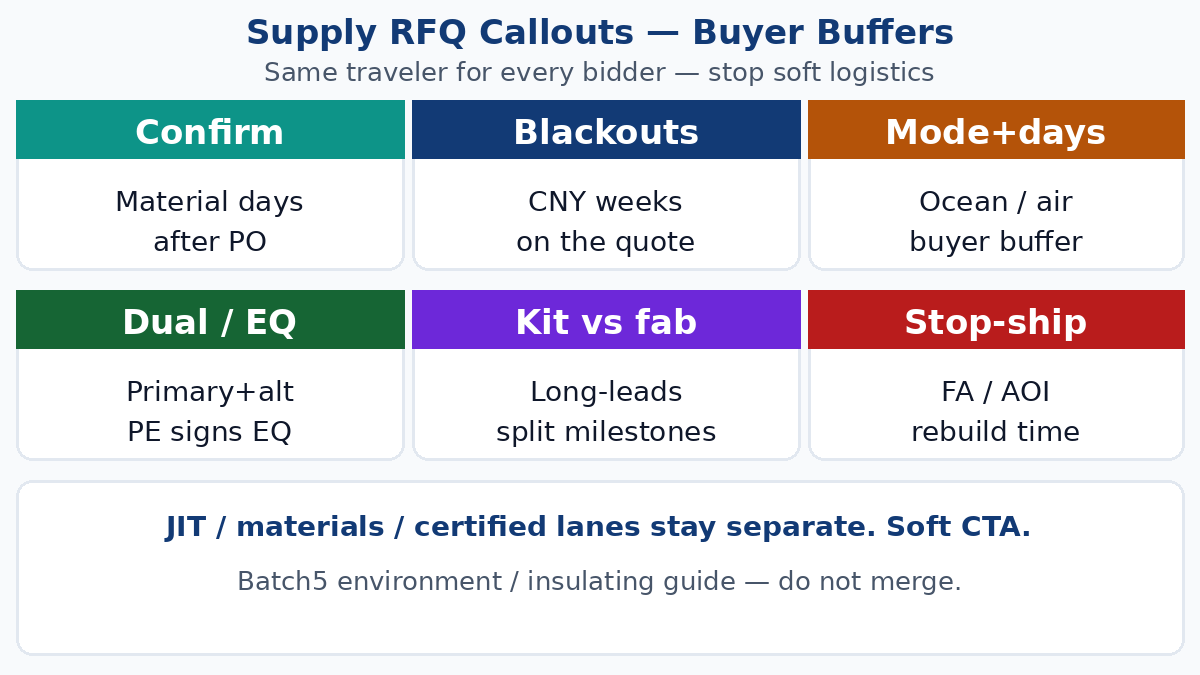
Export quotes diverge when buffer language stays soft (“best effort logistics,” “materials available,” “components as market allows”). Paste comparable callouts:
- Material confirm window — days after PO for laminate / foil / finish confirm; state what happens if the locked type is constrained (hold / PE EQ / cancel) — no silent substitute.
- Plant calendar blackouts — CNY and other blackout weeks listed on the quote; ship promises that ignore blackouts are non-comparable.
- Logistics mode + buffer days — ocean vs air named; buyer-owned buffer days from fab exit to dock written as numbers you choose — not as invented XFPCB SLA.
- Dual-source / EQ rule — primary fab + approved alternate, or material lock vs PE-only equivalent; who signs EQ; no silent brand or Tg-class swap.
- Kit vs fab split — for PCBA, “fab start after laminate confirm” vs “SMT start after kit complete” as separate milestones; long-lead PNs listed with target dock dates.
- QC stop-ship — FA clearance before volume, AOI / electrical / FAI expectations, and rebuild lead time if escape found — so schedule risk is priced, not hidden.
- File freeze — Gerbers/ODB++, stack note, BOM, and AVL attached via Manufacturing Files before award; “TBD material / TBD kit” quotes are not buffer-comparable.
- No invented claims — no XFPCB multi-month inventory boasts, no CHIPS-Act-as-capability lines, no competitor brand ads.
China fab honesty — what buffers can and cannot buy
China export fabs routinely run strong FR4-family and high-Tg programs, plus flex, aluminum / MCPCB, selective HF, quick-turn NPI, and mass panels. That does not mean every constrained laminate SKU, every long-lead IC, or every CNY week disappears because a brochure said “supply chain resilience.”
Honest buyer practice:
- Prefer written confirm cycles and blackout weeks over verbal reassurance.
- Prefer property locks + PE EQ when exact brands are not frozen by qualification.
- Separate fab buffers from BOM buffers — Component Sourcing owns buy execution; this page owns the split on the RFQ.
- Route award logistics through How to Place an Order only after material gates, kit rules, and calendar buffers are frozen — not after a soft “we’ll expedite” reopens the traveler post-PO.
Environment / sustainability and insulating-materials / dielectrics deep dives are later Batch5 lanes — do not merge them into this supply-risk playbook.
Soft next step
Write laminate / foil confirm windows, logistics mode + buffer days, dual-source or PE EQ rules, kit-vs-fab milestones, and QC stop-ship gates so every bidder answers the same traveler. Soft next step when buffers and files are clear: send the RFQ through your normal path via How to Place an Order with Manufacturing Files attached — and pull Component Sourcing or Turnkey language only when the BOM is on the critical path, not when a bare-board delay was really an unlocked stack note.