
Procurement RFQs that say “full QA” still ship boards that look clean, pass a soft traveler line, then fail bring-up. The failure is rarely that the factory owns no cameras or probes. It is that six common quality-assurance checks — AOI, BGA X-ray, functional test, ICT, flying probe, and burn-in — get dumped as nouns without volume, fixture, catch/miss, and traveler stage. Brochure pages list the six and praise each machine. China fab and PCBA buyers need a when-to-buy matrix: which gate earns its keep at prototype versus pilot versus volume, what each catches versus misses, and traveler language that keeps quotes comparable. Deep AOI traveler essays, X-ray mandate pages, and full methods encyclopedias live elsewhere. This page owns the six-check RFQ matrix only — no competitor brands, no invented XFPCB dollar or TAT menus.
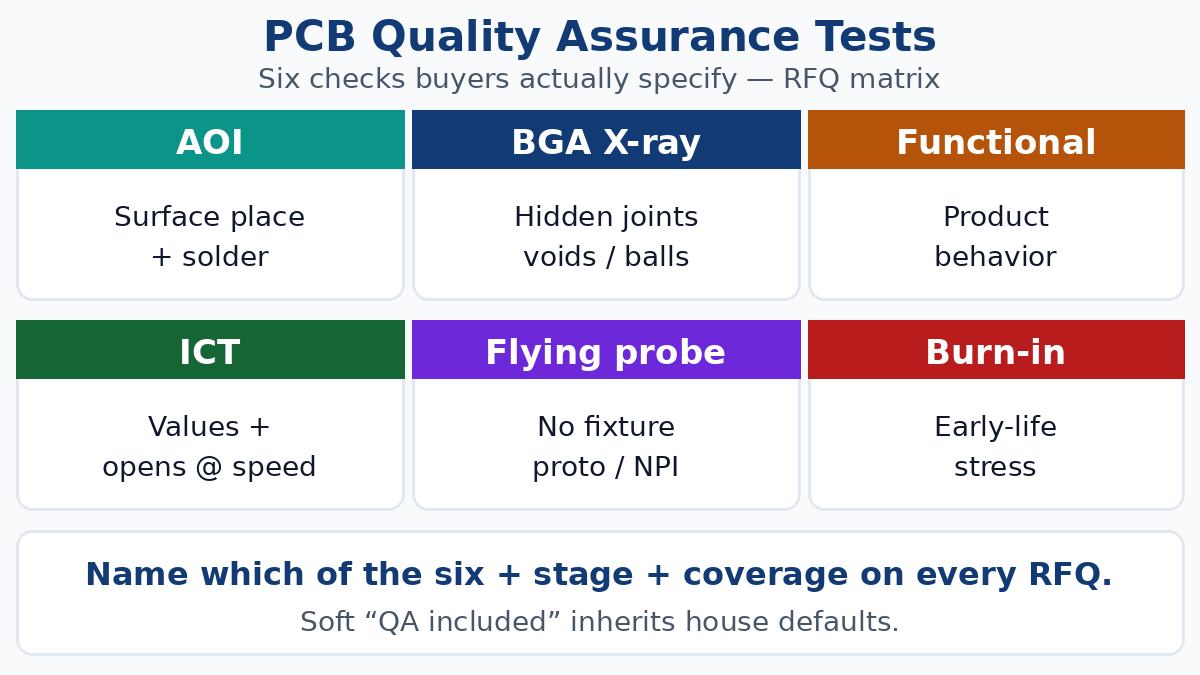
Why “QA included” is not a specification
“QA included” inherits house defaults: sample AOI instead of 100%, X-ray on first article only, functional as “power on and see,” ICT quoted without fixture NRE, flying probe assumed only on bare board, burn-in never mentioned until a field return. Soft defaults are not malicious; they are how factories fill blank travelers. Buyers who want comparable China quotes name which of the six, at which stage, at what coverage, with who owns fail disposition.
Separate three jobs before you pick a check:
- Surface inspection sees paste, placement, and visible fillets (AOI family).
- Hidden-joint inspection sees under BGA/QFN/LGA (X-ray family).
- Electrical / product proof measures nets, values, or behavior (flying probe, ICT, functional, burn-in).
Inspection is not electrical proof. Electrical nets are not product behavior. Reliability stress is not a substitute for either. Stack by defect family — do not treat any one noun as a certificate.
The six checks buyers actually specify (catch vs miss)
1. AOI — Automated optical inspection
Buy when surface defects drive scrap risk: missing/shifted parts, polarity, bridges on exposed leads, many insufficient fillets — especially after SMT PCB assembly reflow on medium-to-high volume or high-mix lines where early optical flags cut rework.
Catches: visible placement and solder anomalies cameras can see.
Misses: joints under BGA/QFN/LGA, voids, head-in-pillow, wrong-value lookalikes, firmware and functional faults.
Cost / fixture / volume gate: program and golden-board maintenance, not a bed-of-nails fixture. Sample vs 100% and NPI vs production coverage change price more than machine brand. Name stage (post-print / post-place / post-reflow) on the traveler — “AOI included” without stage is soft.
2. BGA X-ray inspection
Buy when packages hide joints that AOI cannot own — BGA PCB balls, QFN/LGA pads, stacked devices — or when Class / field risk demands void and bridge criteria in writing. Pair with X-ray inspection depth language on scope, not as a camera upgrade slogan.
Catches: voids, bridges under packages, many misaligned balls, some open/short signatures visible in projection or AXI.
Misses: wrong component values, software faults, intermittent functional bugs, most bare-board etch issues already owned by electrical test.
Cost / fixture / volume gate: operator time and image review dominate; sampling scales with risk and volume. First-article 100% then production sample is common — write it. Do not invent equipment model claims; lock accept limits and image retention instead.
3. Functional circuit testing (FCT)
Buy when the product must prove behavior under a written script after populate — power rails, interfaces, sensors, firmware hooks — especially on prototype PCB assembly bring-up and before customer pilots.
Catches: design and process faults that only appear when the board runs as a product.
Misses: many latent solder defects that still “work” on the bench; early-life wear-out; parametric drift under long stress (burn-in’s job).
Cost / fixture / volume gate: script ownership, fixture complexity, and fail disposition — not a generic “functionality” checkbox. Name who writes the script, who owns golden units, and pass/fail limits. Soft “power on” is not FCT.
4. In-circuit testing (ICT)
Buy when volume amortizes bed-of-nails NRE and you need fast, repeatable measurement of values, opens, shorts, and many solder defects before full functional coverage.
Catches: incorrect values, opens/shorts accessible to nails, many manufacturing defects at high throughput.
Misses: defects on nets without access, some fine-pitch / connector limits, product-level behavior, hidden joints under packages.
Cost / fixture / volume gate: custom fixture NRE is the real gate. Prototypes and frequent respins rarely justify ICT; stable high-volume designs often do. Quote fixture NRE separately from unit test — silent “ICT included” without NRE is not comparable.
5. Flying probe testing
Buy when fixtureless electrical coverage is needed on prototypes, NPI, high-mix, or respin work — bare board and often assembled — before ICT NRE makes sense. Prefer flying probe language on the traveler when you want opens/shorts/values without a nail plate.
Catches: opens, shorts, many resistance/capacitance/polarity checks guided by CAD.
Misses: product behavior under load (FCT), long-duration reliability (burn-in), optical surface defects (AOI), hidden BGA joints (X-ray).
Cost / fixture / volume gate: no custom nail plate; longer per-board time than ICT at volume. Ideal below the ICT payback curve. State bare vs assembled FPT and netlist/access assumptions so China houses program the same coverage.
6. Burn-in testing
Buy when early-life failure risk and elevated stress proof matter — aerospace-adjacent, medical, industrial uptime, or customer contracts that name infant-mortality screening — not as a default on every consumer lot.
Catches: early failures under elevated temperature/electrical load; some solder and component weaknesses that only appear under stress.
Misses: design bugs that FCT should have caught cold; surface placement escapes; most etch/fab issues already owned upstream.
Cost / fixture / volume gate: chamber time, fixtures, and calendar dominate. Treat as a named adder with duration, temperature, load, and sample size — never as silent “reliability included.”
Buyer RFQ matrix — when to buy which gate
Use volume and fixture economics as filters, then stack by defect family. The matrix below is decision language for RFQs, not a lab SOP rewrite.
| Check | Typical buy trigger | Skip / defer when | Primary catch | Primary miss | Fixture / cost gate |
|---|---|---|---|---|---|
| AOI | Populated SMT; surface scrap risk | Bare-only visual lots with no assembly | Visible place/solder | Hidden joints, function | Program + coverage % |
| BGA X-ray | BGA/QFN/LGA or written void criteria | No hidden packages; low risk sample OK | Under-package joints | Values, firmware | Review time + sample plan |
| Functional | Product behavior must ship | Bare board only; no script yet | Run-time faults | Latent / wear-out | Script + fixture ownership |
| ICT | Stable high volume; access designed | Proto / respin / low volume | Values, opens/shorts @ speed | No-access nets, FCT | Bed-of-nails NRE |
| Flying probe | Proto / NPI / high-mix electrical | ICT already amortized and access locked | Opens/shorts/values no fixture | Behavior, burn-in | Program time vs ICT speed |
| Burn-in | Named reliability / infant mortality | Commodity consumer with no contract need | Early-life under stress | Cold functional bugs | Chamber hours + sample |
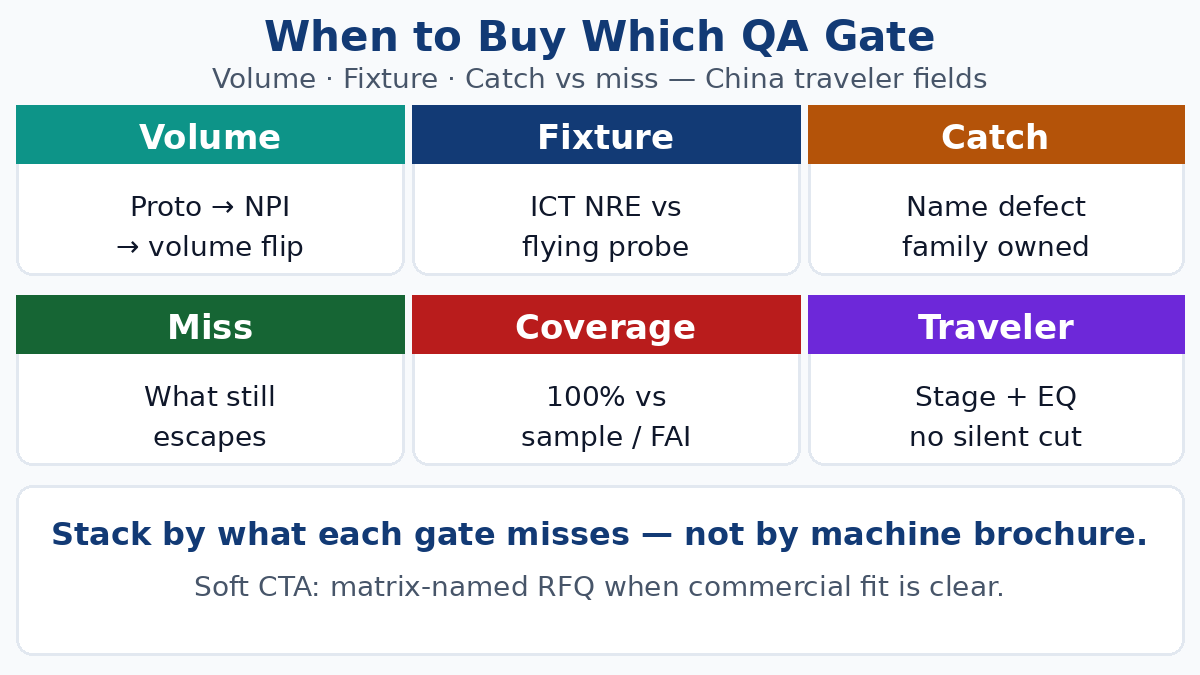
Stacking order on a realistic traveler
A practical China PCBA traveler rarely runs all six on every board. Typical stacking for a populated SMT lot with BGA risk:
- Bare-board electrical (often flying probe) before populate when netlist risk is high.
- AOI at the stages you named — commonly post-reflow for visible defects.
- X-ray on BGA/QFN lots per sample plan and written void/bridge limits.
- ICT only when fixture NRE is already justified by volume and access.
- Functional against a revision-controlled script before ship.
- Burn-in only as a contract adder — duration, temperature, load, and sample size written once.
Prototype PCB assembly lots usually favor flying probe + AOI + targeted X-ray + FCT, and skip ICT/burn-in until the design freezes. Volume lots flip: ICT may replace most flying-probe time; burn-in appears only when the end-use contract demands infant-mortality screening. The matrix question is always the same: which defect family still escapes if you drop this gate?
Do not buy burn-in to hide a missing FCT script, or X-ray to compensate for unnamed AOI stages. Complements stack by what each misses — that is how fixture and chamber spend stay rational.
China fab / PCBA traveler language that keeps quotes comparable
Paste fields into the RFQ so houses cannot “include QA” as a soft blob. Prefer service-page depth on PCB board testing and inspection for method menus; keep this page’s fields matrix-tight:
- Named checks — list only the gates you buy (from the six), not “full QA.”
- Stage — fab bare / post-print / post-place / post-reflow / post-assembly / pre-ship.
- Coverage — 100% vs sample; NPI vs production; first-article vs lot.
- Accept limits — voids %, bridge criteria, FCT script revision, burn-in hours/°C/load.
- Fixture / NRE — ICT nail plate, FCT fixture, burn-in rack — quoted separately.
- Fail disposition — stop-ship, rework authority, image/report deliverables, no silent downgrade without signed EQ.
- Assembly path — consign vs turnkey PCB assembly kit rules when FCT/ICT touch customer parts.
When files are ready to award, How to Place an Order is the commercial next step — after the traveler names the six-check subset you actually want.
How this differs from sibling XFPCB pages
- Methods encyclopedia / inspection stack hubs own broad method catalogs and Class depth essays — not this six-check when-to-buy matrix.
- AOI-role pages own traveler stage detail for optical inspection alone.
- X-ray when-to pages own package/void/2D-vs-3D mandate depth alone.
- Flying-probe and functional playbooks own DFT and script/fixture detail for one method each.
Do not merge those angles into one post. Buyers who need one RFQ sentence for “which of the six at what volume” start here; buyers who need one method’s deep traveler open the sibling.
Soft next step
Write the matrix on the RFQ before you ask for unit price. Name AOI stage and coverage, X-ray sample plan when packages hide joints, FCT script ownership, ICT NRE vs flying-probe payback, and burn-in only when contract reliability requires it. Ask houses to confirm each named gate as a line item or explicit inclusion — not a marketing paragraph. Comparable China fab and PCBA quotes follow named gates — not a soft “QA included” line. When the traveler is clear and files are frozen, move commercial award through normal order channels rather than renegotiating QA nouns after the PO.