
PCB prototyping is sold as “small volume before production.” Buyers who award fab and assembly partners know the real selection problem is different: which shop can open a complete package, answer DFM without rewriting the stack, and return a comparable quote for bare board, PCBA, or turnkey scope. Soft local-brochure pages lean on plant storytelling and prestige certificates. Factory practice asks for RFQ package quality — Gerber and fab notes, Class 2 vs Class 3 language, finishes and materials that actually sit on stock, standards signals that mean process control, and quote types that do not mix apples with oranges. This guide is the buyer checklist for choosing prototype partners. Quick-turn definition and freeze-gate economics live on their own pages. Production OTD and JIT program clocks live on theirs. Here the job is partner selection and RFQ hygiene for prototype lots — without US-only sales framing, competitor name-drops, or invented plant TAT and certificate menus.
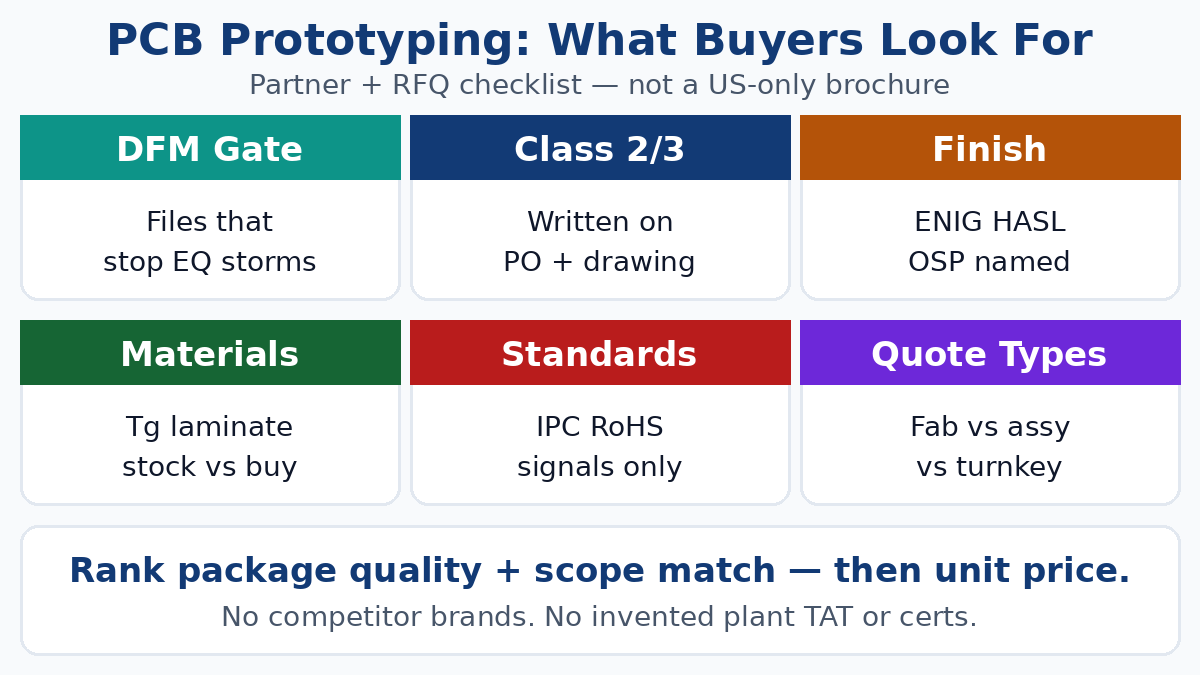
What “looking for” actually means on a prototype RFQ
Prototypes exist to find design and process risk before pilot money lands. That only works when the fab and assembly house can build what the drawing says, report what they cannot, and price the same scope you will later scale. “Looking for” is therefore not a tour of a factory lobby. It is a short list of buyer checks:
- Package completeness — can CAM open the zip without inventing layers, finishes, or test depth?
- DFM honesty — do holds and EQs arrive early, with named owners, instead of after the lot is already on etch?
- Scope clarity — bare fab, prototype PCB assembly, or full turnkey with kit ownership stated once?
- Class and acceptance language — IPC Class 2 or Class 3 written on drawing and PO, not assumed from a homepage badge?
- Materials and finish realism — stock vs buy, Tg and copper weight named, surface finish locked?
- Standards as signals — RoHS / lead-free process, IPC document families, and plant system certificates treated as evidence — not as a substitute for traveler notes?
- Quote type integrity — board-only, assembly-only, and turnkey lines compared on matching rows?
If a bidder cannot restate those seven checks in their own words, unit price is noise. Rank package quality and scope match first; price second.
DFM as a partner filter — not a brochure word
Design for manufacturability is the first real filter. Reputable prototype shops run CAM against the fab notes you sent: copper-to-edge, annular ring, drill-to-copper, mask openings, impedance coupons or waivers, and stack registration risk. Soft marketing says “we do DFM.” Buyer practice asks:
- Will DFM start before the clock, or only after a PO so the lot sits in limbo?
- Are EQs written against named revision IDs, with a rule for whether answers reset the promised date?
- Does the shop push silent copper or laminate swaps, or do they ask before substituting?
Incomplete Gerbers, missing fab notes, and “rev almost-final” uploads are NPI chaos dressed as urgency. Partners worth awarding send a short hold list early and refuse to invent finish or class when the drawing is silent. Attach a clean manufacturing package — Gerber or ODB++, fab drawing, stackup, and notes — using the same discipline you would for volume. Site support for what belongs in that zip lives under Manufacturing Files; use it as a checklist for your own release, not as a substitute for fab notes on the traveler.
DFM depth for dense builds matters too. HDI PCB constructions, controlled impedance, and sequential lamination need early CAM eyes. Commodity 2-layer stocked FR-4 does not. Matching partner capability to construction is part of “looking for,” not an afterthought when the first EQ arrives on Friday night.
Class 2 vs Class 3 — write it, do not assume it
Class is an acceptance and workmanship level on the drawing and PO. It is not a plant nickname. Leave it blank and many China fab and PCBA travelers default toward Class 2 process windows and sampling — then argue after you reject on Class 3 microsections or solder criteria.
Bare-board language usually points at IPC-6012 / IPC-A-600 families. Assembly language usually points at IPC-A-610. Mixing those families on one RFQ line is how quotes look cheap until inspection criteria surface mid-lot. For prototype awards:
- State Class 2 or Class 3 once for fab and once for assembly when both scopes exist.
- Name coupon, microsection, or sample depth when Class 3 is real — not after award.
- Do not treat Class as a silent upgrade because sales said “high reliability.”
Class is also not a certificate. An AS9100 or ISO system certificate (when a plant holds one) is a management-system signal. It does not by itself put Class 3 coupons on your traveler. Write the class and test depth you need; ask for certificates only as supporting evidence for the process controls you already named. Never invent plant certificate claims for XFPCB or any unnamed shop — ask for current scope on the RFQ if your end use requires it.
Finishes, materials, and construction options that change partners
Prototype RFQs fail when finish and laminate stay soft. Name them once.
Surface finish. Common buyer choices include leaded HASL where still allowed, lead-free HASL, ENIG, immersion silver, immersion tin, and OSP. Each changes solderability window, flatness for fine pitch, shelf life, and whether the lot stays on a fast process path. Lock finish before comparing day counts. If the end product must be lead-free, say so on both fab and lead-free assembly scopes so paste and finish do not fight each other.
Laminate and Tg. “FR-4” is a family, not a single recipe. State Tg (for example 130 vs 170 class), copper weight, and any AVL-locked brand or glass style. Ask whether the quote assumes stock on hand or buy lead time. Silent substitutions reset impedance and reliability risk even when the unit price looks friendly.
Construction family. Through-via rigid multilayers, flexible PCB and rigid-flex, aluminum PCB / metal core thermal boards, and HDI skins are different buying problems. A shop strong on commodity rigid may still be the wrong partner for dynamic flex or MCPCB thermal paths. Match construction to capability sheet before you argue pennies on a 5-piece lot.
Mask and legend. Color and type belong on the fab note. Uncommon mask systems can fall off rush lines the same way specialty finishes do. Prototypes that will later become cosmetic brand boards should freeze mask early so pilot does not inherit a “temporary green” that never match-paints.
Assembly scope: SMT, through-hole, turnkey, and kits
Many “prototype” RFQs are really small PCBA jobs. Separate the scopes so quotes stay comparable.
- Bare board only — fab, finish, electrical test depth, packing. No BOM risk on the fab side.
- Consigned assembly — you own the kit; the shop owns placement and solder process. State SMT PCB assembly vs through-hole assembly mix, double-sided flow, and BGA/QFN X-ray expectations.
- Turnkey PCB assembly — shop or designated buyer path owns component sourcing, AVL rules, and shortage escalation. Name who may substitute and who pays expedite freight on long-lead parts.
Prototype assembly partners should show how they handle partial kits, last-time-buy footprints, and ECO mid-lot — not only a machine list. Mixed-tech boards (SMT plus THT) need a method map: wave, selective, or hand for which refdes. Skipping that map is how a “simple prototype” burns a bottom-side SMT pass.
When schedule pressure is real and files can freeze, quick turn PCB capacity is a separate product from partner quality. Buy expedite only after DFM, class, finish, and kit ownership are already clear — otherwise the premium funds inbox latency.
Standards signals worth reading (and ones that are theater)
Standards and certificates are buyer signals when they map to traveler controls. Treat them as evidence, not as a substitute for notes.
Useful signals
- Named IPC document families on the PO (6012/A-600 for board, A-610 for assembly, J-STD-001 when solder process control matters).
- Explicit RoHS / lead-free process statements when the product must ship into restricted markets.
- Electrical test depth (flying probe vs fixture, sample vs 100%), AOI default, and X-ray for hidden joints — written before award.
- Moisture-barrier packing and humidity-control notes when boards go straight to assembly.
Theater to push back on
- Prestige adjectives (“aerospace quality,” “military grade”) with no class, coupon, or test depth on the RFQ.
- Certificate name-drops that never state the certificate’s scope or whether your lot rides that QMS traveler.
- “Any layer, any finish, same package price” when construction physics disagree.
- Speed claims that imply skipped inspection. At reputable shops, rush buys schedule priority — not a free pass on AOI or continuity.
Pushback stays in RFQ language. Do not chase competitor brands; compare field tables.
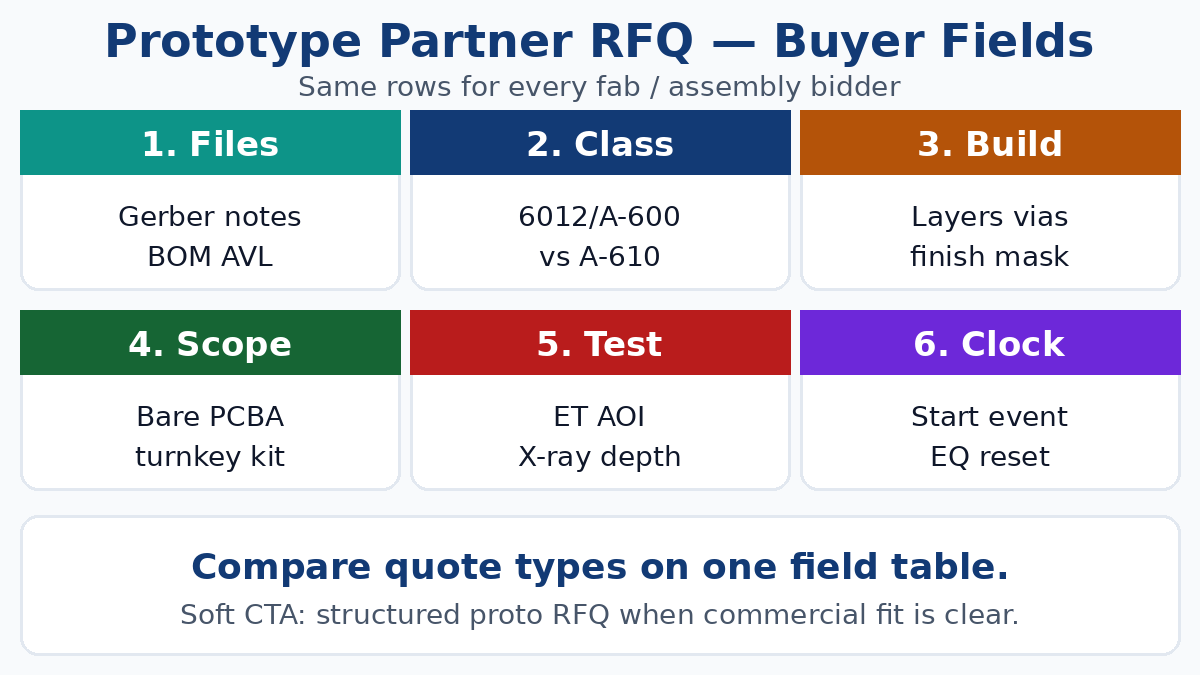
Quote types: board, assembly, and specials on one table
Thin competitor pages often advertise three quote buckets: board/fabrication, assembly, and advertised specials. That split is useful when each bucket stays honest. It fails when a special silently locks finish, layer count, or test depth you did not want.
Board (fab) quotes should restate layers/via plan, dimensions, thickness, laminate/Tg, copper weight, finish, mask, impedance or waiver, class, and electrical-test depth. Quantity and panel/pooling rules belong here. Compare bidders on those rows — not on a homepage day badge.
Assembly quotes should restate unique part count, total placements, through-hole count, single- vs double-sided, fine-pitch / BGA/QFN flags, class (A-610), inspection depth, and whether paste, flux, and conformal coat are in or out of scope. Kit ownership (consign vs turnkey) must be explicit.
Specials and promotions can be real cost levers on commodity constructions. Treat them as constrained SKUs: read the locked finish, layer, and test assumptions before you force a non-standard stack into a promo line. A special that forces engineering exceptions is not a bargain; it is a silent scope change.
Landed cost still differs from unit price. Freight, Incoterms, duties, and re-spin risk belong on the same decision sheet. Do not invent XFPCB dollar tables or turnaround menus — process risk, stack, finish, kit completeness, and capacity differ by lot. Rank clock honesty and scope match; then compare price.
Partner red flags and green flags
Green flags
- Restates your fab notes and class in the quote instead of pasting a generic capability sheet.
- Asks early DFM questions with revision IDs and an EQ reset rule.
- Separates stock vs buy materials and names finish once.
- Offers board-only, assembly, and turnkey as distinct scopes with matching field rows.
- Can walk How to Place an Order steps without inventing missing files.
Red flags
- Refuses to write Class, finish, or test depth “because prototypes are flexible.”
- Quotes calendar theater without a named clock-start event.
- Treats certificates as a substitute for traveler controls.
- Mixes bare-board and assembly acceptance language on one vague line.
- Pushes silent AVL or laminate substitution to hit a promo SKU.
Soft next step
If the design can freeze, class and finish are named, kit ownership is clear, and you need a prototype partner who answers the same field table every time, send a structured RFQ: manufacturing files package, Class 2/3 language for fab and assembly, laminate/Tg and finish, construction family, SMT/THT/turnkey scope, test and inspection depth, clock-start and EQ reset rules, and freight/Incoterms. XFPCB can respond on that checklist when commercial fit is clear — without brochure adjectives standing in for acceptance criteria on your traveler.