
Industry overviews that define PCB insulating materials as “non-conductive layers that isolate copper, manage heat, and add strength,” then list FR-4, polyimide, PTFE, ceramic, and flex films — often ending with a house brand CTA — still leave export buyers without insulation-class locks. This page owns a different frame: PCB insulating materials as dielectrics and isolators — what insulation must do (layer isolation, CAF / CTE risk language, Dk / Df roles), how FR-4-family vs high-Tg, polyimide, PTFE / low-loss, ceramic and metal-core dielectrics, and flex-film insulators differ in buyer practice, and how to call out insulation class on a China fab RFQ (Tg, Td, CTExy / z, Df at named frequency, halogen-free). Soft CTA only. Sibling XFPCB lanes already own fabrication material-selection RFQ grammar, FR4 when-to-use depth, copper surface-finish choice, and environmental / compliance narrative — name those lanes in prose; do not clone them. No competitor brands. No invented XFPCB laminate warehouse inventory or lab Dk tables.
What insulation must do on a multilayer board
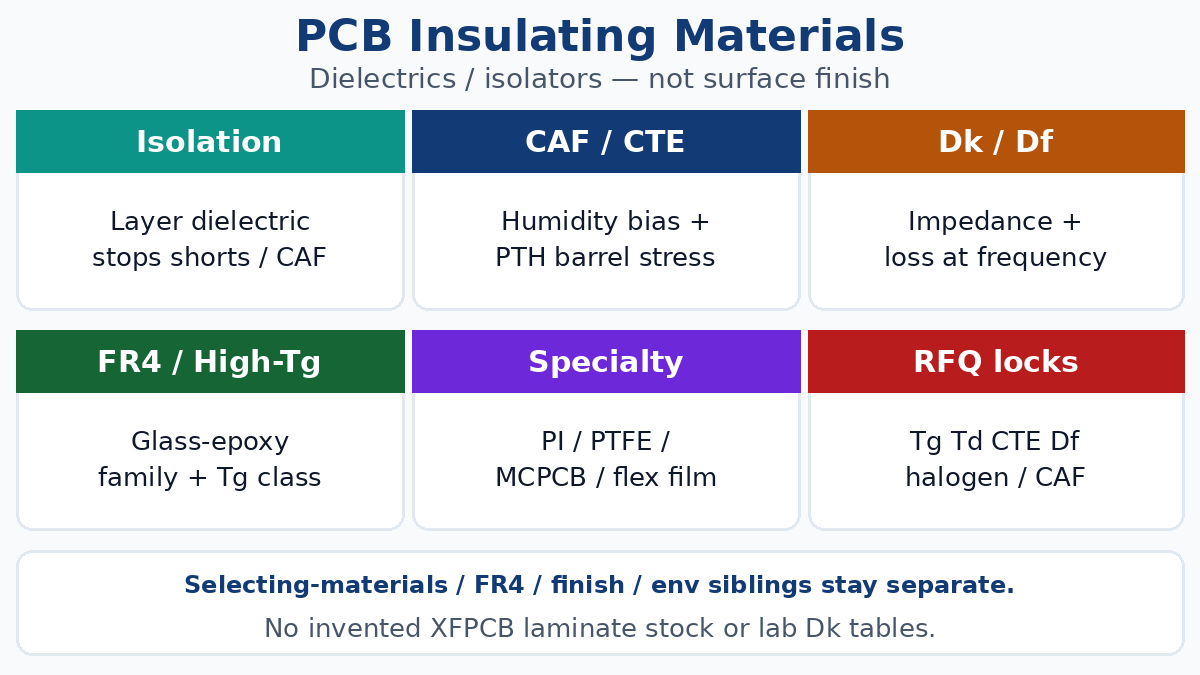
Insulating materials are the non-conductive dielectrics between and around copper. On a buyer traveler they are not “plastic filler.” They set isolation distance, control how heat and expansion stress the stack, and dominate signal loss once edge rates climb.
Layer isolation. Core and prepreg dielectrics keep voltage and current on the intended nets. Inadequate dielectric thickness, resin content, or glass style shows up as shorts after drill / plate, CAF growth under humidity and bias, or impedance that drifts when the fab substitutes a thinner “equivalent” prepreg.
CAF and CTE language (buyer, not lab claim). Conductive anodic filament (CAF) risk rises with fine pitch, high humidity, and sustained bias across glass-resin interfaces. Coefficient of thermal expansion (CTE) — especially Z-axis — drives PTH barrel stress through reflow and thermal cycling; in-plane CTE interacts with packages and metal cores. Write CAF and CTE as stackup risk notes when pitch, humidity, thick copper, or metal-core constructions are real — do not invent XFPCB CAF pass menus or a single universal CTE number as plant law.
Dk and Df roles. Dielectric constant (Dk) shapes impedance geometry and delay. Dissipation factor (Df / loss tangent) dominates insertion loss as frequency rises. For controlled-impedance work, pair dielectric locks with Impedance Control PCB process ownership; for microwave / mmWave loss budgets that FR4-family cannot hold, open High Frequency PCB rather than pasting a brochure “low loss” slogan.
What insulation is not. Copper surface finish (HASL, ENIG, OSP, and peers) is a solderability / contact decision on exposed pads — already owned on XFPCB’s surface-finish buyer guide. Conformal coating is a board-level environmental overcoat after assembly, not the laminate dielectric between layers. Halogen-free / RoHS narrative for programs and shipping paperwork belongs with the environmental sibling — here only the insulation callout line (halogen-free resin system yes/no) belongs on the RFQ.
FR-4 family and high-Tg glass-epoxy dielectrics
FR-4-family glass-epoxy remains the default rigid dielectric for cost, availability, and most digital / mixed-signal China export lots. Buyer practice treats “FR-4” as a family, not a single SKU: resin systems and Tg classes differ, and silent “FR4 or equivalent” awards are where insulation class drifts.
Commodity Tg vs process peaks. Common FR4-family Tg classes (rough industry bands such as ~130 °C, ~150 °C, ~170 °C+) must cover operating and process peaks you actually see — lead-free reflow, multiple cycles, burn-in — not a marketing “high heat” adjective. When the traveler needs an explicit high-Tg class and process window, route capability depth to High Tg PCB instead of rewriting FR4 pedagogy here. The live “when to use FR4” sibling owns FR4 decision depth — prose pointer only.
What FR4-family insulation buys well. Multilayer isolation at familiar Dk ranges, good fab tooling availability on China PCB Manufacturing menus, and cost control when loss and continuous-temperature budgets fit glass-epoxy.
Where FR4-family insulation stops being enough. Continuous temperature or toughness beyond commodity FR4 → rigid polyimide discussion. Channel loss or Dk stability that fails at your band → PTFE / low-loss family. Bend form factor → flex films. LED / power heat spreading through a metal plane → metal-core / aluminum dielectric constructions. Do not “upgrade” by slogan; write the family change on the traveler.
Polyimide, PTFE / low-loss, ceramic and metal-core, flex films
Rigid polyimide laminates. Compete with high-temp FR4-family on thermal endurance and toughness. Say rigid polyimide laminate on the RFQ — it is not the same sentence as polyimide flex film. Do not award “better FR4” when you mean a polyimide type.
PTFE and low-loss HF dielectrics. Earn their keep when insertion-loss or phase budgets fail on FR4-family at named frequencies. Expect specialized drill, plate, and bond process windows. Buyer failure mode: “PTFE equivalent” without process notes, then schedule and yield shock. Lock family + type and ask what process deltas the fab assumes; deepen process questions on the High Frequency product page already linked above.
Ceramic-filled and ceramic-based dielectrics. Industry practice uses ceramic-rich systems where thermal conductivity and dimensional stability matter more than commodity FR4 cost — power, RF niches, and specialty modules. They can be more brittle and process-constrained than glass-epoxy. Call out the construction class and thickness; do not invent XFPCB ceramic SKU lists or lab conductivity tables.
Metal-core / aluminum dielectrics. The insulating layer above the metal plate is a different insulation job than multilayer FR4 prepreg. Thermal path, dielectric thickness, and CTE behavior change. Open Aluminum PCB or Metal Core PCB when heat spreading needs MCPCB / Al construction — and do not paste “FR4 Tg alone” onto an MCPCB traveler.
Flex-film insulators. Polyimide (and related) films, coverlay, and adhesiveless vs adhesive systems serve bend and space constraints. Geometry that needs flex or rigid-flex belongs on Flexible PCB depth — here only the insulation gate: freeze film type and stack notes when the form factor demands it. Rigid polyimide laminate ≠ flex film.
How to call out insulation class on a China fab RFQ
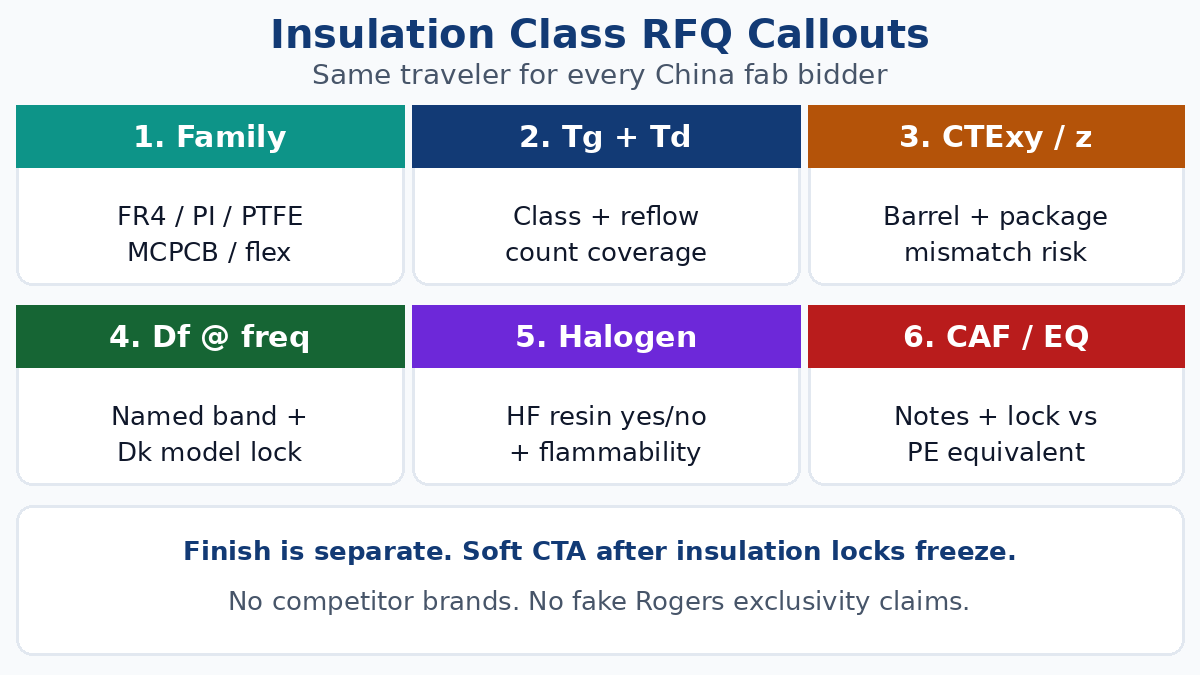
Export quotes diverge when insulation language stays soft (“FR4,” “HF material,” “flex OK”). Paste comparable locks so every bidder answers the same traveler. Attach stack notes with Manufacturing Files before “material TBD” quotes are treated as comparable.
- Dielectric family — FR4-family / high-Tg FR4-family / rigid polyimide / PTFE–low-loss / ceramic-class / metal-core dielectric / flex film — named, not “or equivalent” without PE rules.
- Tg class — numeric class on the traveler (e.g. Tg 150 / Tg 170 class as your lock). Route High Tg process questions to the product page; do not invent a stock boast.
- Td / reflow exposure — ask whether decomposition / thermal endurance covers your reflow count and rework plan.
- CTExy / CTEz — call out Z-axis risk on thick / high-layer / BGA boards; call out in-plane risk when packages or metal cores interact. Write as stackup risk, not a single pasted cell without context.
- Df (and Dk) at named frequency — for impedance or RF lots, lock modeled Dk / Df at the frequencies that matter, with coupon / test ownership when the program needs it. A single datasheet headline is not an RFQ lock.
- Halogen-free / flammability — yes/no halogen-free resin system and any UL 94 / flammability expectation your controlled document requires. Environmental program narrative stays on the environment sibling; here freeze the insulation line only.
- CAF notes — when fine pitch, humidity, or bias risk is real, ask for CAF-oriented resin / glass expectations and any lot evidence the program needs — without inventing XFPCB test counts.
- Lock vs PE-approved equivalent — either no substitute without signed EQ, or state who approves equivalents and which properties must match (Tg class, Dk/Df band, halogen status, flammability). Silent brand swaps refused.
- Finish / copper / mask remain separate fields — insulation family does not freeze ENIG thickness or mask type.
Do not paste competitor laminate brand ads or invent XFPCB warehouse SKUs, unit prices, or turnaround times. Generic family + property locks are enough for comparable RFQs; named brands belong only when your controlled document already specifies them. Confirm process fit against Technical Capabilities when the construction leaves commodity FR4-family.
Buyer mistakes that burn insulation awards
Conflating surface finish with dielectric insulation. Awarding ENIG does not lock Tg, Df, or prepreg style. Finish and insulation are separate traveler lines.
“FR4 or equivalent” with no Tg / Df / halogen gates. Two fabs quote different resin systems and still both claim FR4. Write class locks.
Treating high-Tg as a slogan. “High Tg” without a number and without reflow count is not comparable. Pair Tg class with process peaks.
PTFE / HF by brochure only. Loss budgets need Df at frequency and process notes — not a marketing adjective.
Rigid polyimide vs flex film confusion. One is a rigid laminate family; the other is a bend construction. Say which.
MCPCB awarded with FR4-only language. Metal-core dielectric thickness and CTE need their own callouts.
Ignoring CAF / humidity on fine-pitch bias boards. Insulation class without CAF notes is incomplete when the application warrants it.
Material TBD until after award. Soft insulation language reopens the stack post-PO. Freeze files and insulation locks before comparing dock dates.
Soft next step
Write what the dielectric must do (isolation, CAF / CTE risk, Dk / Df roles), pick the family that matches the job, then paste Tg / Td / CTExy·z / Df@freq / halogen-free / CAF / lock-vs-equivalent language so China fab quotes share one insulation traveler. Soft next step when the stack and insulation callouts are clear: send the RFQ through How to Place an Order with Manufacturing Files attached — after insulation class is written, not after an “or equivalent” slogan reopens Tg and Df post-award.