
China fab quotes do not move because a brochure listed “size, layers, and materials.” They move because named RFQ fields change process steps, panel waste, yield risk, and schedule priority. Buyers who compare only unit price often miss panel utilization, copper weight, via technology, mask and finish steps, impedance coupons, class and test depth, lead-time premiums, and the specials that force engineering exceptions. This factory buyer guide walks which fields actually shift a fabrication quote, how to read a line-item quote without inventing dollar tables, how prototype lots differ from volume, and how landed cost differs from bare unit price — without cloning a multilayer-only manufacturing deep dive or a general process primer.
What a China fab quote is actually pricing
A fabrication quote is a risk and process contract, not a catalog sticker. The shop prices copper and laminate consumption, imaging and etch cycles, drill and plate time, lamination presses, mask and finish chemistry, electrical test labor, coupon and microsection work when specified, and the calendar cost of pulling a lot ahead of the queue. Scrap probability sits inside the number even when no line says “yield adder.” Vague RFQs force the estimator to pad; complete RFQs let two shops price the same traveler.
Market explainers often stop at board size, layer count, thickness menus, quantity breaks, turnaround, “customizations,” shipping, and a laundry list of materials. Those topics matter. They are incomplete for overseas buyers who control the levers China CAM and estimating actually use. Size without panel nesting is only half the story. Layers without via type and copper weight understate sequential work. Materials without Tg, copper foil weight, and finish leave the estimator guessing. Shipping covered or not does not replace understanding what drives scrap and NRE before the board ever ships.
Treat every price as conditional on the files and notes you froze. Change copper from 1 oz to 2 oz after award and you did not “update a preference” — you changed etch and plate time. Add blind vias after the quote and you changed lamination cycles. The quote was never wrong; the contract changed.
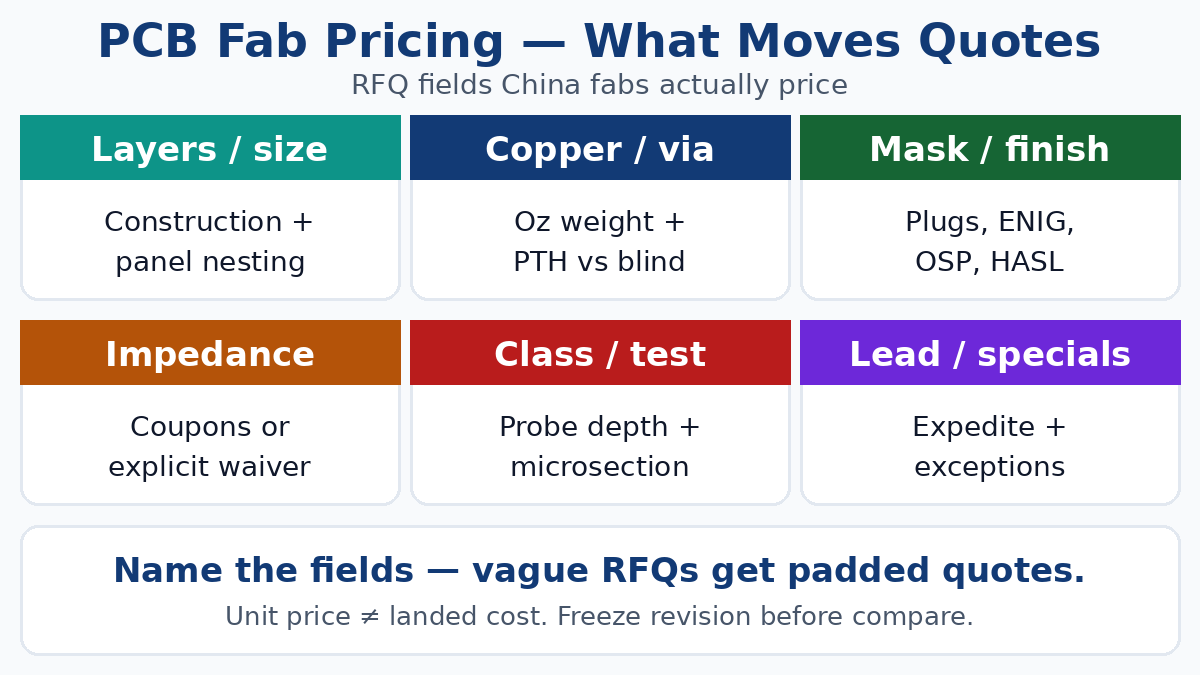
RFQ fields that move the quote (buyer-controlled levers)
Write these on the fab drawing or RFQ package so apples stay apples. Do not leave them as “TBD” and expect comparable numbers.
Layer count and construction. More layers mean more inner imaging, more dielectric and copper, thicker stacks to drill and plate, and more registration risk. Layer count is the headline — it is rarely the whole invoice. A stocked four- or six-layer through-hole menu usually prices differently from a custom hybrid stack with the same layer count. Call finished thickness and tolerance; odd thicknesses and thin cores change press and drill windows.
Board size and panel utilization. Outline area matters, but nesting on the working panel often matters more. Odd outlines, large keep-outs, rotated arrays, and boards that leave unused panel strips make you pay for copper and process you never ship. Early array talk (V-score, mouse bites, rail width) with the fab beats discovering utilization after tooling. Two boards with similar single-piece area can diverge sharply on panel yield.
Copper weight. Outer and inner ounce callouts change etch time, plating, and warpage risk when layers are unbalanced. Jumping from 1 oz to 2 oz or 3 oz on power layers is a real process adder, not a line-item cosmetic. Symmetry and copper balance are fab constraints; unbalanced heavy copper invites yield risk that estimators price even when they do not spell it out.
Via type and aspect ratio. Plated through-hole on a single press is the baseline for many rigid menus. Blind, buried, and laser microvias usually add sequential lamination, controlled-depth or laser drill, and extra registration. Aspect ratio limits still apply: thick stacks with tiny drills raise plate risk. Name which layers each via connects. “Blind/buried TBD” is how quotes diverge and how CAM later asks for a redesign after escape routing is frozen. Via technology often moves price as much as adding one casual signal layer — that multilayer process story is covered elsewhere; here the buyer takeaway is simply to name the via plan on day one.
Solder mask and legend. Standard LPI mask in common colors is baseline. Tight mask dams, plugged or tented via rules, selective mask opens, and exotic colors or finishes add setup and inspection. Silkscreen density rarely dominates cost, but white-on-black or double-sided legend still adds a pass. Call plugged vias when you need them; do not sprinkle “fill all vias” as insurance.
Surface finish. OSP, HASL/lead-free HASL, immersion silver, immersion tin, and ENIG are not interchangeable on cost, shelf life, or flatness. Selective finishes and hard gold fingers add process steps. Match finish to assembly plan and shelf life — not to a habit of always specifying the most expensive option “just in case.”
Impedance coupons. Controlled-impedance nets need target ohms, reference layers, geometry, and tolerance on the drawing. Coupon area, controlled etch, and measurement labor are not free. If you do not need impedance control, waive it explicitly so quotes stay comparable. Mixed language (“impedance if possible”) produces mixed quotes and CAM EQs.
Class and test depth. Continuity and isolation test method (flying probe vs fixture), sample plan, IPC class callouts, microsection, and first-article deliverables all show up as labor and scrap gates. Class 3 style acceptance and denser microsection sampling raise both direct cost and the yield bar the shop must hold. Incomplete electrical-test notes produce either padded quotes or weak acceptance after award.
Lead time. Expedite premiums buy queue position and overtime, not magic. Standard lead time on a frozen CAM package is usually the cheapest calendar option. Changing files mid-lot resets the clock and often the price.
Specials and exceptions. Non-standard materials (high-Tg, low-loss, metal-core, PTFE hybrids), edge plating, cavities, press-fit holes, deep back-drill, carbon ink, and tight bow/twist limits force engineering review. Each special is a process exception. Bundle known specials on the first RFQ; adding them after award is how NRE and scrap surprises appear.
Landed cost vs unit price
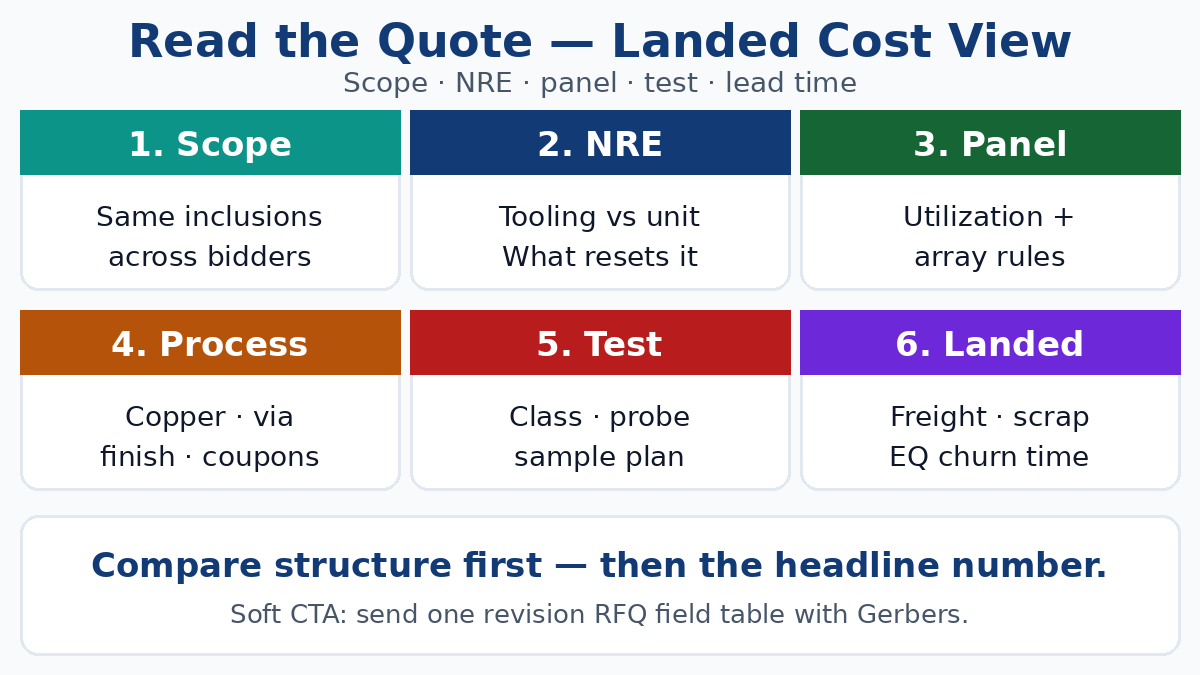
Unit price on a quote is what you pay per board or per panel at the factory gate under stated terms. Landed cost is what your program actually absorbs: fabrication, freight and duties where applicable, packaging and moisture protection, incoming inspection and scrap, rework from EQ churn, buffer stock while waiting on expedites, and the engineering time spent answering CAM questions that a clearer RFQ would have prevented.
A lower unit price with poor panelization, vague via notes, and “impedance TBD” can lose to a slightly higher unit price on a clean traveler. Expedite freight can erase a unit-price win on a small lot. Prototype scrap that forces a second spin dominates any line-item saving from an under-specified finish. Buyers who only rank quotes by unit dollars systematically underprice risk.
Ask for the same Incoterms and packaging assumptions across bidders when you compare. Separate tool/NRE and coupon setup from recurring unit price so volume math stays honest. Do not invent factory dollar tables — compare structure: what is included, what is optional, what changes if quantity or lead time moves.
What drives scrap and NRE (and how buyers accidentally raise both)
NRE and setup. CAM engineering, tooling (drills, rout, fixtures when used), coupon layout, and first-article documentation are front-loaded. Proto and pilot lots carry those fixed costs. Production lots amortize them — provided ECO churn does not reset CAM every week. Every unfrozen revision reopens engineering time.
Scrap drivers buyers control. Geometry outside the shop’s process capability class (trace/space, annular ring, aspect ratio) raises etch and plate scrap. Unbalanced copper and hybrid stacks without proven press recipes raise warpage and delamination risk. Impedance coupons that do not match the drawing create EQ loops and hold lots. Incomplete netlists and missing stackup notes delay electrical test and invite escapes that become customer returns. Panel arrays with fragile breakaways increase handling damage.
Silent cost raisers. “Same as last time” without a revision lock. Finish changes after stencil and paste windows were proven. Adding blind vias after placement. Waiving test on the RFQ then demanding Class-driven microsections at shipping. Each of these turns a clean estimate into scrap, overtime, or a requote.
Write capability class language the fab already runs. Freeze Gerbers or ODB++, drill, stackup notes, and fab drawing at one revision before asking for production pricing. Soft claims that “quality is free” do not survive a traveler with open EQs.
How to read a fabrication quote (without invented price tables)
Read structure before you read the headline number.
- Scope. Bare fab only, or fab plus extras (coupons, microsection, certificates of conformance wording, special packaging)? Same scope across bidders?
- Quantity breaks. Which quantities were priced? Does the unit price assume a panel quantity you cannot use?
- NRE / tooling. One-time vs recurring? Waived at what volume? What resets NRE (ECO, outline change, copper change)?
- Lead time. Standard vs expedite tiers; where the clock starts (after CAM freeze, after payment, after material in stock)?
- Material and stack. Commodity FR-4 assumptions vs your Tg / loss / copper callouts. Hybrid allowed or not?
- Via and finish. Explicit match to your notes, or house defaults that differ from the drawing?
- Test and class. Flying probe vs fixture; sample vs 100%; impedance measurement included or optional?
- Validity and exclusions. Quote expiry; exclusions for gold fingers, plugged vias, controlled impedance, or special materials.
When two quotes diverge widely, the usual cause is mismatched assumptions — not one shop “being expensive.” Ask both to price the same revision package with the same field table. Still avoid publishing or inventing fixed dollar menus; process and risk differ by lot.
Prototype vs volume — same fields, different math
Prototype / first article. Fixed CAM and coupon setup dominate. Unit price looks high because setup has nowhere to hide. Speed premiums are common. Yield risk is priced conservatively when the stack and via plan are new to that line. Paying for clear impedance and test notes here often saves a respins later.
Pilot / pre-production. Some NRE already sunk. Panelization and array rules should freeze. ECO discipline starts to matter more than shaving finish cost.
Volume production. Recurring process cost and panel utilization dominate. Fixture test may beat flying probe above a crossover the shop can show. Material buys and schedule slots stabilize — until an ECO resets the traveler. The cheapest production quote is usually the one with frozen files, realistic lead time, and no “TBD” specials.
Do not force production unit-price expectations onto a five-piece lot with sequential blind vias and tight impedance. Do not keep prototype coverage forever on a high-runner without saying so — sample plans and test methods should be written so production pricing does not silently inherit NPI depth.
Soft next step
Start from the product constraints and the RFQ field table, not from a brochure checklist of size and materials alone. Name layers and construction, outline and array for panel utilization, copper weights, via types and connecting layers, mask and finish, impedance targets or an explicit waiver, class and test method, lead-time tier, and every known special — at one file revision. Compare quotes on scope, NRE structure, and landed-cost assumptions, not on unit price in isolation.
When those fields are clear, a China fab can price process steps and yield risk instead of padding unknowns. Share the fab notes and volume band early, freeze ECO churn once CAM is locked, and treat the quote as a manufacturing contract you can audit — not as a sticker you hope stays valid after the design moves.