
PCB assembly RFQs that chase “AI-ready,” “dissolvable,” or “next-gen HDI” slogans still ship lots with soft inspection stages, silent laminate substitutions, and no named process window for the density or signal class the product actually needs. The failure is rarely that China export houses cannot place parts or drill microvias. It is that brochure landscape articles mix market growth, e-waste headlines, and partner CTAs without translating recent assembly-era tech into buyer pressure tests. Competitor industry write-ups often open with global market dollars, e-waste tonnage, and named dissolvable-substrate demos; treat those figures and brand stories as outside industry talk, not XFPCB factory facts. This page owns a different frame: a buyer guide to assembly-era tech choices buyers have had to pressure-test in recent years — AI-assisted process and inspection expectations, HDI / rigid-flex / high-speed materials RFQ implications, dissolvable and sustainable claims (real vs press-release), and China fab readiness questions. Soft CTA only. Evergreen voice — not stuck on a calendar-year hype cycle. Sibling XFPCB posts already cover broader future trends, AI-server / data-center hardware depth, and automotive harsh-environment fab/assy locks — do not merge those angles. Queued Batch5 supply-chain / environment / stats URLs stay separate. No invented XFPCB AI production lines or equipment brands; no invented global market $ / CAGR / e-waste tonnes as XFPCB facts.
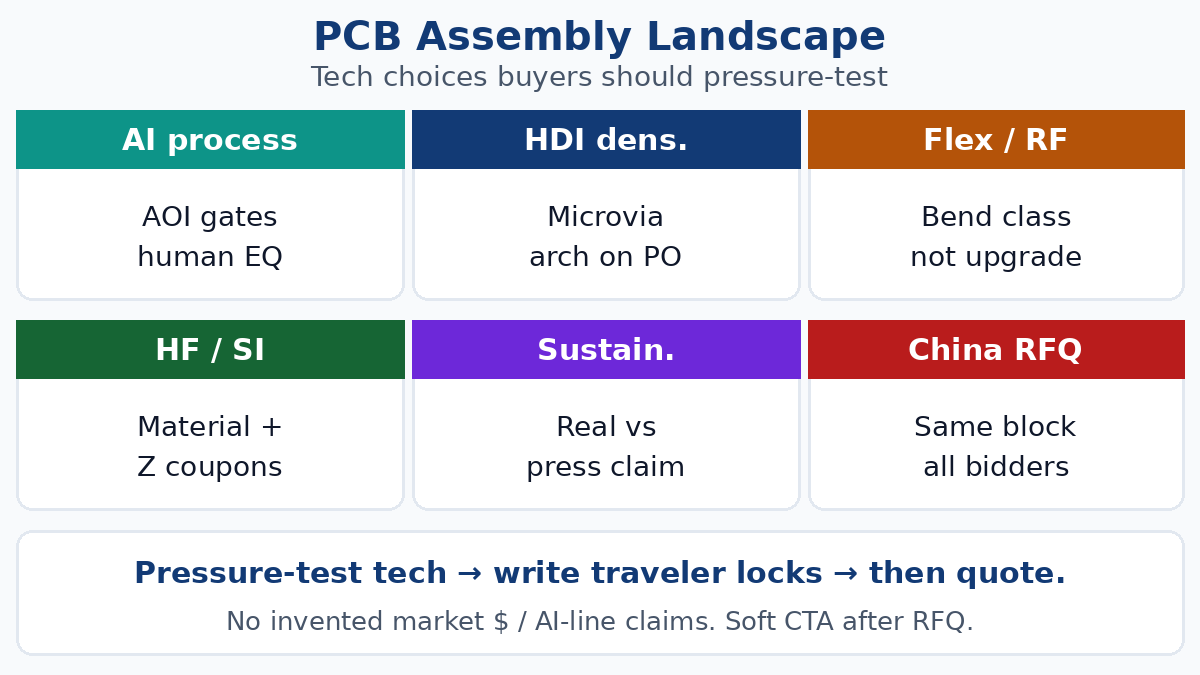
What “assembly landscape” should mean for buyers
“Landscape” on a marketing blog usually means demand narratives: AI racks, 5G handsets, EV modules, medical wearables. Buyers already know demand is fragmented. What changes quote quality is whether the RFQ forces process-era choices the traveler will actually see:
- Process and inspection expectations — what “AI-assisted AOI / SPC” is allowed to mean on a PO versus brochure language.
- Construction class — when density, bend, or multi-GHz nets force HDI, flex / rigid-flex, or low-loss stacks instead of soft FR-4 defaults.
- Sustainability claims — when dissolvable or recycled-substrate language is a pilot SKU versus a drop-in for long-life power electronics.
- China readiness — which questions make export quotes comparable without inventing plant certificates or machine lists.
Broader trend storytelling lives on XFPCB’s future-trends overview. AI accelerator board depth lives on dedicated AI-server / high-speed data-center posts. Automotive environment → fab/assy locks live on the automotive PCB page. This guide stays on what to write into fab/PCBA RFQs when those headlines hit the sourcing desk.
AI-assisted process and inspection — expectations, not equipment theater
Vendors increasingly say AI helps placement programming, SPI/AOI triage, predictive maintenance, and yield dashboards. For buyers, the useful question is not “do you have AI?” It is which human-owned gates still appear on the traveler, and what the model is allowed to change without EQ.
Pressure-test language that belongs on the RFQ:
- AOI stage and coverage — post-reflow optical after SMT PCB Assembly; state 100% vs sample, and whether false-call review is human-gated.
- Hidden-joint proof — X-ray sample plan for BGA / QFN / LGA when the package hides fillets SPI cannot see.
- Electrical / functional owner — bare-board electrical test plus flying probe, ICT, or functional script ownership when nets demand it — prefer named stages on PCB board testing and inspection over “smart QA included.”
- Change control — AI or SPC suggestions that alter paste volume, oven profile, or accept criteria require signed EQ; models do not silently redefine Class acceptance.
- Data retention — which images / fail codes ship with the lot CoC when field returns start.
Human expertise still owns feeder setup, unusual defect triage, first-article disposition, and customer EQ. Treat “lights-out” and “AI dominance” phrases as capability conversation starters, not proof that inspection coverage is locked. This guide does not invent XFPCB AI lines, camera brands, or ML model claims — ask suppliers for current site process sheets, then still write stages on the PO.
HDI density — RFQ implications, not brochure layer counts
High-density interconnect solves real packaging problems: finer pitch BGAs, shorter stubs, more routing in less area. It also multiplies registration, microvia, and stackup risk. Soft “HDI capable” on a China quote without architecture language inherits the house’s cheapest via recipe.
When density (not marketing) drives the build, name HDI PCB needs on the drawing:
- Microvia type (laser / stacked / staggered) and which layers they connect.
- Minimum trace / space and finished hole / pad sizes the design actually uses — not the fab marketing max.
- Any sequential lamination cycles and impedance coupons that must survive those cycles.
- First-article cross-section or coupon expectations when microvia reliability is in scope.
Do not merge full HDI stackup essays into this page — dedicated HDI DFM posts own that depth. Here the buyer lock is simple: architecture on the PO, or the quote is not comparable to a true HDI traveler.
Flex and rigid-flex — packaging choice, not a free upgrade
Flexible and rigid-flex constructions reduce connectors and fit irregular housings. They also change coverlay, bend rules, stiffener, and assembly fixturing. Flexible PCB and Rigid-Flex PCB earn their keep when bend or connector count is the failure mode — not when a flat consumer UI board wants a premium label.
Buyer discipline for assembly-era RFQs:
- Static (install) bend vs dynamic life-cycle bend — write which you have; copper type and coverlay follow.
- Rigid islands for dense SMT or controlled impedance; flex necks replace cables — do not force flex on every “compact” sketch.
- Stiffener, coverlay openings, and ZIF/FFC tails are product locks — deep bend-life essays stay on dedicated flex posts.
Assembly houses need fixture and handling notes early; a rigid-flex panel that survives fab can still fail at SMT if carriers and support are undefined. Call those notes on the PCBA RFQ, not only the bare-board fab quote.
High-speed / high-frequency materials — impedance and loss on the traveler
Multi-gigabit and RF paths punish soft FR-4 assumptions. Low-loss laminates, hybrid stacks, and controlled dielectric thickness affect loss, skew, and cost. Buyers should choose materials from electrical requirements, not from “AI hardware” branding.
RFQ language that stays honest:
- Call High Frequency PCB materials by family or datasheet when the netlist needs them — “low loss” without a Dk/Df or approved-vendor list is soft.
- Require Impedance Control PCB coupons and tolerance on the nets that matter; state single-ended vs differential targets.
- Lock finish, copper roughness class, and stack table revision so CAM cannot silently swap to house FR-4 for schedule.
- Keep SI depth on dedicated high-speed / AI-server posts; this page only forces material + coupon locks when the assembly landscape headline is “high-speed ready.”
Dissolvable and sustainable claims — real vs press-release
Interest in recyclable, bio-based, or water-soluble substrates is real for short-lifecycle, low-power, or disposable electronics. Press releases and demo-board counts do not make those substrates a universal FR-4 replacement. Competitor articles often cite e-waste tonnage and named dissolvable brands; do not copy those figures or brand names into XFPCB copy as factory facts. Prefer qualitative risk language:
What can be real for the right SKU
- Pilot or NPI builds on specialty substrates where end-of-life recovery matters more than decades of thermal cycling.
- Clear process notes: max temperature, humidity, mechanical load, and whether the substrate survives standard reflow / wash.
- Separate BOM and traveler from long-life power, automotive under-hood, or high-rel industrial product lines.
**What stays press-release until proven on your traveler**
- Drop-in claims for high-power, high-temperature, mechanically demanding, or long-service products.
- Carbon or plastic “savings per square meter” quoted without a program LCA and without naming the baseline stack you actually buy.
- “Sustainable assembly” slogans that never state solder alloy, coat chemistry, or scrap disposition.
Buyer pressure test: ask for material datasheet, qualified process window, and which product classes the house refuses. If answers are demos-only, keep the claim on a marketing pilot — not on the production PO for the revenue SKU.
China fab and PCBA readiness questions that make quotes comparable
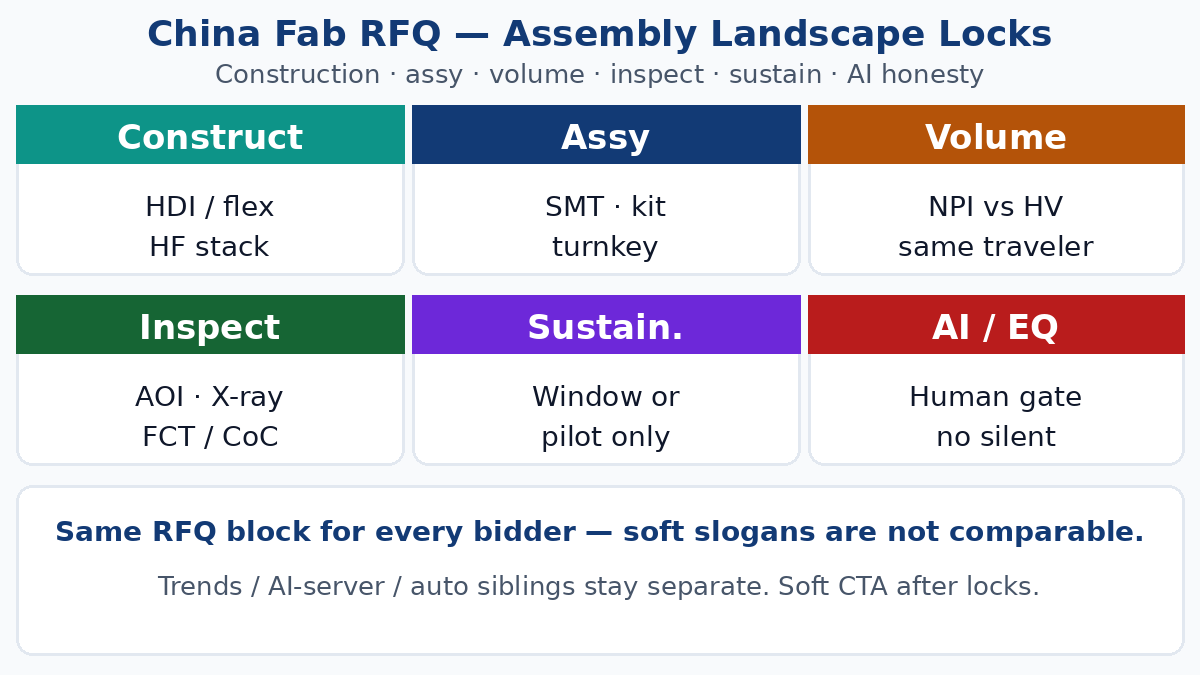
Export houses vary widely in HDI registration discipline, flex fixturing, low-loss stock, and inspection automation. Readiness is not a vibe. Paste the same block so every bidder prices the same traveler:
- Construction class — rigid / HDI architecture / flex / rigid-flex / high-frequency material callouts with stack table revision.
- Assembly scope — SMT-only vs mixed technology; Turnkey PCB Assembly vs consigned kits; authorized sources and no silent substitution on critical parts.
- Volume path — prototype vs High Volume PCB Assembly assumptions (panelization, SMT program reuse, sample vs 100% AOI) so NPI and mass quotes do not hide different travelers.
- Inspection gates — AOI stage/coverage; X-ray sample for hidden packages; electrical/functional owner; lot CoC fields — again prefer PCB board testing and inspection language over machine brand lists.
- Sustainability honesty — specialty substrate yes/no, qualified window, and which SKUs are excluded; no invented e-waste maths on the quote.
- AI / automation honesty — which inspection stages are automated, which reviews stay human, and EQ rules when SPC suggests profile changes. No invented XFPCB AI equipment claims in this guide — verify on the supplier’s current site docs.
- Change control — no silent laminate, finish, via architecture, or test downgrade without signed EQ; mixed-revision ship prohibited.
- Files — Gerbers/ODB++, stack table, fab notes, BOM, CPL, and process notes on one revision so fab and assy do not diverge.
How this differs from sibling XFPCB pages
- Future printed-circuit-board trends owns the broader trends overview — pair for context; do not clone market-narrative breadth here.
- AI-server PCB / 800G data-center posts own hardware and SI depth for accelerators and optics — leave rack-level storytelling there.
- Automotive PCB owns harsh environment → fab/assy locks and automotive China RFQ checklist — leave vibration / load-dump depth there.
- Dedicated HDI / flex / high-frequency DFM posts own stackup and bend-life essays — this page only forces RFQ architecture language.
- Queued Batch5 supply-chain / environment / 25-stats URLs (if published later) own logistics, ESG scorecards, and statistic roundups — do not merge those angles into this assembly-era buyer guide.
- Role-of-AOI and testing-method blogs own inspection pedagogy — cite service testing pages when locking gates; zero forced blog-to-blog.
Soft next step
Map the product’s real needs — density, bend, signal class, lifecycle, and inspection risk — to construction and traveler language, then paste the readiness block so every China fab/PCBA bidder prices the same process window. Soft next step when Gerbers, stack notes, BOM/CPL, and named gates are frozen: route the award through your normal path via How to Place an Order — after tech choices are pressure-tested, not after a landscape brochure reopens laminate and AOI coverage post-PO.