
Lead-free reflow raised the thermal bar on glass-epoxy boards. Many RFQs still answer with “high-Tg FR-4, lead-free OK, HF capable” — three slogans that do not lock Tg against actual peak profiles, do not say whether datasheet Dk/Df was measured at your band, and do not decide when FR-4-family loss stops being enough. This page owns that buyer frame: lead-free soldering temperature vs FR-4 Tg/Td, when “HF FR-4” marketing is enough vs when true low-loss laminates are required, impedance and stack honesty, and China fab RFQ locks. Soft CTA only. Sibling XFPCB lanes already cover material-family selection gates, laminate vs prepreg vs bondply stack grammar, and insulating-materials callouts — name those lanes in prose; do not clone them. Process depth for microwave builds sits on the High Frequency product page. No competitor brands. No invented XFPCB warehouse grade lists or lab Dk tables.
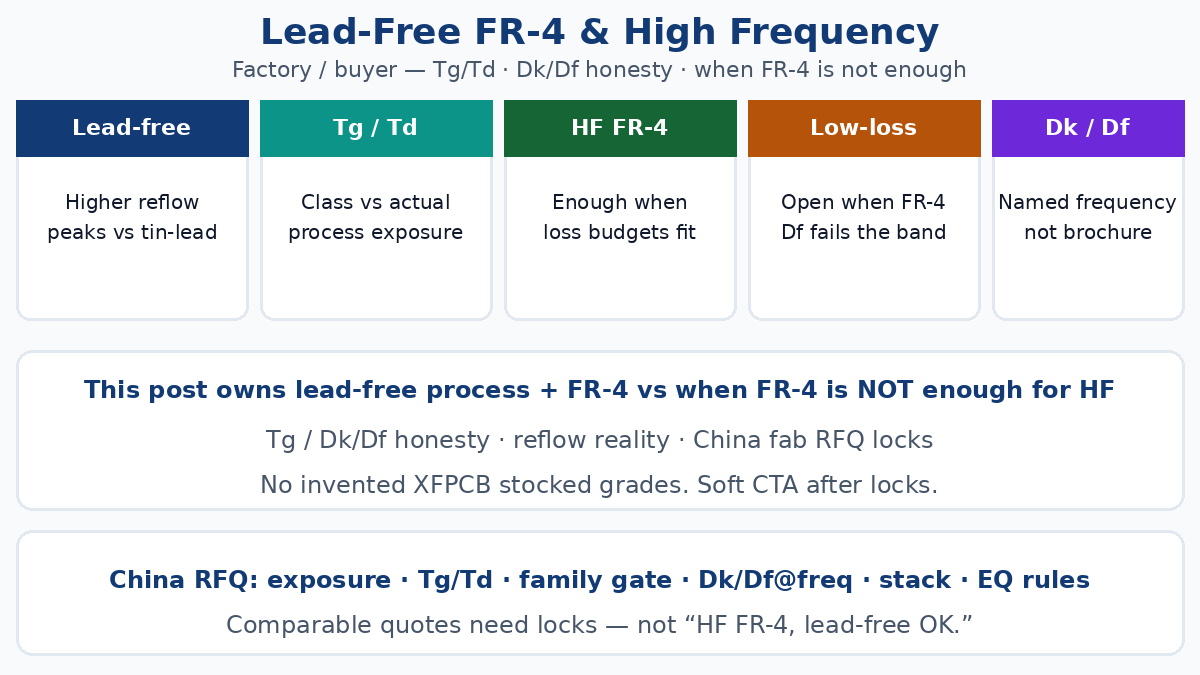
Lead-free reflow vs FR-4 Tg and Td
Lead-free solder alloys (SAC-class and peers) typically need higher peak reflow temperatures and often more thermal exposure than older tin-lead profiles. The laminate must survive that heat-time without delamination, measling, or irreversible resin damage — and still hold dimensional control through multiple passes if the assembly plan includes rework or double-sided SMT.
Tg (glass transition). Below Tg the resin system behaves as a rigid solid for most fab and assembly planning; above Tg it softens and Z-axis expansion rises. Buyer practice: size operating peaks and process peaks against a written Tg class on the traveler (common FR-4-family bands such as ~130 °C, ~150 °C, ~170 °C+). “High Tg” without a number is not a lock. Lead-free alone does not magically select Tg 170 — write the profile count and peaks you actually see.
Td (decomposition). Td marks irreversible resin mass loss under enough heat-time. Buyers care when multiple reflow passes, selective solder, or rework stack. Ask whether the quoted FR-4-family system’s thermal endurance covers your exposure plan — not whether a brochure says “lead-free compatible.”
What Tg/Td do not buy. They do not freeze Dk/Df at 5 GHz, impedance coupons, CAF immunity, or a free upgrade from FR-4-family glass-epoxy to PTFE / ceramic-filled low-loss systems. Thermal survival and electrical loss are separate traveler lines.
Resin curing chemistry (legacy DICY vs phenolic / modified systems used for lead-free thermal robustness) can shift dielectric loss at GHz. You do not need a materials-science lecture on the RFQ — you need honesty: if the fab substitutes a lead-free-compatible FR-4 with a different resin system, Dk/Df and press behavior can move even when the Tg class label looks the same. Lock properties, not a nickname.
When “HF FR-4” marketing is enough
Not every multi-gigabit or RF-adjacent board needs specialty laminate. FR-4-family (including lead-free, high-Tg grades) remains the right cost and availability choice when:
- Channel length and edge rates keep insertion-loss budgets inside what FR-4-family Df can hold at your frequencies
- Impedance targets are achievable with documented stack thickness, glass style, and a modeled Dk the fab will actually press to
- Lead-free reflow peaks fit the written Tg/Td class without heroic process exceptions
- The design is mixed-signal / digital with GHz content that is real but not microwave front-end critical
In that band, buyer work is still hard — but it is honesty work, not family upgrade work: freeze Tg class for reflow, freeze Dk/Df modeling frequency for impedance, freeze stack notes, and refuse silent “FR4 or equivalent” swaps that change resin system mid-lot.
For ordinary multilayer rigid builds under PCB Manufacturing menus, lead-free high-Tg FR-4-family is often the default China export answer. Default is fine when the loss and thermal gates fit. Default is a failure mode when RFQ language never tested those gates.
When FR-4-family is not enough for high frequency
Open a true low-loss / PTFE / ceramic-filled / hybrid conversation when any of these are real on the program — not when a marketing page prefers a brand adjective:
- Insertion loss or eye / phase budgets fail on FR-4-family at named frequencies after honest stack modeling
- Dk stability vs frequency and temperature is part of the channel budget (filters, matched RF paths, tight skew)
- Hybrid stack (FR-4-family digital layers + low-loss RF layers) is already the electrical plan
- Copper roughness, glass weave, and resin content effects dominate at your band and commodity FR-4 process windows cannot hold the tolerance
That gate belongs on High Frequency PCB process ownership: material family, drill/plate/bond deltas, impedance and inspection notes — not a blog slogan that “HF FR-4 equals specialty low-loss.” Do not invent XFPCB stocked grade menus here. Write the family and property gates; let DFM confirm process fit against the files you send.
Buyer failure mode: awarding “HF FR-4 lead-free” because the datasheet showed a friendly Df at 1 GHz, then discovering the channel is 6–10 GHz with a loss budget written for a different resin system. Frequency on the datasheet headline must match frequency on the channel — or the number is decoration.
Dk / Df honesty for impedance and stack notes
Dielectric constant (Dk) sets impedance geometry and delay. Dissipation factor (Df / loss tangent) dominates dielectric loss as frequency rises. Lead-free FR-4 marketing often quotes a single Dk/Df pair without test method, resin content, glass style, or frequency. That pair is not an RFQ lock.
For controlled-impedance work, pair dielectric honesty with Impedance Control PCB process ownership:
- Modeled Dk at the frequency the fab uses for the stack calculator — and the pressed thickness / glass style assumed
- Df at named frequencies when loss matters; one 1 MHz or 1 GHz brochure number is not enough for multi-GHz channels
- Coupon / test ownership when the program needs measured impedance evidence, not only CAM estimates
- Stack note that freezes core/prepreg intent, copper weights, and overall thickness — the same grammar multilayers already need under a Multilayer PCB Guide conversation
Resin content and glass weave change effective Dk even inside one “FR-4” family. Pressed reality beats datasheet headline. Ask bidders to acknowledge the stack note and the modeling frequency — not to paste a generic “Dk 4.5” into the quote email.
What electrical honesty does not buy: automatic CAF immunity, free HDI microvia process windows, or a silent upgrade to PTFE. Family upgrades are priced and scheduled as process changes; write them explicitly.
China fab RFQ locks for lead-free + HF decisions
Export quotes diverge when material language stays soft (“lead-free FR-4,” “HF capable,” “or equivalent”). Paste comparable locks so every bidder answers the same traveler. Attach stack notes and Gerbers/ODB++ with Manufacturing Files before “material TBD” quotes are treated as comparable.
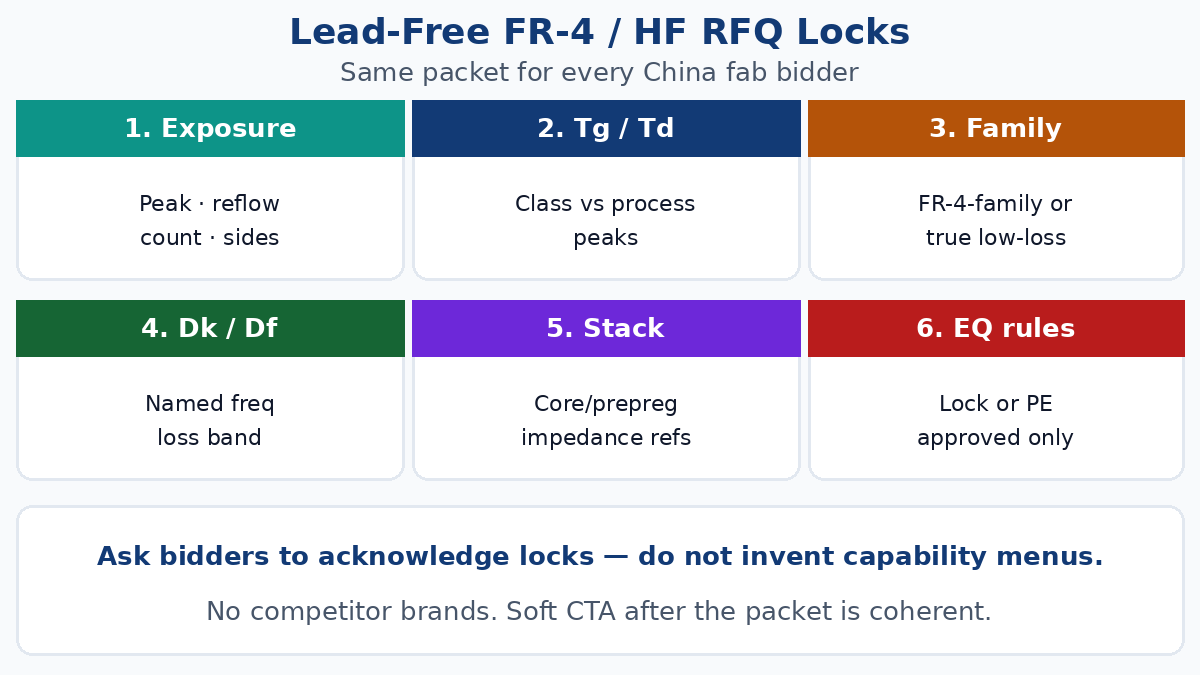
- Lead-free process exposure — peak temperature intent, approximate reflow / rework count, and whether assembly is single- or double-sided SMT. Do not assume the fab knows your oven recipe; state the exposure class the laminate must survive.
- Tg class — numeric class on the traveler (e.g. Tg 150 / Tg 170 class as your lock). Pair with process peaks; do not invent a stock boast.
- Td / thermal endurance note — ask compatibility with your reflow count when multi-pass or rework is planned.
- Dielectric family gate — FR-4-family lead-free high-Tg or true low-loss / PTFE / hybrid — named. “HF FR-4” alone is ambiguous; say whether FR-4-family is accepted or refused for RF layers.
- Dk / Df at named frequency — modeling frequency for impedance; Df band if loss budgets exist. Refuse single-headline-only answers when the channel is multi-GHz.
- Stackup note — layer count, core/prepreg intent, copper weights, thickness target, impedance reference layers. Multilayer stack grammar stays on the multilayer product conversation already linked above.
- Lock vs PE-approved equivalent — either no substitute without signed EQ, or state who approves equivalents and which properties must match (Tg class, Dk/Df band, halogen / flammability, lead-free thermal class). Silent resin-system swaps refused.
- Finish / copper / mask — separate fields. Material family does not freeze ENIG thickness or mask type.
- No silent downgrade — Tg class, FR-4 vs low-loss family, or hybrid RF layer changes need EQ before build.
Do not paste competitor laminate brand ads or invent XFPCB warehouse SKUs, unit prices, or turnaround times. Generic FR-4-family vs low-loss family language plus property locks is enough for comparable RFQs; named brands belong only when your controlled document already specifies them.
Selecting PCB materials already owns cross-family buyer gates. Laminates and adhesive sheets own core vs prepreg vs bondply roles. PCB insulating materials own dielectric isolation / CAF / CTE callout grammar. This post stays on lead-free thermal reality + FR-4 vs when FR-4 is not enough for HF — link those sibling topics in prose; do not href blog-to-blog.
Buyer mistakes that burn lead-free HF awards
“Lead-free OK” with no Tg class or reflow count. Thermal survival is a number problem, not a checkbox.
Treating high-Tg as automatic low-loss. Tg and Df are different axes. A Tg 170 FR-4 can still lose too much at 8 GHz.
Datasheet Df at the wrong frequency. Lock the band you ship, not the flattest marketing curve.
“HF FR-4” when the channel already needs PTFE / hybrid. Family upgrade must be written; slogan awards create yield and schedule shock.
Impedance without stack + modeling frequency. CAM cannot honor a slogan Dk.
Silent equivalents after award. Resin system changes under the same “FR-4” label reopen both thermal and electrical gates.
Material TBD until dock date pressure. Soft language makes two quotes incomparable and reopens the stack post-PO.
Soft next step
Write lead-free exposure against Tg/Td, decide honestly whether FR-4-family Df holds at your frequencies or whether a true low-loss / hybrid gate must open, then paste Dk/Df@freq, stack, and lock-vs-equivalent language so China fab quotes share one traveler. Soft next step when thermal and electrical gates are clear: send the RFQ through How to Place an Order with Manufacturing Files attached — after Tg class and family gates are written, not after an “HF FR-4 lead-free” slogan reopens loss and reflow reality post-award.