
Marketing pages often define “large-scale PCB manufacturing” with a brochure checklist: same-day or 24-hour turns, six-figure unit capability, SMT lines, AOI and X-ray, global sourcing, then a soft CTA. Those capability themes are real selection filters. They are incomplete for a buyer who must qualify a high-volume China fab on how panels nest, when a revision locks, how capacity is reserved, how first article becomes a ramp, which AOI and functional tests stay at 100% versus sample, and how logistics buffers and dual-source actually work — without inventing plant unit counts or dollar menus. This factory buyer guide is written from a Shenzhen China fab perspective for overseas buyers: what “large scale / high volume” means in fab practice, which RFQ questions open honest volume pricing, and which quality gates must not disappear when quantity rises.
What “large scale” means in fab practice (not a brochure)
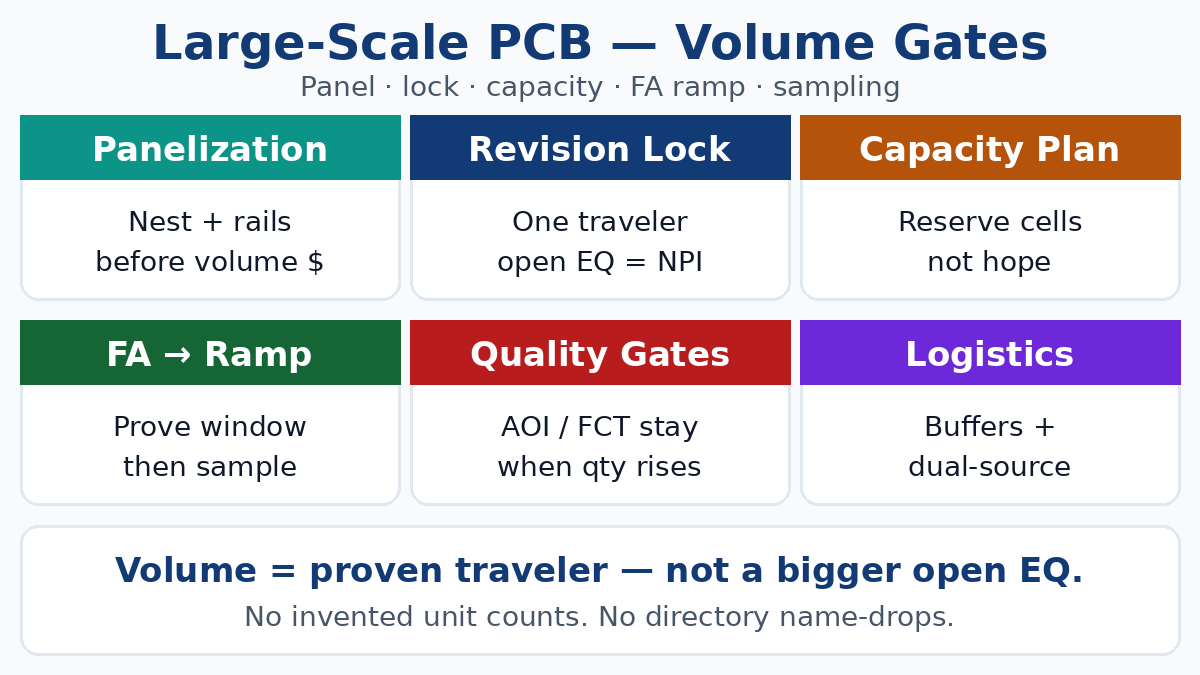
In day-to-day fab language, large scale is less a single unit-count trophy and more a repeatable traveler at production rhythm. That usually implies:
- Stable panelization. Boards nest on a working panel with defined rails, scoring or tab-route, and copper/process utilization that the shop can run every week without redesigning the array.
- A locked revision. Gerber/ODB++, stackup notes, finish, class/test depth, and fab drawing freeze under one revision ID. Volume pricing assumes that freeze. Open EQs are NPI work dressed as production.
- Capacity planning, not hope. The shop can say which press, drill, plate, and mask windows can absorb your lot size on a stated calendar — and what happens if a second OEM lot lands the same week.
- A first-article → ramp path. FA or pilot lots prove process windows; production lots inherit those windows with sampling plans that still catch drift.
- Logistics that match dock dates. Freight mode, Incoterms, carton moisture protection, and buffer stock are part of volume delivery — not an afterthought once the gate stamp is dry.
Brochure numbers (rush hours, headline unit capacity, equipment lists) matter as existence proofs. They do not replace asking how your stack, via plan, and finish behave when quantity moves from dozens to thousands. Two shops that both claim “high volume” can diverge sharply on panel yield, ECO discipline, and whether Class-driven microsections stay on the traveler after the pilot.
Geography slogans and capability lists belong in other guides. Here the question is narrower: can this fab run your frozen design at production cadence without silently dropping quality gates or inventing capacity that does not exist on the floor calendar.
When volume pricing actually opens
Volume pricing opens when fixed work has somewhere to amortize and recurring process dominates. In practice that means:
Revision lock. CAM has priced one traveler. If you still change copper weight, via type, mask color, or impedance notes every week, you are buying NPI engineering repeatedly — the unit number will look like a proto even at higher quantity.
Known panel rules. Array orientation, breakaway method, and keep-outs are agreed. Odd outlines that waste panel strips keep unit cost high no matter how many pieces you order. Early array talk with the fab beats discovering utilization after tooling.
Quantity and call-off clarity. Estimators need a production quantity (or a call-off schedule with a planning horizon), not “maybe 50k later.” Soft forecasts without a purchase commitment usually get soft quotes. Honest volume RFQs state lot sizes, ship windows, and whether partial releases are allowed.
Material and finish already on the menu. Stocked FR-4, common finishes, and published via menus price faster than hybrid stacks and specials that need engineering exceptions on every lot. Specials can still run at volume — they just need explicit process ownership, not “same as last time” folklore.
Test depth stated once. Flying probe vs fixture, sample vs 100% electrical, AOI coverage, X-ray on BGAs, FCT sample rate — all written on the RFQ. Changing test depth after award is a scope change, not a free upgrade.
Do not expect production unit economics on a five-piece sequential-via spin with open stackup notes. Do not keep full NPI microsection depth forever without saying so — and do not waive it silently when the product still needs it. Volume pricing is a contract on a frozen scope, not a discount code tied to a round number.
RFQ questions that qualify a China volume fab
Use these as buyer questions. Compare answers on the same field table across bidders.
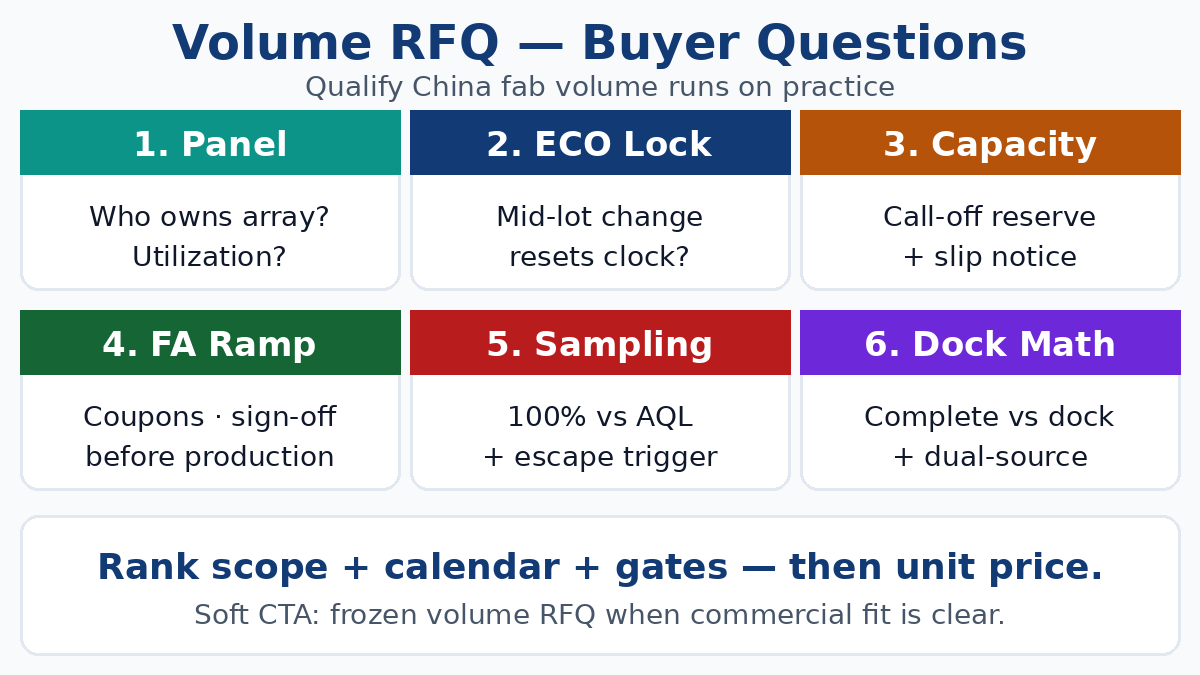
- Panelization ownership. Who designs the array — buyer or fab? What rail width, V-score or mouse-bite rules, and copper thieving assumptions will you freeze? Ask for a panel utilization estimate on this outline, not a generic claim.
- Revision and ECO rules. How does the shop treat a mid-lot ECO? Does the clock and price reset? Who is the single revision owner on your side and theirs?
- Capacity reservation. Can they reserve press/drill capacity against a call-off schedule? What lead time applies if you pull an extra lot forward? What is the cancellation or deferral rule if demand softens?
- First-article / pilot plan. How many FA boards, which coupons, which microsections, and what sign-off freezes the process window before ramp? Who owns FA failures — design vs process?
- AOI, electrical, X-ray, FCT sampling. What runs at 100% on every production lot, and what drops to AQL or periodic sample after FA proves stable? Write the sample plan on the PO traveler language, not in a sales email.
- Material lot control. Can laminate, foil, and finish chemistry lot codes be traced per ship lot? Do you need same-lot laminate across a multi-week call-off?
- Logistics buffers. Production-complete date vs deliver-to-dock under stated Incoterms. Recommended buffer days for express vs economy air. Packaging and moisture protection for volume cartons.
- Dual-source readiness. If you keep a second fab, will both shops price the same frozen revision with the same stack, finish, and test depth? Dual-source is capacity insurance — not a way to skip locked notes.
Ask for structure: NRE/setup vs recurring unit, what is included in electrical test, what is optional, what changes if quantity or lead time moves. Do not invent XFPCB unit-count ceilings or dollar tables — process risk and break structure differ by lot and stack. Rank shops on scope match and calendar honesty first.
Quality gates that must stay when quantity rises
The common failure mode on volume awards is silent gate erosion: FA ran tight sampling; production quietly switches to “visual only” because the lot is large and the calendar is tight. Buyers who only celebrated a unit-price win discover escapes at SMT or in the field.
Gates that usually must stay — or be reduced only with a written sample plan:
- Electrical continuity/isolation at the method you bought (flying probe or fixture). Sample rates can change after process prove-out; “none” is a different product.
- AOI coverage on SMT assemblies (and on fab features where the shop offers it). Recipe libraries matter more at volume; non-stock mask colors and dense BGAs need golden-sample tuning before you cut sample rates.
- X-ray on hidden joints (BGA, QFN where specified) — either 100% on critical assemblies or a documented sample with escalation on fails.
- Functional circuit test (FCT) where the product needs it. Volume does not make firmware and connector seating self-proving. Decide sample vs 100% against escape cost, not against brochure throughput.
- Coupon and microsection depth tied to class and impedance. Production may thin the cadence versus FA, but the acceptance criteria on the drawing should not vanish without an ECO.
- FQC and packaging rules for volume cartons: bake/dry pack when required, humidity indicators, shock labels, and count reconciliation. Large lots amplify packing damage if rails and trays were designed only for proto hand-carry.
Write which gates are non-negotiable on the RFQ. Then ask the fab which gates they propose to sample after N lots of zero criticals. That conversation is volume maturity — not distrust.
First article → ramp without drama
A clean ramp looks boring on a spreadsheet:
- Freeze files and fab notes under one revision.
- Run FA / pilot with agreed coupons, microsections, and (for PCBA) AOI/X-ray/FCT depth.
- Close EQs and lock process parameters that matter (drill recipes, plate windows, mask, finish dwell, reflow profile if assembled).
- Release production with a written sample plan and a trigger to return to 100% if yield or customer escapes move.
- Hold ECO discipline — batch changes into planned spins; do not drip copper and via edits into weekly live lots.
Ramps fail when FA is skipped, when FA is treated as “extra proto boards” without coupons, or when production starts on a different revision than FA proved. They also fail when capacity was never reserved and your “volume lot” waits behind three other OEMs with firmer call-offs. Ask for the capacity story before you celebrate the unit price.
Logistics buffers and dual-source (volume reality)
High volume does not delete oceans, customs, or weekend gate times. Build calendar buffers into the plan: production complete, freight transit, customs where applicable, and incoming inspection before SMT. Expedite freight can recover a late lot; it cannot recover a revision that was never locked.
Dual-source for volume programs works when:
- Both fabs price the same revision and notes.
- AVL and IP/NDA gates are equal.
- You accept that “identical” boards still need incoming correlation (impedance coupons, finish thickness, mask registration) until both travelers are proven.
- You do not use dual-source to route controlled or domestic-only work overseas.
Capacity buffers matter as much as freight buffers. A volume fab that wins your RFQ may still share presses and drill cells with other OEMs. Ask what share of the cell calendar your call-off occupies, whether overtime is priced into expedite, and how they communicate a slipped lot before your SMT line starves. Buyers who only track unit price discover capacity risk as a dock-date surprise.
Sampling plans should name the escape trigger, not only the happy-path AQL. Example language buyers use: after three consecutive production lots with zero critical AOI/electrical failures, electrical may move from 100% to a stated sample — and return to 100% for the next N lots if yield drops or a customer escape appears. Without a trigger, “sample” becomes a permanent erosion. Write the same logic for X-ray and FCT when those gates matter to the product.
Soft CTA for buyers whose commercial programs fit a China volume fab: send a frozen package with panel intent, quantity/call-off, test depth, and FA→ramp language. XFPCB fabricates and assembles to the traveler you freeze within stated capability — we do not invent USA plant claims or fake six-figure capacity trophies in this guide. Compare dock dates and quality gates, then unit price.
Buyer checklist before you call it “volume ready”
- Is the revision locked? One ID for Gerbers/ODB++, stack, finish, class/test.
- Is panelization agreed? Utilization and breakaway method written down.
- Is capacity reserved or at least calendar-honest? Lead time with clock start after CAM freeze.
- Is FA→ramp defined? Coupons, sign-off, and sample-plan triggers.
- Which inspection/test stays at 100%? AOI, electrical, X-ray, FCT — named.
- Are logistics buffers and Incoterms on the RFQ? Production complete vs dock date.
- If dual-source, is the second shop on the same freeze? Same notes, same gates.
If those answers are vague, you are still in NPI — regardless of how large the quantity field looks on the RFQ form. Large-scale manufacturing is disciplined repetition of a proven traveler, not a bigger number on an open EQ package.