
China fab RFQs that only say “FR-4 multilayer” still leave PE guessing which layers are finished cores, which gaps are prepreg, and whether a flex or rigid-flex construction needs adhesive sheets (bondply) instead of glass-epoxy B-stage. This page owns that stackup grammar for buyers: what core laminates, prepreg (bonding sheets), and adhesive sheets / bondply each do in multilayer and flex constructions, Tg / Td / CTE notes at buyer level, and RFQ fields so quotes stay comparable. Soft CTA only. Material-family selection and dielectric-insulation callouts already live on separate XFPCB lanes — name them as pointers in prose; do not treat this post as those guides. No competitor brands. No invented XFPCB material stock lists, certificates, turnaround days, or dollar menus.
Why buyers mix up laminates and adhesive sheets
On a purchasing form, “laminate” often means whatever copper-clad sheet the salesman named last week. On the press, the traveler is stricter:
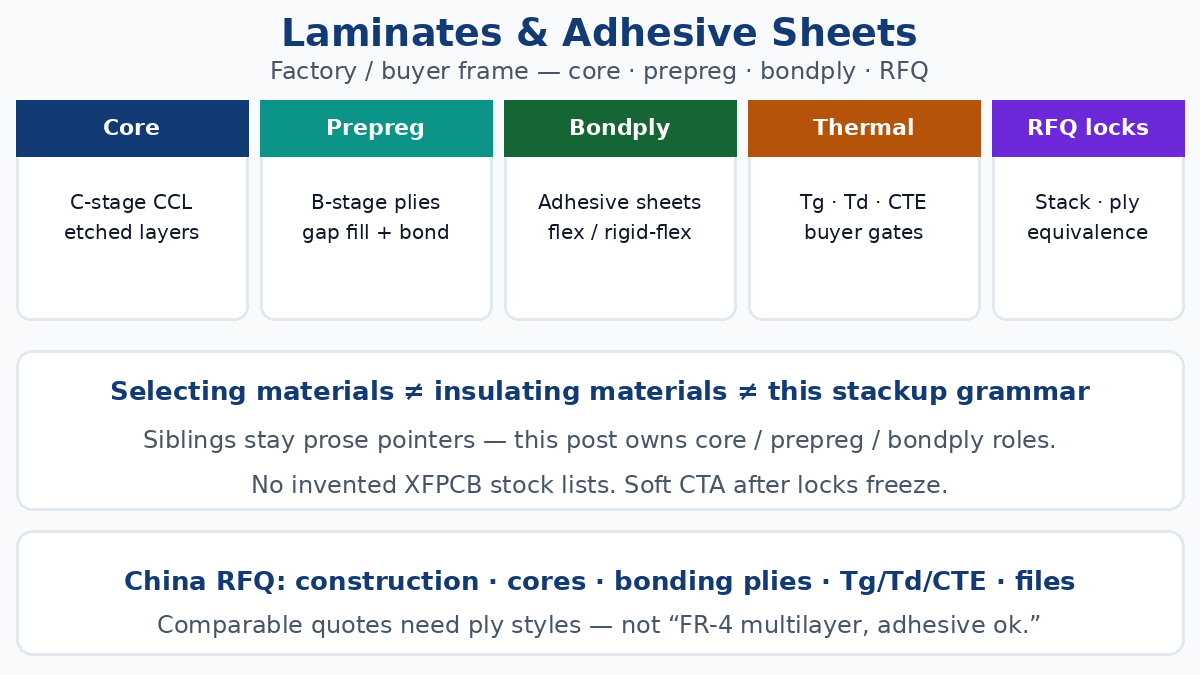
- Core laminate (C-stage) — fully (or nearly fully) cured dielectric with copper already bonded on one or both sides. Cores are the rigid building blocks you etch into circuit layers.
- Prepreg / bonding sheet (B-stage) — glass reinforcement impregnated with partially cured resin. Under heat and pressure it flows, wets copper and glass, then finishes curing to glue cores (and foils) into a multilayer.
- Adhesive sheet / bondply — adhesive film systems used especially in flex and rigid-flex constructions, often without the same woven-glass B-stage behavior as FR-4 prepreg. Bondply joins flex films, coverlay, or rigid-to-flex transitions where a glass-epoxy prepreg would be the wrong process.
Saying “adhesive sheet” when you mean commodity FR-4 prepreg, or “prepreg” when you mean acrylic / epoxy bondply for polyimide flex, is how RFQs get answered with the wrong press recipe. Lock the role, not just a brand nickname.
Selecting PCB materials covers family gates (FR-4-family vs polyimide vs PTFE vs metal-core). PCB insulating materials covers dielectrics as isolators (Dk / Df, CAF, CTE risk). This guide stays on roles inside the stackup — core vs B-stage vs bondply — so CAM and PE quote the same construction.
Core laminates — what they do in the stack
A copper-clad core is the finished dielectric sandwich you buy as sheet stock: copper foil + cured resin/glass (or other reinforcement) + optional second foil. After imaging and etch, that core becomes an inner or outer circuit layer.
Buyer facts that matter:
- Thickness and copper weight on the core drawing drive impedance and finished board thickness more than marketing names do. Call out unfinished core thickness and copper (e.g. 1/1 oz, 0.5/0.5 oz) the way your stack note already does.
- Resin system and reinforcement (E-glass styles, filled resins, polyimide, PTFE blends) set Tg, Td, CTE, and loss. The core is where those datasheet numbers live for the cured laminate.
- Cores do not “flow” in press the way prepreg does. They contribute dimensional stability and copper circuitry. Gap fill between cores is the prepreg’s job (or bondply’s job in flex constructions).
For ordinary multilayer rigid work, cores plus prepreg plies are the default language under a Multilayer PCB Guide stack conversation. If your RFQ only lists “6-layer FR-4” with no core/prepreg breakdown, vendors invent a stack — and two vendors invent two different ones.
Prepreg (bonding sheets) — the B-stage glue for multilayer
Prepreg is partially cured resin on reinforcement. Industry shorthand calls it B-stage; the cured laminate is C-stage. Buyers do not need treater-line chemistry, but they do need the manufacturing consequences:
- Resin content and glass style (106, 1080, 2116, 7628, and filled variants) control how much resin is available to fill etched copper and how thick the dielectric ends up after press.
- Gel time / flow window must match the fab’s press cycle. Old or humid-stored prepreg flows poorly and raises void / delamination risk.
- Multiple plies between cores are normal. “One sheet of prepreg” is not a stack specification — ply count, style, and target pressed thickness are.
Prepreg is also how many shops build foil-on-outer constructions: foil + prepreg + core stack, pressed as one book. That is still rigid multilayer language, not flex bondply language.
Storage and handling (buyer-level). Prepreg is moisture- and time-sensitive. Ask the fab to state shelf-life / dry-bag practice when you lock a low-loss or high-Tg system that is less forgiving than commodity FR-4. You do not need their oven recipe; you need confirmation that the quoted construction uses controlled B-stage material, not warehouse leftovers.
Adhesive sheets and bondply — flex and hybrid constructions
In flex and many rigid-flex builds, the joining layer is often an adhesive sheet (bondply) rather than woven-glass FR-4 prepreg. Bondply and related adhesive films:
- Bond polyimide (or other) flex films to copper or to coverlay
- Create flexible dielectric thickness without forcing a glass style that fights dynamic bend
- Appear at rigid-to-flex transition zones where resin flow, glass, and adhesive choice change reliability
Calling every joining layer “prepreg” on a flex RFQ invites a rigid-process quote. If the product is true flex or rigid-flex, say adhesive / bondply construction (or the exact film system your PE approved) and attach bend / coverlay notes. Process depth for those builds sits on the Flexible PCB and Rigid-Flex PCB service lanes — use those lanes when the stack actually leaves glass-epoxy multilayer territory.
Coverlay vs bondply (short). Coverlay is the flexible soldermask analog (film + adhesive) over flex circuits. Bondply is often the adhesive-only or adhesive-core sheet used to laminate layers together. Mixing the two words on an RFQ is a classic clarifying-email generator. Name which layers are coverlay, which are bondply, and which (if any) are glass prepreg in rigid sections.
Multilayer vs flex: who owns which joining layer
| Construction | Typical “solid” layers | Typical joining layers | Buyer trap |
|---|---|---|---|
| Rigid multilayer | Copper-clad cores | Glass-epoxy (or filled) prepreg plies | RFQ without ply / style / pressed thickness |
| Flex | Copper on PI (or similar) films | Adhesive sheets / bondply; coverlay | Saying “FR-4 prepreg” for a dynamic flex stack |
| Rigid-flex | Rigid cores + flex films | Prepreg in rigid zones; bondply / no-flow or low-flow systems at transitions | One BOM line that pretends both zones use the same B-stage |
Hybrid RF / digital boards sometimes mix low-loss cores with FR-4-family prepreg or use pure low-loss books end-to-end. That is a stack and process call under High Frequency PCB rules when Dk / Df and foil type dominate — still describe cores and bonding plies separately so PE does not “equivalent” a microwave core into commodity FR-4 silently.
Tg, Td, and CTE — buyer notes, not datasheet cosplay
Buyers do not need to recite every IPC slash sheet. They do need three thermal / mechanical gates that survive translation into a China fab traveler:
Tg (glass transition). Temperature where the resin softens significantly. Higher Tg classes matter for lead-free reflow, thick boards, and high layer counts that see more thermal stress. Quote a Tg class (or named system) that matches assembly, not a random marketing number.
Td (decomposition). Temperature where the resin begins to break down (often reported at a defined weight-loss point). Td headroom vs reflow peak matters for reliability and for whether a “high Tg” label is actually process-safe. If assembly uses aggressive profiles, say so on the RFQ so PE does not pick a system that only looks good on Tg.
CTE (especially Z-axis). Expansion through thickness stresses plated through-holes on thick / high-layer boards and on stacks that see deep thermal cycles. Filled resins, glass style, and resin content all move CTE. Buyer action: call out layer count, finished thickness, and any thermal-cycle or CAF risk so the fab does not thin the prepreg stack into a pretty but fragile book.
Dk / Df belong on the RFQ when impedance or RF loss is in play — with a frequency attached. Blind “low loss” without a band is not a lock.
None of these gates invent a stock list. They stop silent downgrades when a bidder swaps a high-Tg core for a commodity core and “similar” prepreg without PE approval.
What belongs on the stackup note
A usable stackup note for laminate / adhesive work usually includes:
- Layer map: copper layers, core thicknesses, prepreg ply count and glass styles (or bondply / coverlay callouts for flex).
- Target finished thickness and tolerance.
- Copper weights per layer; foil type if RF or fine-line cares (ED vs rolled, treatment).
- Material family / Tg class; brand-and-type lock or PE-approved equivalent rules — pick one rule and write it down.
- Impedance references (layer pairs, target ohms, reference planes) when controlled impedance is required.
- Special process flags: sequential lamination, hybrid RF/FR-4, no-flow prepreg, rigid-flex transition, CAF-sensitive pitch.
- Surface finish, soldermask, and legend as separate fields — they are not laminates.
If that note lives only in a chat screenshot, every bidder rebuilds it differently. Put it in the fabrication drawing and the RFQ packet.
China fab RFQ locks for laminates and adhesive sheets
Send the same packet to every bidder:
- Construction class: rigid multilayer / flex / rigid-flex — one primary class, hybrids called out explicitly.
- Core list: material family or P/N, thickness, copper weight, Tg class.
- Bonding list: prepreg styles and ply counts or adhesive sheet / bondply / coverlay system for flex zones — not a single vague “bonding sheet” line.
- Pressed thickness target and tolerance; impedance coupons if required.
- Thermal gates: Tg class, any Td / reflow note, CTE or thermal-cycle concern for thick / high-layer boards.
- Equivalence rule: locked type vs PE-only substitute. Silent “same Tg” swaps are not approval.
- Files: Gerbers, drill, stackup/fab drawing, and (for flex) bend / coverlay / stiffener notes — keep Manufacturing Files naming consistent so CAM is not reverse-engineering three zip styles.
- Quantity, e-test, first-article expectations (cross-section or coupon photos when hybrid stacks are new to that fab).
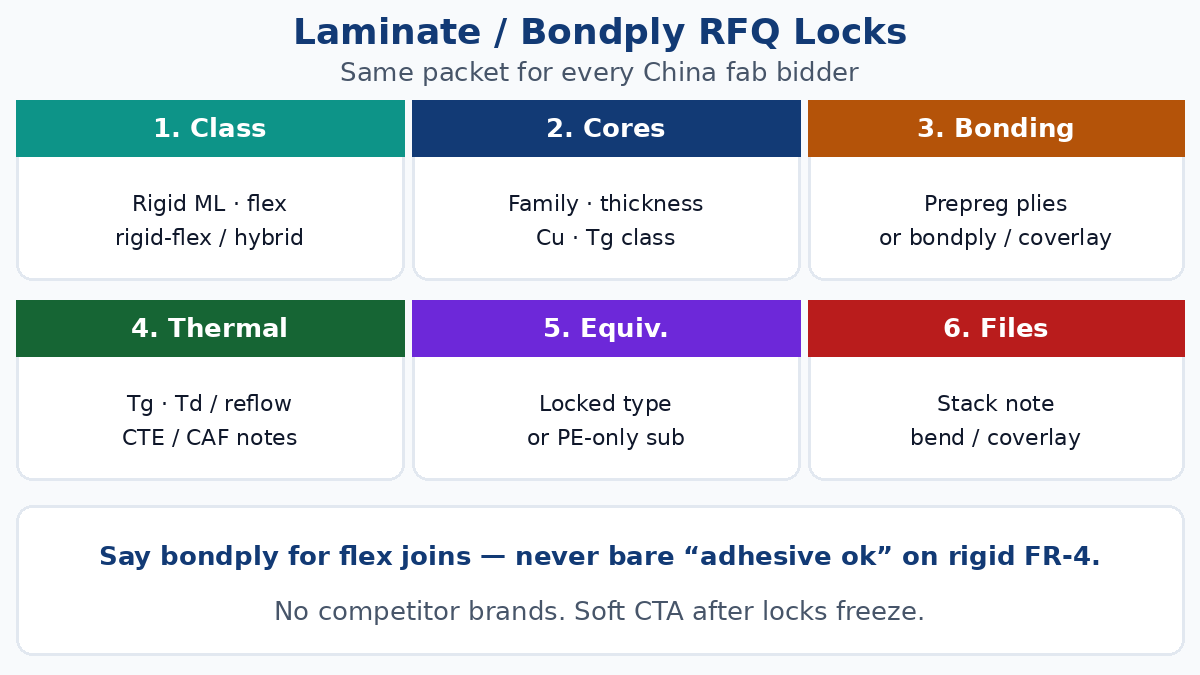
Vague RFQs (“FR-4, 8L, high Tg, adhesive ok”) produce incomparable prices because each vendor fills the bonding gap differently. Comparable quotes need the locks above. Technical Capabilities on the site describe what a fab can run; they do not replace a stack note. PCB Manufacturing is the commercial umbrella — the engineering path is freezing core vs prepreg vs bondply language first.
Common buyer mistakes that burn awards
- One word for three materials. “Adhesive sheet” used for FR-4 prepreg and for flex bondply in the same email.
- Thickness without a stack. Finished 1.6 mm with no core/prepreg map invites whoever quotes cheapest resin content.
- Tg without assembly context. High Tg stamped on the PO while the stack still uses commodity flow-sensitive prepreg that the fab did not plan to dry or press carefully.
- Flex language on rigid boards (or the reverse). Slotted FR-4 is not bondply flex; polyimide flex is not “thin FR-4.”
- Equivalence by brochure. Accepting “compatible laminate” with no PE sign-off on Dk, Tg, and foil type for impedance or RF boards.
- Missing humidity / shelf-life questions on specialty B-stage while arguing only about unit price.
Each mistake shows up as delamination, impedance drift, wrong-process flex quotes, or a week of clarification before NPI.
Soft close for buyers
Core laminates carry your etched circuitry; prepreg (B-stage bonding sheets) fills and glues rigid multilayer books; adhesive sheets and bondply earn their name in flex and rigid-flex constructions where glass-epoxy prepreg is the wrong tool. Write Tg / Td / CTE and Dk / Df gates at buyer level, put ply styles and bondply callouts on the stack note, and freeze equivalence rules before price shopping. When the packet is honest, route the RFQ through a clear fab path rather than a vibe check — that is how overseas buyers keep China quotes comparable on laminates and adhesive sheets without inventing a warehouse stock story.