
Brochures that celebrate jumper wires as a clever layout feature still leave export buyers without a factory decision frame. This page owns that frame: when a jumper is a legitimate ECO or prototype bridge, when it is papering over missing layers or broken escape, how 0 Ω resistors / hand wire / bodge pads show up on travelers, what assembly and inspection inherit, and which RFQ notes keep fab and assembly quotes comparable. Soft CTA only. Prefer redesign levers — another layer, cleaner via strategy, tighter routing discipline — over treating jumpers as a product strategy. Live XFPCB PCB board design and wiring-density lanes already own layout hubs and density alternatives — name those lanes in prose; do not clone them. No competitor brands. No invented XFPCB certificates, turnaround days, dollar menus, or capability dashboards.
What a jumper is on a fab and assembly traveler
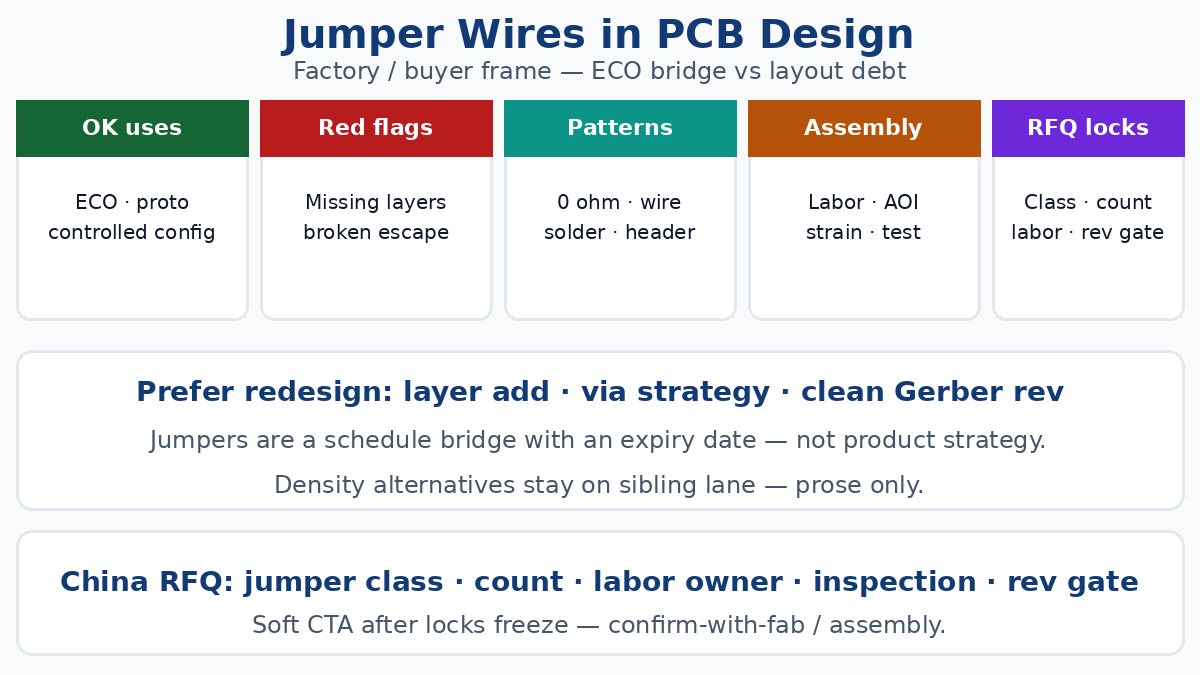
On the floor, a jumper is not a romantic “bridge.” It is a named interconnect that is not a finished copper trace on the released Gerber set — or a copper feature deliberately left open / closed for configuration. That distinction matters for quoting.
Three jobs get collapsed into one soft RFQ line (“jumpers OK”):
- Design-time configuration — solder jumpers, 0 Ω resistors, or header shunts that select voltage, boot mode, address, or feature variants on one bare board.
- Prototype / ECO bridge — insulated wire or bodge pads used after fab to correct a net, bypass a wrong pin, or prove a fix before the next revision.
- Production rework habit — the same wire / bodge pattern left in the traveler because nobody funded a layout rev.
Only the first belongs in a clean BOM and pick-and-place program by default. The second is time-boxed and documented. The third is cost and reliability debt wearing a schedule costume.
Legitimate uses — ECO, prototype, controlled configuration
Engineering change after fab. A missing net, swapped UART pins, or cut power rail on a small pilot lot can be saved with a short insulated wire, documented ECO, and retest — cheaper than scrapping the lot when schedule is frozen. That is a controlled exception, not a design style.
Prototype learning. Early boards often need temporary paths: tie a GPIO high, bypass a regulator, mirror a sensor rail. Hand wire and flying leads accelerate learning. Plan the next Gerber rev to absorb the permanent nets; do not ship the learning scaffold into volume.
Intentional configuration. One layout supporting multiple SKUs via 0 Ω resistors, solder-bridge pads, or removable shunts is a real product pattern. Silkscreen, schematic notes, and assembly drawings must show default state and which option is fitted. Configuration jumpers that CAM and SMT can place like any other part are not the same class as random bodge wire.
Low-layer cost boards with few bridges. On simple single- or double-sided control boards, one or two planned wire jumpers can close a crossing that would otherwise force an extra layer. Count them. When jumper count climbs into a web, the “cheap” board is usually more expensive than a clean Multilayer PCB Guide stack once labor, inspection, and field returns are honest.
When jumpers hide bad layout or missing layers
Factory PE and CAM see the same pattern weekly: boards that “almost routed,” then a cluster of jumpers across power domains, clocks, or dense packages. That is not DFM cleverness. It is unfinished layout.
Missing layers. If nets cannot escape without bridges because there is no inner routing plane, the redesign lever is another layer or a different stack class — not celebrating wire aesthetics. Wiring-density practice (finer L/S, via architecture, HDI when PTH escape collapses) already lives on its sibling page; this article only states the rule: density pressure closed with copper and vias, not with aftermarket wire.
Broken via strategy. Dogbone collisions under fine BGA / CSP arrays that get “fixed” with topside wire loops are schedule traps. Escape belongs in pad/via design before outline freezes.
Signal types that refuse jumpers. RF, controlled-impedance pairs, clocks, and precision analog rarely survive long hand wires without loop area, EMI, and impedance chaos. If those nets need a jumper, treat it as a red flag for stack or placement — not a best practice tip.
Volume intent vs prototype habit. A pilot lot with three documented jumpers can be acceptable. A thousand-piece PO that still lists “install per ECO wire map” is a redesign that never got budget. Buyers who score unit price without labor minutes for hand wire are comparing different products.
Patterns — 0 Ω resistor, hand wire, solder jumper, header, bodge
Not every “jumper” burns the same assembly minutes.
| Pattern | Typical home | Assembly reality | Prefer when |
|---|---|---|---|
| 0 Ω resistor (SMT) | Production config / debug cut | Pick-and-place + reflow; inspect like any chip part | Fixed option, current within package rating |
| Solder jumper pads | Compact config | Hand solder or selective; silkscreen must show open/closed | Semi-permanent, low change rate |
| Header + shunt | Field / lab select | Extra height, BOM, and mis-shunt risk | User-changeable settings |
| Insulated hand wire | Proto, ECO, repair | Hand solder, strain, insulation, AOI blind spots | Time-boxed fix with ECO ID |
| Bodge / cut-and-strap | ECO on copper | Cut trace + strap; document before/after nets | Controlled rev bridge only |
0 Ω resistors win production because they behave like components: tape-and-reel, polarity-free (usually), and visible to AOI as presence/absence. Still lock package size, current, and whether DNP options are allowed per SKU.
Hand wire must specify gauge, insulation color if color-codes matter, max length, routing path (against board, not lofted arcs), and strain relief. Floating loops over tall parts fail vibration and shipping.
Solder jumpers need clear pad geometry and default state on silkscreen. Normally-open vs normally-closed (cut-trace) designs confuse assemblers when the drawing is silent.
Headers are configuration tools, not repair tools. Do not use a header where a permanent 0 Ω would do — height and cost accumulate.
Document every pattern in schematic + assembly drawing the same way. Undocumented jumpers become tribal knowledge that dies with the last technician who built the pilot.
Assembly, inspection, and reliability implications
PCB Assembly lines price what they can see and program. Hand wire and bodge work rarely fit cleanly into SMT cycle time. Expect separate labor lines, operator notes, and often a second visual pass.
AOI and coverage. Flying wires and odd straps sit outside standard library packages. AOI may skip them or throw nuisance fails. Plan a named visual or ICT / flying-probe step for ECO nets if those nets matter to function.
Solder joint mechanics. Wire ends on pads without proper strain path crack under vibration and thermal cycling. Keep wires short, dressed to the surface, and clear of connectors and heatsinks.
Contamination and insulation. Scraped enamel, overlapping bare straps, and flux traps under wire bundles create intermittent shorts that pass first power-up and fail in the field.
Rework history. Boards with multiple ECO generations of jumpers become hard to reverse-engineer. Freeze a “clean Gerber rev absorbs ECOs N through M” gate before volume — or accept that every unit carries unique tribal mods.
Test coverage. If a jumper creates or removes a net after fab electrical test, say so. Bare-board e-test will not see a post-fab wire; assembly functional test must own that path.
Redesign levers that beat celebrating jumpers
When jumper count or jumper criticality rises, buy layout honesty instead of assembly theater.
- Add a layer or change stack class — give nets a legal copper path. Multilayer constructions exist for this reason; quote them against the true labor of hand bridging.
- Fix via / escape strategy — smaller vias, blind/buried where justified, via-in-pad with fill/cap named, or a measured HDI build when PTH escape collapses. Density tactics belong on the wiring-density sibling; decide here only that wire is not a substitute for escape engineering.
- Re-place parts — swap two ICs, rotate a connector, or free a channel before you invent a wire highway.
- Split nets earlier in schematic — optional features as real 0 Ω / DNP trees designed for SMT, not afterthought straps.
- Rev the Gerber for volume — absorb ECO wires into copper before mass production PO. Quick Turn PCB fabrication exists partly so that clean rev can land before the pilot habit hardens into the traveler.
Treat jumpers as a schedule bridge with an expiry date. Product strategy that depends on permanent hand wire is usually unfinished DFM.
China fab / assembly RFQ notes so quotes stay comparable
Export quotes diverge when RFQ language says “jumpers allowed” without saying which pattern, who installs them, and whether the bare board already includes the copper. Attach Gerbers, stackup, BOM, and assembly drawings with Manufacturing Files before scoring unit price.
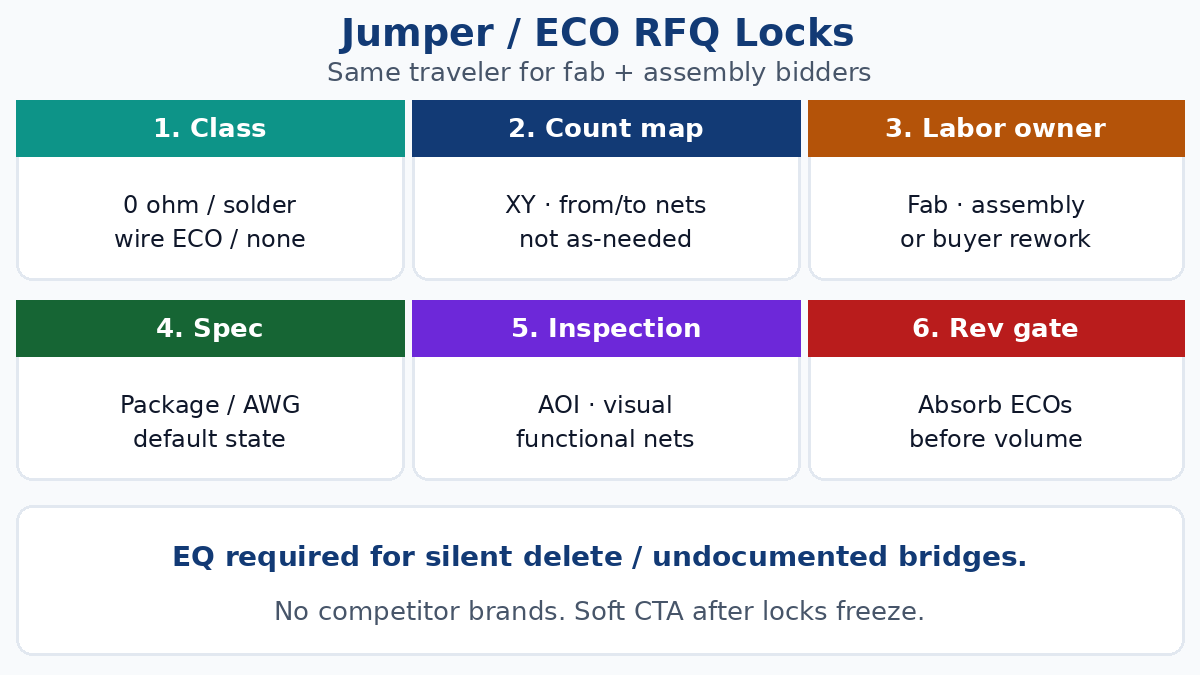
Locks that keep bidders honest:
- Jumper class — design-time 0 Ω / solder jumper / header vs post-fab ECO wire vs “none — copper only.”
- Count and locations — XY map or ECO drawing with from-net / to-net, not “as needed.”
- Owner of labor — fab only, assembly house, or buyer-supplied rework after receipt.
- Package / wire spec — 0 Ω size and current; wire AWG and insulation; solder-jumper default state.
- Inspection — AOI presence for 0 Ω; named visual for wire; functional test points for ECO nets.
- Rev gate — whether volume PO requires a clean Gerber that absorbs listed ECOs.
- No silent downgrade — EQ required if bidder proposes deleting documented jumpers without copper replacement, or adding undocumented bridges to “make it work.”
Soft “assembly will figure it out” language is how one shop quotes SMT-only and another quotes two hours of hand work per panel — then both look “competitive” until the first FAIR.
Soft close
If your next RFQ still carries ECO wire maps, decide whether you are buying a prototype bridge or a volume product. Freeze jumper class, count, labor owner, and the rev gate that absorbs straps into copper — then compare fab and assembly quotes on the same traveler. When you are ready to place that locked package, use How to Place an Order and keep confirm-with-fab / confirm-with-assembly on anything this page cannot invent. Soft CTA only. No capability menus, no fake TAT, no competitor names.