
Aerospace RFQs still mash fabrication and assembly into one vague “build the boards” line. Fabrication builds the bare multilayer — laminate, copper, holes, finish, coupons, and a certificate of conformity for that panel lot. Assembly loads parts, joins them (solder or press-fit), coats when required, and inspects or tests the populated assembly. On aerospace programs those two scopes own different traveler gates, different paper packs, and different escape costs. Mixing them is how Class 2 house defaults and “aerospace OK” quotes walk into the same price comparison.
This note is a factory buyer guide to what buyers should spec separately for aerospace PCB fabrication versus PCB assembly. It is not an environment-evolution map, not a design-rules textbook, and not a certificate sales sheet. Program and flight qualification stay with the design authority. The plant executes the manufacturing locks you write on the drawing and the purchase order.
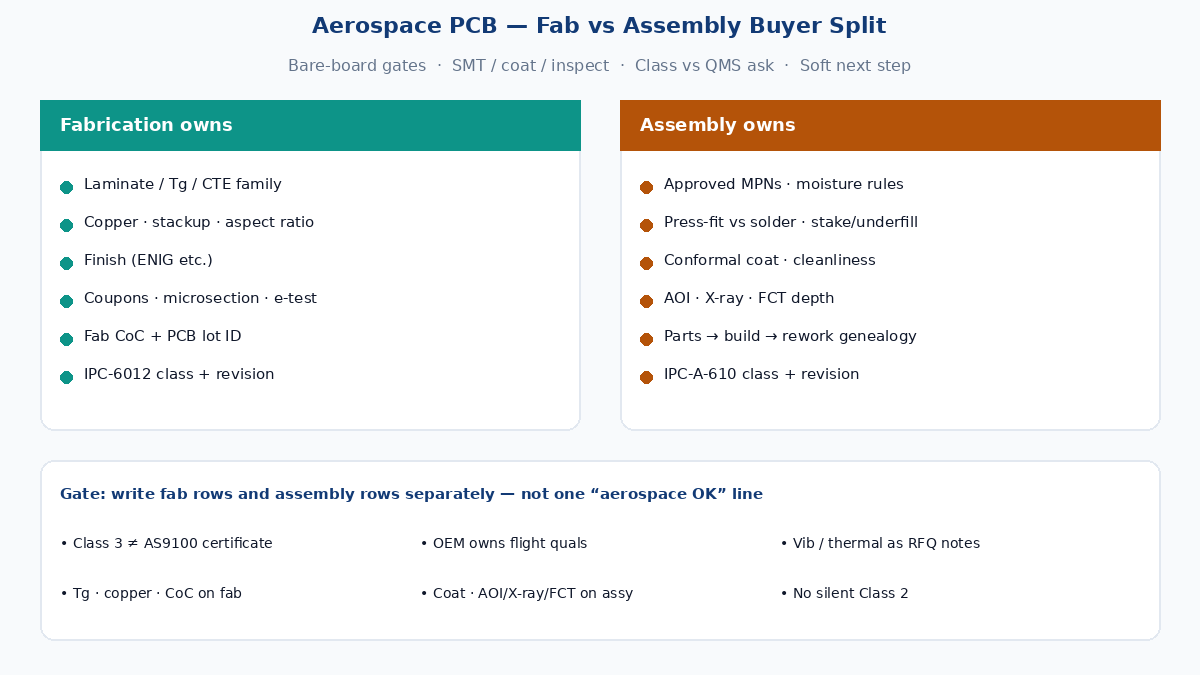
What fabrication owns on the bare-board traveler
Bare-board fabrication is where laminate, copper geometry, plating integrity, and surface finish become physical product. Aerospace intent does not invent itself from the word “flight” on a quote request. Write the fab locks.
Materials — Tg, CTE, and named laminate family. Thermal cycle and sustained heat push buyers to freeze a laminate family and glass-transition temperature (or a named material callout), not a slogan like “aerospace FR-4.” When the design authority cares about coefficient of thermal expansion relative to ceramic packages or thermal cores, put the CTE expectation or material family on the fab notes so CAM cannot silently swap a commodity stack. Polyimide-glass constructions are common when the design already chose them for temperature range; they are not automatic just because the RFQ says aerospace. Lock what the stackup already decided.
Copper weights and construction. Outer and inner copper, any heavy-copper planes, and via-fill or thermal-via expectations belong on the fab drawing. Vibration and current density do not get fixed by hoping the assembly house will “stake everything later.” Hole-wall copper, annular ring, and aspect-ratio feasibility are fab DFM gates. If the design needs a high aspect-ratio through-hole stack, that is a fabrication and plating conversation — not an SMT line item.
Plane separation and stackup windows. Power/ground plane spacing, dielectric thickness windows, and impedance control (when clocks or RF sections need it) are fab stackup locks. Soft brochure language about “separating high and low frequency” without dielectric and copper callouts still leaves CAM free to quote a house default.
Surface finish. ENIG, electrolytic nickel/gold, immersion silver, and other finishes survive different storage, soldering, and wire-bond contexts. HASL may be restricted on some programs for lead or coplanarity reasons. Name the finish and any thickness window on the fab PO. Do not leave “suitable finish” as a plant choice when the assembly process already assumes ENIG flatness or wire-bondable gold.
Coupons, microsections, and electrical test on the bare board. Impedance coupons, via coupons, and a microsection plan are fab evidence. Netlist electrical test depth (flying probe or fixture) belongs here too. If the program expects coupon results or cross-sections to travel with the lot, say so on the fab traveler — assembly AOI will not invent bare-board plating evidence after the fact.
Certificate of conformity and lot identity. A fab CoC, panel or lot ID, and material lot ties (when flowed) close the bare-board side. Incoming inspection at the CMS should be able to match boards to that paper before SMT loads a wrong revision.
Fabrication does not own press-fit versus solder decisions, conformal coat chemistry, or functional circuit test of the populated product. Those land after parts exist on the board.
What assembly owns after the bare board ships
PCB assembly for aerospace-intent builds is the process of placing approved parts, joining them, protecting them when required, and proving the populated assembly meets the workmanship and test depth you cited. Advantages marketed as “catch flaws early” only hold when the traveler names the inspection and disposition rules.
Approved MPNs and moisture discipline. When you are buying PCBA, freeze the BOM revision and approved manufacturer part numbers. Moisture-sensitive devices follow bake and floor-life rules. Soft “equivalent OK” language is how genealogy breaks on the first shortage.
Press-fit versus solder (and combinations). Vibration and shock environments often drive press-fit connectors, soldered joints with stake or adhesive on tall parts, or a documented combination. That is an assembly process lock. Brochure claims that aerospace “must press pins rather than solder” oversimplify — the drawing and the CMS process decide join method per part. Write press-fit, solder alloy/profile, underfill, and stake notes where the risk file needs them. Fab cannot execute those steps on an empty panel.
Conformal coating and cleanliness. Coat type, keep-outs, thickness or coverage inspection, and clean chemistry (no-clean versus aqueous) sit on the assembly traveler. Corrosion and condensation concerns that older marketing pages raise as “coat the copper” are really split: solder mask and finish protect fab copper; conformal coat and selective barriers protect the populated assembly. Name both sides when both matter.
AOI, X-ray, and FCT depth. SPI/AOI coverage for fine-pitch and bottom-terminated packages, X-ray for hidden joints when risk warrants it, and functional circuit test (or ICT) when the program flows a test fixture or script — these are assembly gates. They do not replace bare-board electrical test or coupons. A beautiful AOI report on a Class 2 laminate swap still ships the wrong risk.
Lot traceability through parts, build, test, and rework. Assembly genealogy should connect PCB lot → component lots → assembly traveler → inspection/test records → NCR/rework dispositions. Fab CoC alone stops at the bare board. If a field failure needs both copper history and which reel fed a BGA, the assembly PO must have required that chain.
Assembly does not re-choose laminate Tg, invent impedance coupons, or redefine finish after the panels are already plated — unless you explicitly open an ECO that restarts fab.
Buyer table — fab gates vs assembly gates on one aerospace RFQ
Use one RFQ conversation when you buy both scopes, but keep the rows separate so price and paper stay comparable.
| Gate | Belongs on fab PO / traveler | Belongs on assembly PO / traveler |
|---|---|---|
| Laminate / Tg / CTE family | Yes — named material, no silent swap | No (except verify incoming against fab CoC) |
| Copper weights / stackup / aspect ratio | Yes | No |
| Surface finish | Yes | Process must match finish (solderability / bond) |
| Coupons / microsection / bare-board e-test | Yes | No |
| Fab CoC + PCB lot ID | Yes | Incoming check against that CoC |
| IPC-6012 class + revision (FS if flowed) | Yes | — |
| IPC-A-610 class + revision | — | Yes |
| Press-fit vs solder / stake / underfill | No | Yes |
| Conformal coat / clean chemistry | Mask/finish only | Coat type, keep-outs, coverage inspect |
| AOI / X-ray / FCT | No | Yes when risk or program flows them |
| Parts genealogy + rework disposition | No | Yes |
| AS9100 as org filter (if program-required) | Ask scope covers fab site | Ask scope covers assembly site |
| Vibration / thermal / radiation notes | Materials, via, finish implications | Coat, join method, post-build test notes |
Reject replies that collapse the table into “we do aerospace PCBs.” Incomplete fab rows and incomplete assembly rows are not the same risk package.
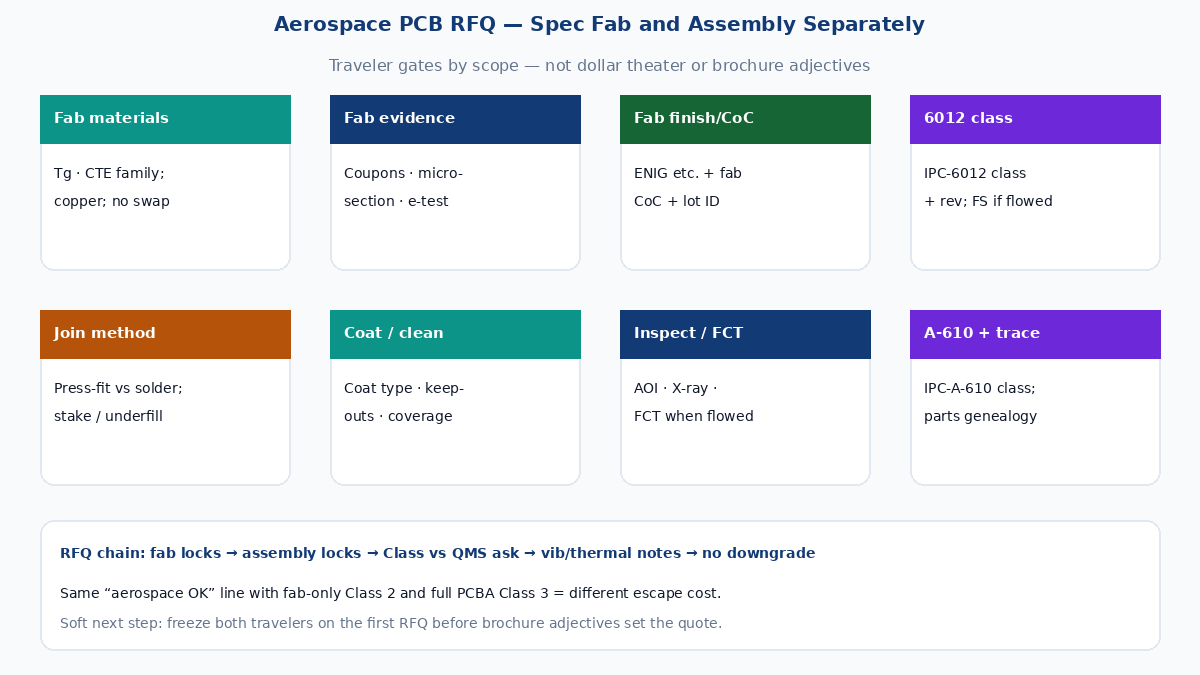
Class 3 workmanship vs QMS — questions without inventing plant claims
Buyers still paste “Class 3 / AS9100” into one cell. Keep product acceptance and organization filters apart — and do not invent certificate claims for any named fabricator, including your own preferred plants.
IPC-A-610 Class 3 (cite revision, e.g. when programs still reference an E-revision habit or current revision) is assembly workmanship acceptance for high-reliability electronics when you put it on the assembly drawing and PO. IPC-6012 Class 3 is bare-board fabrication acceptance when you put it on the fab drawing and PO. Neither class is an organization certificate. Neither class invents flight qualification.
AS9100 (when a program flows it) is an organization QMS under a defined scope and manufacturing site. It disciplines document control, configuration, and supplier process for aviation, space, and defence-related manufacturing. It does not stamp a part number as flight-qualified, and it does not invent Class 3 if the traveler never said Class 3. ISO 9001 is general QMS discipline — not automatic aerospace QMS equivalence.
Buyer questions that stay honest:
- Is AS9100 program-required for fab, for assembly, or for both? If yes, request current certificates and verify scope wording and site address match the plants quoting each scope.
- What IPC-6012 class/revision sits on the fab traveler? What IPC-A-610 class/revision sits on the assembly traveler? Is 6012FS flowed or not?
- Which fab locks (Tg/copper/finish/coupons/CoC) and which assembly locks (join method/coat/AOI-X-ray-FCT/genealogy) are frozen with no silent downgrade without a signed EQ?
- How are ECO, NCR, and rework recorded so WIP cannot mix revisions across fab and assembly lots?
Treat “aerospace experience” and mil-spec tolerance percentages on a brochure as non-answers. Treat a QMS PDF as a supplier filter when required — not as a substitute for class, materials, and inspection depth. This guide does not claim any specific plant holds AS9100; verify paper when your program requires the filter.
Radiation, vibration, and thermal — RFQ notes, not brochure adjectives
Older industry pages list radiation, vibration, and corrosion as reasons aerospace boards are “special,” then jump to shuttle name-drops and soft partner CTAs. Factory buyers need notes that change travelers.
Vibration and shock. On the fab side: annular ring, hole-wall copper, and via reliability assumptions. On the assembly side: press-fit versus solder, stake/adhesive, underfill, coat before vib exposure if the plan says so, and any vibration or shock test notes the CMS must respect after build. “High reliability” without those notes still prices like a quiet office board.
Thermal cycle and heat. Fab: laminate/Tg/CTE, copper, thermal vias or cores only when the design already chose them. Assembly: solder profile, underfill on selected packages, coat chemistry that survives the temperature range, and any thermal screening the program separately scopes. Do not assume the fab invents DO-160 or customer thermal qualification unless that work is purchased as a distinct scope.
Radiation-adjacent asks. Space and some high-altitude contexts may flow design changes (parts selection, shielding, layout) that the design authority owns. Manufacturing RFQs should carry whatever material, finish, or documentation notes the design already decided — not a marketing claim that the plant “builds radiation-hardened PCBs” as a generic capability. Anti-fuse or rad-hard part strategies are BOM and design decisions, not a bare-board slogan.
Corrosion and coatings. Split the ask: fab finish and solder mask protect exposed copper on the bare board; assembly conformal coat and selective barriers protect the populated product in humidity or condensing storage. Name both when both matter.
Leave system environmental qualification with the OEM. Write the manufacturing implications on the traveler.
Soft next step
Split the aerospace RFQ into fab rows and assembly rows before you chase brochure adjectives. On fabrication, freeze laminate/Tg (and CTE family when it matters), copper and stackup, finish, coupons/microsection, bare-board electrical test, CoC, and IPC-6012 class. On assembly, freeze IPC-A-610 class, approved MPNs, press-fit versus solder and stake/underfill notes, coat and cleanliness, AOI/X-ray/FCT depth, and genealogy through rework. Ask whether AS9100 is program-required for each plant as a scope-and-site filter — without treating a certificate as a part stamp. Put vibration, thermal, and radiation-adjacent notes where they change materials or process, not as decoration. Share Gerbers, stackup, finish, BOM/CPL, and environment notes under one revision conversation when you buy both scopes. System and flight qualification remain with the design authority; fab and assembly quality become real when the traveler gates are written separately — and kept that way through first article and production.