
Buyers often treat “IPC Class 2” and “IPC Class 3” as plant badges. They are not. Class is an acceptance and workmanship level you write on the fab drawing, assembly drawing, and purchase order. Leave it blank and many China fab and PCBA travelers default to Class 2 process windows and sampling — then argue after you reject on Class 3 microsections or solder criteria. This factory buyer guide separates when Class 2 is enough from when Class 3 is justified, clarifies bare-board language (IPC-6012 / IPC-A-600) versus assembly language (IPC-A-610), lists RFQ wording that blocks silent downgrade, and explains why Class is not the same thing as an AS9100 or ISO certificate. Cost drivers stay qualitative: no invented percentage markup for XFPCB or anyone else.
What Class 2 and Class 3 mean for buyers
IPC product classes describe how much defect the product can tolerate relative to its end use — not how flashy the factory brochure looks.
Class 1 covers general electronic products where cosmetic quality and long life are secondary. It is rarely requested on serious industrial RFQs; when someone asks for Class 1, many shops still process closer to Class 2 habit.
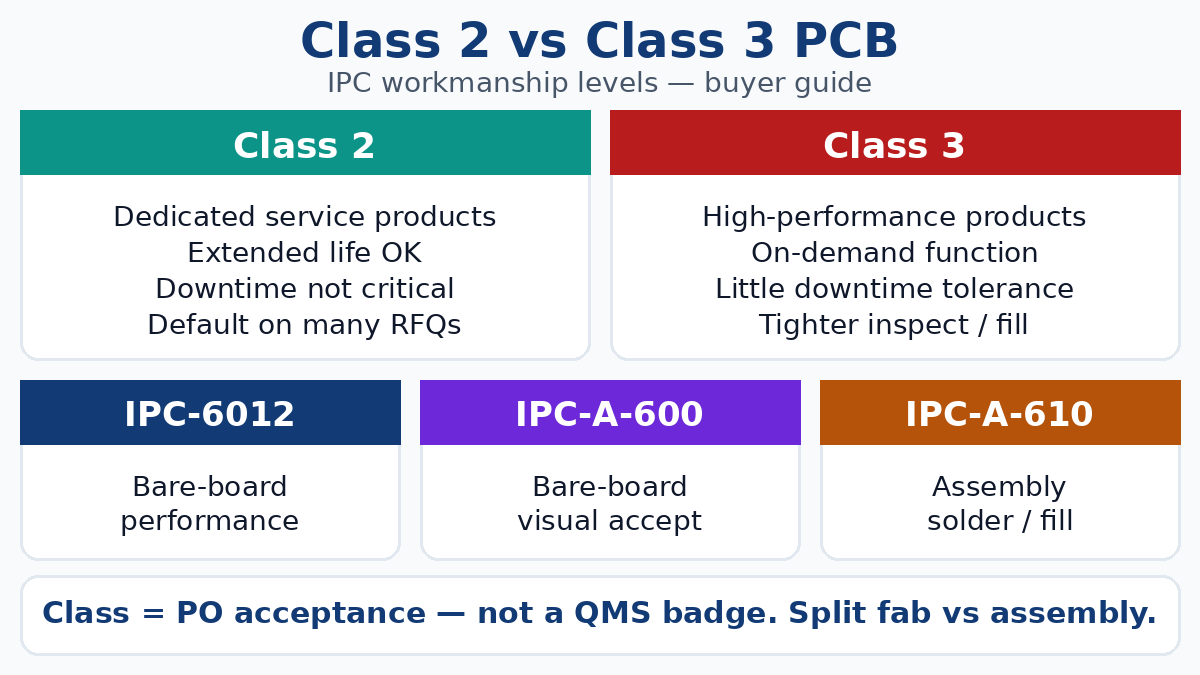
Class 2 — dedicated service electronic products. Extended life and continued performance matter, but uninterrupted service is not critical. Field failure is unwanted and may cost warranty dollars; it is not assumed to create safety or mission-critical downtime. Most commercial and industrial boards ship under Class 2 when the drawing is silent or explicit.
Class 3 — high-performance / high-reliability electronic products. Continued performance on demand, with little or no tolerance for equipment downtime. End-use failure is expensive or dangerous: life-support adjacency, flight and vehicle systems, long-life industrial controls in harsh plants, and similar risk profiles. Class 3 tightens workmanship and inspection depth on both bare board and assembly travelers.
The OEM (or its contract manufacturer writing the PO) chooses the class. IPC definitions guide that choice; they do not magically appear because a salesperson said “aerospace capable.” Exact numeric limits live in the revision you cite on the drawing. Treat the sections below as a buyer map, then lock numbers from the edition on your documents.
Assembly vs bare board: A-610 is not 6012 / A-600
Mixing document families is the most common Class mistake on China RFQs.
| Document family | What it governs | Typical buyer callout |
|---|---|---|
| IPC-6012 | Bare-board qualification and performance (rigid printed boards) | “IPC-6012 Class 2” or “Class 3” on fab drawing / PO |
| IPC-A-600 | Bare-board visual accept / reject criteria | Often paired with 6012 for FQC / receiving visual |
| IPC-A-610 | Electronic assemblies — solder joints, component placement, hole fill, cleanliness | “IPC-A-610 Class 2” or “Class 3” on assembly drawing / PCBA PO |
Bare-board Class changes annular ring, plating thickness floors, spacing and defect allowances, coupon expectations, and how hard FQC argues over etch nicks or breakout. Assembly Class changes solder fillet criteria, SMT placement tolerances that count as defects, PTH barrel fill expectations, and cleanliness / residue rules after wash or no-clean.
A fab-only PO that says “IPC Class 3” with no document number is ambiguous. A PCBA PO that cites A-610 Class 3 but never states fab class leaves the bare board on whatever the fab assumed. Split the language when both fab and assembly are in scope:
- Fab: IPC-6012 Class X (revision optional but preferred) + A-600 visual as needed
- Assembly: IPC-A-610 Class X (same revision discipline)
Do not write “IPC-A-610 Class 3” on a bare-board-only RFQ and expect plating and annular ring to tighten. Wrong document family; wrong traveler.
Workmanship examples buyers actually feel (A-610)
Exact percentages and fillet tables belong in the current A-610 revision. Buyers still need a mental model of what tighter Class costs on the line.
SMT placement / pad overhang. Under Class 2, modest pad overhang or placement offset that still leaves a sound joint may be acceptable. Under Class 3, the same visual condition can be a reject because the acceptance window is narrower. That does not always change electrical function on day one; it changes scrap rate, rework loops, and how AOI programs are set. Shops that quote Class 3 without updating AOI recipes are selling a stamp, not a process.
PTH barrel fill. Through-hole vertical fill is a classic Class 2 versus Class 3 diverge. Class 2 commonly allows more incomplete fill on some joint types; Class 3 expects a higher share of the barrel filled with solder on the applicable criteria. High-aspect-ratio vias and dense mixed-technology boards feel this first: wave or selective solder windows narrow, paste-in-hole recipes get pickier, and rework risk rises. If your design is mostly SMT with few THT pins, the cost delta may be modest. If the BOM is heavy with connectors and power pins, Class 3 fill drives process time and yield.
Cleanliness and residue. Class 3 programs often push harder on ionic / visual cleanliness after assembly, especially where conformal coat or harsh environments follow. “No-clean is fine” without a Class and residue note invites the cheapest compliant-looking wash story.
Inspection depth. Class 3 travelers more often include deeper AOI criteria, X-ray on hidden joints when the program demands it, first-article scrutiny, and documented disposition. Class 2 volume may ride on sample visual plus electrical continuity. Put the inspection package on the PO or you get the cheaper default.
These examples are assembly-side. On the fab side, buyers feel Class most through annular ring, PTH copper thickness, and microsection / coupon discipline — topics covered in detail on XFPCB’s Class 3 fab note; here the takeaway is simple: name both fab class and assembly class when both apply.
When Class 2 is enough vs when Class 3 is justified
Match class to failure consequence, not brochure prestige.
Prefer Class 2 when:
- Consumer or short-life commercial products with easy field replace
- Indoor, benign environments where failure is warranty cost, not safety risk
- Cost and schedule dominate and scrap is recoverable
- Early prototypes still changing layout before reliability freeze
- Dense consumer HDI where Class 3 pad and ring rules will not fit DFM without a redesign
Justify Class 3 when:
- Safety-critical control, medical-adjacent, or life-support-adjacent electronics
- Flight, vehicle, transportation, or other systems with no tolerance for downtime
- Harsh vibration, thermal cycling, humidity, or long unattended service life
- Failure cost far exceeds board cost (recall, certification, downtime, liability)
- Design already sized for Class 3 annular ring, plating, and solder criteria
Aerospace and medical programs often need Class 3 plus a quality-management system and additional process controls. Class alone does not replace those. Conversely, many industrial controllers live happily on Class 2 when the environment is mild and replaceability is real. Over-classing a consumer SKU to sound premium buys plating time and scrap, not reliability.
Cost drivers (qualitative — no invented markup)
Class 3 usually costs more than Class 2 for the same Gerbers. How much depends on the job; invented single-digit or mid-teen percentages as a universal rule are marketing fiction. Drivers that actually move China fab and PCBA quotes:
Yield and scrap. Tighter annular ring, plating, and solder criteria reject more panels and boards. Scrap risk is priced into unit cost whether you see a line item or not.
Process time. Longer plate windows, tighter registration, more careful wave / selective recipes, and rework loops add machine and labor minutes — especially on THT-heavy assemblies.
Inspection and coupons. Microsections, first-article packages, deeper AOI, and documented CoC language add NRE and calendar time. Silent Class 3 expectations with Class 2 inspection scope produce receiving fights.
Design fit. Pads and clearances drawn for Class 2 habit may fail Class 3 DFM. Fixing that late means EQ loops, pad growth, or layout spins — cost that looks like “Class 3 markup” but started as geometry.
Volume and mix. High-volume SMT-only Class 3 can be a small delta. Low-volume, high-THT, high-aspect-ratio Class 3 can dominate the quote. Ask the estimator which driver moved the needle on your BOM — not for a generic industry percentage.
If marketing wants Class 3 language without an engineering failure mode that Class 2 cannot accept, you are buying optics. Push back with the failure-mode question before you lock the PO.
Class ≠ AS9100 / ISO (or any QMS stamp alone)
Quality-management certificates answer a different question than IPC class.
| Claim you hear | What it actually means | What it does not mean |
|---|---|---|
| “We are AS9100” | Aerospace-oriented QMS for how the organization manages quality | Every lot ships Class 3 annular ring / plating / A-610 fill without a drawing callout |
| “ISO 9001 certified” | General QMS maturity signal | Automatic Class 3 product acceptance |
| “ISO 13485” | Medical-device QMS scope (when applicable) | Automatic Class 3 boards or assemblies |
| “IPC Class 3 capable” | The line can hit Class 3 when specified and inspected | Silent POs ship Class 3 economics |
| “High reliability PCB” | Vague sales language unless tied to class, materials, and test | Enforceable acceptance at receiving |
Decision rule: Treat QMS certificates as a supplier filter. Treat IPC class as a product specification on the drawing and PO. Safety-critical and aerospace programs usually want both — plus material, test, and traceability notes. One without the other is incomplete. A Class 3 callout at a non-certified shop can still be a contractual acceptance level; an AS9100 shop with a silent Class field can still ship Class 2 workmanship.
What to put on a China fab / PCBA RFQ
Silent fields become house defaults. Write these in the note block and RFQ line items.
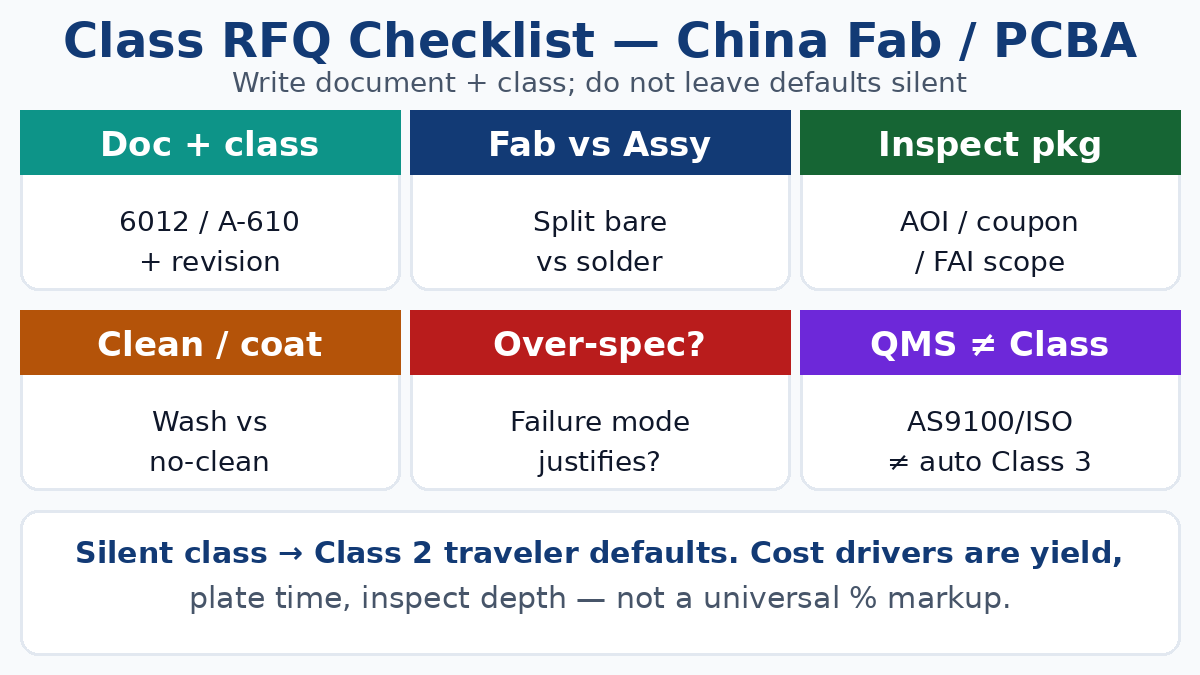
1. Document + class + revision. Example patterns: “Bare board: IPC-6012 Class 2” and, if assembling, “Assembly: IPC-A-610 Class 2.” Prefer citing the revision you own. “IPC Class 3” alone is ambiguous.
2. Fab vs assembly split. If one vendor fabs and another assembles — or one PO covers both — state both classes. Do not assume A-610 language flows upstream into plating.
3. Inspection package. Electrical test scope, inner/outer AOI expectations, microsection or coupon requirements, first-article needs, and any X-ray scope for hidden joints. Class without inspection scope is half a contract.
4. Cleanliness / coat. Wash vs no-clean, ionic limits if required, conformal coat after assembly. Class 3 programs often need this in writing.
5. Material and stack. Laminate type, copper weights, surface finish, and any impedance coupons. Class does not replace stack notes.
6. Disposition rules. Who owns EQ answers, how nonconformances are approved, and whether “use vendor standard” is forbidden. Chat screenshots are not traveler updates.
7. Over-spec check. If the product is consumer Class 2 by failure mode, do not copy Class 3 from an aerospace template “just in case.” Over-spec risks longer lead time, higher scrap, and DFM fights that do not buy field reliability.
Soft next step
If you are locking a China fab or PCBA RFQ and the Class field is still a brochure adjective, send the stackup, Gerbers, and BOM with explicit IPC-6012 / A-610 class lines and the inspection package you expect. XFPCB can review whether Class 2 or Class 3 fits the failure mode and traveler — without inventing a universal markup percentage. Clear class language beats a soft unit price that silently assumes the wrong workmanship level.