
Laser ablation on flex circuits is not one shop floor trick. Buyers use the phrase for coverlay windows, adhesive skim, selective dielectric openings over pads or fingers, and — separately — for HDI microvia formation in thin dielectrics. Those jobs share a laser head and almost nothing else on the traveler. This page owns the factory/buyer frame for flex PCB laser ablation as dielectric and coverlay opening work: when laser beats mechanical skiving or die-cut coverlay, what UV and CO2 actually buy you at quote time, how pad cleaning and residue show up in FA, and which DFM/RFQ locks keep China flex fabs answering the same packet. Soft CTA only. Product depth for Flexible PCB and Rigid-Flex PCB builds lives on those manufacturing pages. Coverlay and adhesive sheet roles already sit on the laminates-and-adhesive-sheets sibling lane — name that lane in prose; do not clone or href it. No competitor brands. No invented XFPCB laser-cell menus, TAT claims, or “we run excimer on every panel” capability lists.
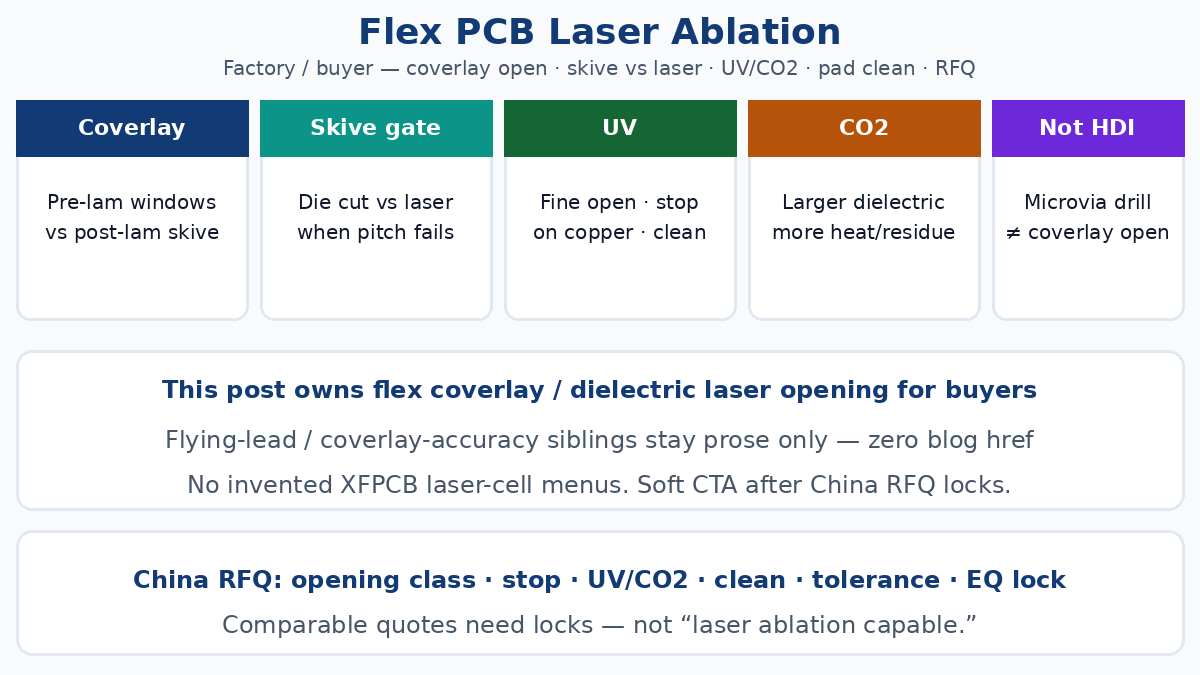
What laser ablation means on a flex traveler
On a flexible circuit, laser ablation removes selected polymer — coverlay film, acrylic or epoxy adhesive, polyimide base film, or other dielectric — to expose copper or to leave a controlled remaining thickness. The laser is chosen for absorption contrast: polymer absorbs; copper preferably reflects or stops the cut so the conductor survives.
Buyer language fails when three different process asks share one RFQ line:
- Pre-lam coverlay windowing — openings cut in coverlay before it is aligned and laminated to the etched flex
- Post-lam skiving / selective strip — openings or adhesive clear-outs after coverlay is already bonded (including squeeze-out cleanup over pads and fingers)
- HDI microvia laser drill — blind vias in thin dielectric for interlayer connection, not a coverlay window
Only the first two belong under this guide’s “flex laser ablation” buyer frame. Microvia work is a different capability conversation; treat it as such on the RFQ so the fab does not quote coverlay windows with a via-drill process window — or the reverse.
For overall Flexible PCB construction, stack thickness, copper weight, and bend class still own yield. Ablation is a selective opening step inside that construction, not a substitute for stack honesty.
Coverlay and dielectric openings buyers actually specify
Most flex laser ablation RFQs are about access: solder pads, gold fingers, bonding areas, sensor contacts, or flying-lead style windows where copper must be free of polymer. Design intent should say which of these you need — and whether the opening is cut before or after coverlay lamination.
Pre-lamination coverlay openings. Coverlay is windowed (die punch, mechanical rout, or laser), then aligned to copper and laminated. Die cutting is economical for high-volume simple shapes. Laser windowing earns its keep on fine pitch, irregular outlines, and registration that punch tooling cannot hold without frequent die refresh. Buyer note: opening size must account for adhesive flow (squeeze-out). A 1:1 pad-to-window ratio often leaves adhesive on the pad or unprotected copper at the rim. Typical DFM starts with a deliberate oversize per side and fab-confirmed registration to fiducials — not a CAD “exact pad” habit copied from rigid solder mask.
Post-lamination laser skiving. After coverlay is bonded, laser removes polymer over selected copper. This is the path when windows are too small or too dense to align reliably before lam, when adhesive squeeze-out must be cleared after press, or when floating contacts need a clean strip for plating or bonding. Depth control matters: stop at copper (material-boundary skive) versus controlled remaining dielectric. Ask which mode the quote assumes. Post-lam skive is also where residue and heat-affected edge quality show up in FA more often than on clean pre-lam windows.
Selective dielectric / adhesive clear. Some builds need adhesive or coverlay removed from a strip, cavity, or bend region without a classic “pad window.” Same laser family, different drawing callout. Name the stack layers to remove and the stop layer; “laser open flex” alone is not a traveler line.
Rigid-flex transition zones and coverlay-to-rigid mask boundaries need the same honesty on the Rigid-Flex PCB manufacturing page’s process ownership — freeze which openings sit on flex film vs rigid mask; do not assume one laser note covers both.
Mechanical skiving and die cut vs laser — buyer gate
Not every opening needs a laser cell.
Stay mechanical / die-cut when:
- Window geometry is simple, volume is high, and die life cost is already amortized
- Registration and annular-ring rules fit the fab’s punch/align process without chronic pad encroachment
- Feature sizes sit comfortably above the house’s laser-only band
- Cost and cycle time dominate over edge cosmetics
Open a laser conversation when:
- Pitch, irregular shapes, or post-lam squeeze-out cleanup defeat reliable die alignment
- You need post-lam selective strip over fingers or pads without a new coverlay tooling cycle
- Drawing calls for openings smaller or denser than the fab will punch
- Edge quality, residue class, or plating readiness after open is part of the acceptance criteria
Laser is not automatically “higher quality.” It is a different process window with different failure modes: carbon or ash on copper, adhesive melt rim, copper discoloration from excess energy, under- or over-size windows from focus/scan drift, and registration that still depends on fiducial strategy. Buyers who switch to laser without updating opening oversize, inspection notes, and cleaning expectations often recreate the same pad-contamination FA under a more expensive line item.
UV vs CO2 at buyer level (not a lab brochure)
Wavelength choice is absorption and heat, not a brand contest. At buyer level you need enough grammar to read a DFM reply — not a photonics thesis.
UV (typically 355 nm class). Strong absorption in polyimide and many adhesives; relatively small heat-affected zone when tuned. Common for fine coverlay windows, post-lam skives over pads/fingers, and work where copper stop and edge definition matter. UV can leave light carbon residue that wet clean or a low-fluence polish pass is meant to clear — ask what cleaning is in the quoted flow. Picosecond-class UV (when a house has it) is often preferred for “cold” adhesive clear and plating-ready copper; nanosecond UV is widely used with multi-pass rough-then-clean strategies. Do not invent which pulse width XFPCB or any named China fab runs — ask the bidder to state the process class they will use for your feature size.
CO2 (10.6 µm class). Efficient polymer removal on larger, simpler dielectric openings and some coverlay windowing where throughput matters. Copper does not absorb CO2 the same way; stop behavior and edge quality differ from UV. Expect more thermal signature, more residue risk on copper, and typically looser positional/dimensional bands than a tuned UV skive. Plasma or dedicated clean steps often follow CO2 dielectric work. CO2 is a poor default for fine post-lam finger skives when the RFQ cares about plating cosmetics.
Buyer comparison habit. Ask for the feature class (pre-lam window vs post-lam skive vs large dielectric open), target tolerance band, cleaning step after ablation, and inspection method — not only “UV or CO2.” Two quotes both saying “laser open coverlay” can still be different travelers.
Pad cleaning, residue, and what FA actually fails
Ablation success is not “copper is visible under the microscope once.” Downstream plating, ENIG, soft/hard gold, wire bond, or SMT solderability owns the real gate.
Common FA themes after flex laser open:
- Organic residue / carbon on pad surface — wettability and plating adhesion suffer
- Adhesive rim / squeeze-out still covering pad edge after an undersized or mis-registered window
- Copper discoloration or micro-roughening from excess fluence or wrong wavelength for the stack
- Undercut or ragged polymer wall that traps debris or creates unreliable solder fillets
- Inconsistent opening size across the panel — CAM assumed one laser recipe for mixed feature sizes
RFQ practice: state the finish and the cleanliness expectation (visual class, tape test, or plating readiness). Ask whether wet clean, plasma, or brush/chemical steps sit after laser. If the program is bond or fine-pitch SMT, say so — commodity “coverlay open” cleaning may not be enough.
Sibling coverlay-opening-accuracy and flying-lead flex lanes already own specialty geometry stories in the XFPCB library — keep those as prose pointers; this guide stays on process selection and RFQ locks for ablation generally.
Do not confuse coverlay ablation with HDI microvia laser drill
Laser microvias on HDI PCB builds remove dielectric to a capture pad, then metallize the hole. That process window cares about via diameter, dielectric thickness, taper, desmear/plate, and stacked/staggered via rules. Coverlay or adhesive ablation cares about lateral window geometry, stop-on-copper behavior, residue on functional pads, and often post-lam registration to etched features.
Mixing the two on one vague “laser flex” line item causes quote noise: a via-capable HDI cell may not be the right coverlay skive cell, and a coverlay UV skive house may not own your blind-via stack. Write separate notes. If the same panel needs both microvias and coverlay laser windows, list both as distinct process asks with their own tolerances and inspection.
DFM notes that prevent award shock
Before the RFQ leaves your desk:
- Call out pre-lam vs post-lam for every laser-touched opening class.
- Size windows for adhesive flow — document oversize intent; do not paste 1:1 pad clones.
- Fiducials the fab can use for coverlay align and for post-lam skive registration.
- Copper weight and coverlay/adhesive construction on the stack note — absorption and stop behavior change with stack.
- Finish and cleanliness class after open (especially gold or bond pads).
- Keep ablation notes off the outline laser-cut path — profile, coverlay open, and stiffener edges are different tools even when all say “laser.”
- Bend and stiffener keep-outs — openings in dynamic bend regions need explicit approval, not silent CAD placement.
Attach stack, fab drawing, and Gerbers/ODB++ through Manufacturing Files so “laser open” is not a verbal side channel. Technical Capabilities pages describe house process envelopes at a catalog level; your drawing still has to name the opening class.
China flex fab RFQ locks for laser ablation awards
Export flex quotes diverge when ablation language stays soft (“laser coverlay,” “laser skiving OK,” “UV preferred”). Paste the same locks for every bidder:
- Opening class — pre-lam coverlay window, post-lam skive/strip, selective adhesive clear, or other — named per drawing layer.
- Stop condition — stop on copper, controlled remaining dielectric thickness, or full dielectric remove in region.
- Critical dimensions — minimum window, pitch, finger width, and tolerance band you will inspect.
- Wavelength / process class acknowledgment — UV vs CO2 (and pulse-class if you already qualified one) as a bidder acknowledgment, not a slogan.
- Post-laser clean — wet, plasma, or other — in or out of the quoted process.
- Acceptance — AOI scope, plating/bond readiness, and any FA sample plan on first article.
- No silent process swap — written EQ if the house changes wavelength class, skive vs punch, or omits cleaning.
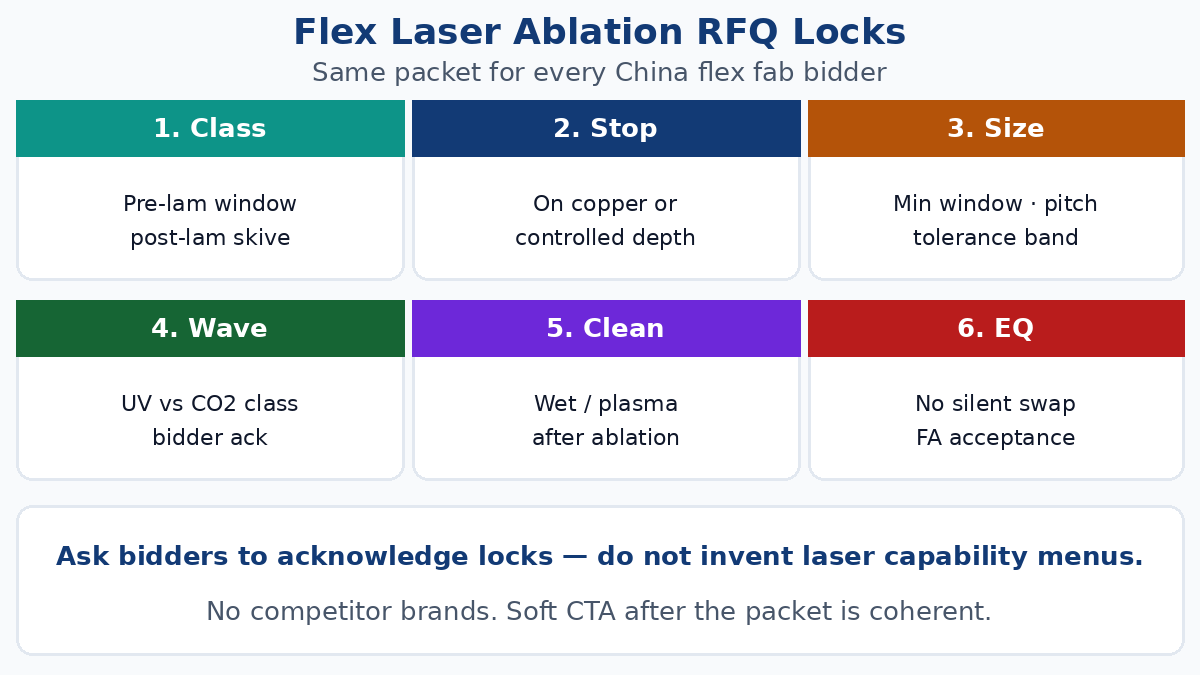
Comparable awards need those locks. “Laser ablation capable” without opening class is not a comparable line.
Soft close
If your next flex build hinges on coverlay or dielectric laser openings — and the packet already names stack, opening class, and cleanliness — send the files and ask for a DFM pass that acknowledges the locks above. Start from How to Place an Order when you are ready to route Gerbers and the fab drawing into quote. XFPCB will answer against the traveler you write, not against an invented laser menu. The RFQ locks are the checklist.