
FQC (Final Quality Control) is the last visual and dimensional gate on a bare PCB or PCBA lot before it leaves the plant floor for outbound packaging. It sits after process and electrical checks have already run — not instead of them. For overseas buyers writing China fab or EMS RFQs, FQC language should answer one question: what must still be true of every shippable unit after IQC, IPQC, AOI/ET, and any first-piece hold, and how must that unit be bagged, labeled, and documented so the carton that lands at your dock matches the PO. This note is a final-gate and outbound-packaging RFQ playbook. It is not a flying-probe method rewrite, not a first-article lot-hold checklist, not a fabrication process tour, and not a semiconductor packaging-levels primer.
Quick answer: where FQC sits and what the RFQ must name
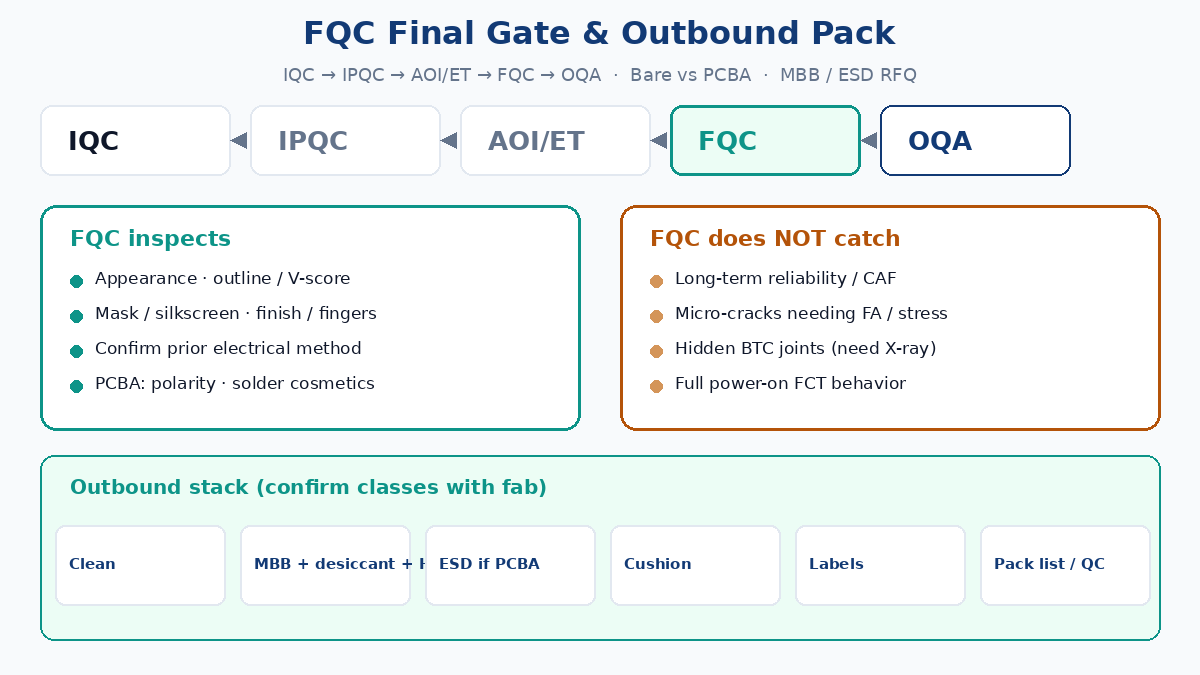
Write the buyer chain in PO language — IQC → IPQC → AOI/ET → FQC → OQA — so every quote prices the same gates:
| Gate | Buyer meaning | Typical proof |
|---|---|---|
| IQC | Incoming laminate, copper, chemicals, components (PCBA) meet released specs | Certs, sampling records, reject logs |
| IPQC | In-process checks during etch, plate, print, SMT, reflow | Traveler stamps, SPC samples |
| AOI / ET | Optical and electrical process gates (panel/board opens-shorts, paste/place optics) | AOI reports; electrical method named separately |
| FQC | Final appearance, outline/dimensional, finish, and ship-ready condition of the finished unit | FQC checklist, sample photos, disposition |
| OQA | Outgoing quality audit on packed lots before ship or at dock | Audit sample vs packing list / QC docs |
FQC is the finished-unit gate. Electrical opens/shorts belong to the electrical method you already specified (flying probe, fixture ICT, or equivalent) — name that method in the RFQ; do not pretend FQC “includes electrical” without a method. First-piece setup release before a PCBA lot continues is a separate hold (FAI). Keep those boundaries so quotes stay comparable.
Place FQC in the buyer chain — not a plant org chart
China shops often use overlapping titles: FQC, FQA, OQC, OQA. Do not argue acronyms. Specify when the check happens and what it covers:
- Before FQC — materials and process controls (IQC/IPQC), plus optical/electrical process gates (AOI, electrical test) on the panel or assembled board.
- At FQC — human or assisted inspection of the finished bare board or PCBA against the released drawing, IPC class callout, and cosmetic criteria you named.
- After FQC / at OQA — confirmation that the packed lot matches quantity, labels, moisture/ESD barriers, and QC paperwork before the truck leaves.
If a vendor collapses “FQC + packing + OQA” into one traveler stamp, still ask for a written checklist that separates cosmetic/dimensional disposition from bag/label/desiccant evidence. A single “OK” stamp does not tell you whether gold-finger scratches were screened or whether HIC cards were sealed inside the MBB.
What FQC inspects on a finished bare PCB
For bare boards, FQC is the last chance to catch ship-killers that survive etch and electrical:
- Appearance — scratches, dents, copper voids visible at edge, foreign debris, delamination clues, contamination on pads or soldermask, warpage obvious by eye or simple feeler/straightedge sample.
- Dimensional / outline / V-score — outline vs Gerber or fab drawing; slot and cutout presence; V-score depth/residue if you buy scored panels; hole presence on critical tooling and mounting holes (sample or 100% as agreed).
- Soldermask and silkscreen — mask registration, exposed copper where mask should cover, mask on pads that must stay open, silk legibility and polarity marks where silk is your assembly cue.
- Gold fingers / surface finish — finger scratch, plating peel clues, finish color/coverage anomalies on ENIG/OSP/HASL as specified; edge bevel if called out. Cosmetic class for connector fingers should be in writing — “no probe marks on fingers” if that is a reject.
- Electrical status — FQC confirms the lot already passed the named electrical method (or segregates fails). It does not rewrite the flying-probe or ICT playbook. Ask for traveler evidence: method, coverage note, and fail disposition — not a vague “ET OK.”
Sample size and AQL (or 100% for high-reliability / low volume) belong in the RFQ. Do not assume every China fab runs 100% visual on every SKU unless you paid for that line item.
Bare PCB vs PCBA: FQC scope is not the same
Bare PCB FQC owns fab cosmetics, outline, mask/silk, finish, and confirmation of prior electrical. PCBA FQC adds assembly-visible checks after SMT/THT and any customer functional gate you specified:
| Check theme | Bare PCB FQC | PCBA FQC |
|---|---|---|
| Outline / V-score / slots | Primary | Usually inherited; watch depaneling damage |
| Mask / silk / finish / fingers | Primary | Still relevant on exposed board areas |
| Component presence / polarity | N/A | Primary — wrong part, missing, reverse |
| Solder cosmetics (visible) | N/A | Bridges, insufficient, tombstone, lead dress |
| Connector / mechanical fit | Limited | Press-fit, pin length, shield can seating |
| Prior electrical / FCT | Confirm bare ET done | Confirm named PCBA electrical + any FCT |
| ESD / moisture pack readiness | Clean + MBB as agreed | Clean + ESD bag/tray + MBB class as agreed |
On PCBA, FQC is not a substitute for SPI/AOI/X-ray process gates or for first-article setup release. Those catch process and setup defects earlier. FQC catches what is still visible or measurable on the finished assembly and what packing must protect.
What FQC does not catch
Buyers over-trust FQC when they treat it as a reliability certificate. Name the gaps in the RFQ so expectations match physics:
- Long-term reliability — CAF, electrochemical migration, coating adhesion over life, solder joint fatigue under thermal cycling. Those need design rules, process control, and often stress or FA methods — not a final visual pass.
- Micro-cracks and latent interconnect — hairline barrel cracks, pad cratering, BGA joint anomalies that need cross-section, dye-and-pull, or X-ray depth. Visual FQC will miss them.
- Hidden solder under BTC packages — without X-ray (or agreed sample X-ray), FQC cannot clear BGA/QFN joints.
- Functional behavior under load — boot, firmware, RF, calibrated sensors. That is customer FCT or system test, not FQC cosmetics.
- Moisture sensitivity of components after bag open — FQC can verify that the outbound MBB/HIC/desiccant stack was sealed as specified; it cannot guarantee floor life after your line opens the bag.
Write disposition rules: what is rework, what is scrap, what is “use as is” with buyer sign-off. Silent “use as is” on gold-finger scratch or missing silk polarity is how dock disputes start.
Outbound packaging RFQ — write the stack, not “standard pack”
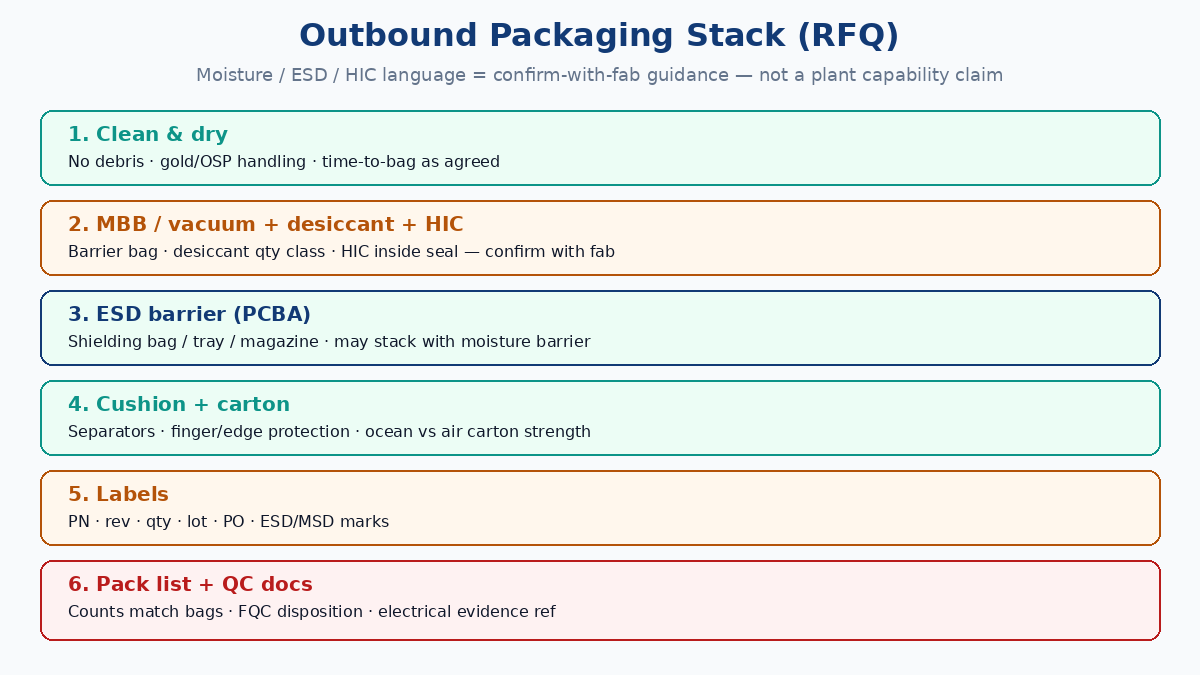
“Standard export packing” means different things at different plants. Spell the stack in PO language. Treat moisture and ESD class numbers below as confirm-with-fab RFQ guidance — industry conversation starters, not a claim that any one plant (including XFPCB) guarantees a specific MSL, bag film, or HIC brand without written agreement.
1) Clean before bag
Require boards or assemblies to be clean and dry before moisture or ESD barriers: no fingerprints on gold, no flux residue outside agreed allowables, no loose debris. For OSP or moisture-sensitive finishes, ask how long boards sit between final clean and bag seal.
2) Moisture barrier: MBB / vacuum + desiccant + HIC
For bare boards (especially multilayer, polyimide, or any finish you treat as moisture-sensitive) and for MSDs on PCBA:
- Name moisture barrier bag (MBB) or vacuum bag as required — not “plastic bag.”
- Call out desiccant quantity class to confirm with the fab (unit count vs bag volume).
- Call out humidity indicator card (HIC) class / spots to confirm with the fab — and that the card is inside the sealed barrier, readable without opening if you use a windowed bag.
- Ask whether the plant seals under vacuum or dry-air; either can be acceptable if the barrier and desiccant/HIC stack meet your PO.
- For PCBA with moisture-sensitive devices, align bagging with the component MSL and floor-life language on your BOM — confirm bake/dry-pack practice with the EMS rather than inventing plant capability claims.
Do not paste competitor brand bag SKUs into the RFQ. Specify performance: barrier type, desiccant, HIC, seal integrity, and label.
3) ESD protection — when the payload is PCBA
Bare copper boards are usually not handled as ESD-sensitive assemblies; assembled boards with semiconductors are. For PCBA outbound:
- Require ESD-shielding bags or conductive/dissipative trays/magazines as appropriate for the form factor.
- Keep ESD and moisture roles clear: some shipments need both an ESD inner pack and a moisture barrier outer (or combined qualified materials) — confirm the stack with the house.
- Call out wrist-strap / grounded-bench rules only if you are auditing process; for outbound RFQ, focus on what arrives in the carton.
4) Cushion and carton
Foam, bubble, or partition cards so edges, gold fingers, and tall connectors do not rub. Carton strength and humidity for ocean vs air freight if that matters to your lane. “No board-to-board bare stacking without separator” is a common reject root cause — write it down.
5) Labels
Minimum identity on inner bag and outer carton: customer PN, PCB/assembly revision, quantity, lot/date code, PO number, ESD/moisture markings if applicable, RoHS/reach marks if you require them. Barcode vs human-readable is your WMS choice — name it.
6) Pack list and QC docs in the carton (or with the ASN)
Require a packing list that matches bag counts, plus the QC package you bought: FQC disposition summary, electrical method evidence reference, material certs if contractually required, and any FA/deviation sheets. Docs in a pouch beat docs “emailed later” when customs or receiving holds the lot.
Comparable China fab / EMS RFQ checklist
Use the same fields on every vendor so price and lead time differences are real:
- Product stage — bare PCB vs PCBA; IPC class; cosmetic class for fingers/silk.
- Gate chain — IQC / IPQC / AOI / named electrical method / FQC / OQA — each with sample plan or 100%.
- FQC checklist attachment — appearance, outline/V-score, mask/silk, finish/fingers, PCBA extras if assembled.
- Electrical method — flying probe, ICT, or other — coverage and exclusions as a separate line (do not bury inside “FQC”).
- FAI / first-piece — only if PCBA lot release needs it; keep as its own hold, not a synonym for FQC.
- Outbound stack — clean → MBB/vacuum + desiccant + HIC (classes confirm with fab) → ESD if PCBA → cushion → labels → pack list / QC docs.
- Label fields — PN, rev, qty, lot, PO, ESD/MSD marks.
- Disposition rules — rework / scrap / buyer-approve for named defect classes.
- Photo / sample evidence — first ship or every lot, as agreed.
- Non-coverage statement — FQC does not certify long-term reliability, micro-crack absence, or full functional test unless those are separately contracted.
Refuse quotes that only say “100% inspected + export packing.” That phrase is not comparable across plants.
Closing: one gate, one pack language
FQC is the finished-unit cosmetic and dimensional gate in a longer buyer chain. Outbound packaging is how that gate survives the ocean. Name both with checklists — IQC through OQA for process and disposition, and a moisture/ESD/cushion/label/doc stack for the carton — and confirm MBB, desiccant, HIC, and ESD classes with the fab rather than assuming a universal “standard.” Keep flying-probe method selection, first-article lot hold, fab process tourism, and semiconductor packaging-level taxonomies on their own pages; this RFQ only needs the final gate and the ship pack.