
Choosing a USA-based PCB manufacturer is a real decision for some programs — and a slogan for others. Overseas marketing often collapses the choice into five claims: higher quality and ISO, faster turnaround, easier communication, faster shipping, and better IP protection, then closes with a soft “work with us” CTA. Those themes matter. They are incomplete for a buyer who must also weigh ITAR and DFARS program constraints, timezone logistics, NRE versus unit economics, dual-source strategy, and what a China fab can and cannot cover on commercial work. This factory buyer guide is written from a Shenzhen China fab perspective: when a domestic USA fab is the better fit, when a China fab RFQ is rational, which IP and NDA practices you should require anywhere, and how to treat lead time and shipping as logistics rather than geography slogans — without China-bashing and without inventing USA plant claims or fake certificates for XFPCB.
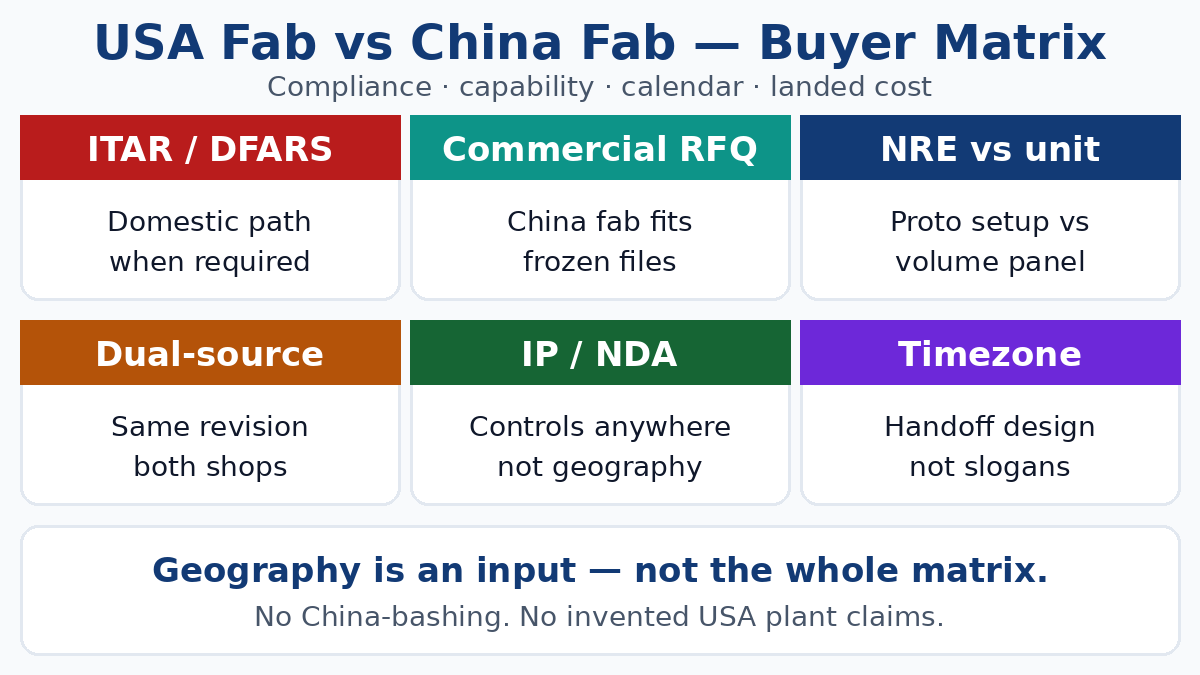
What USA-fab marketing usually gets right (and where it stops)
Quality systems, turnaround, communication, freight distance, and IP hygiene are legitimate selection criteria. A shop with a working QMS, clear CAM ownership, and disciplined traveler control can deliver better boards than a shop that only markets “ISO” on a brochure. Local presence can shorten some review loops. Domestic freight can shrink calendar risk on small rush lots. Strong data handling reduces one class of IP incident.
Where the listicle stops short is the decision matrix. Geography is not a quality system. ISO registration is not unique to one country. Turnaround depends on queue, material stock, via technology, and whether your files are frozen — not only on the passport of the factory. Communication quality is process and language discipline, not a timezone label. Shipping speed is mode and Incoterms, not a slogan. IP protection is contract, access control, and shop culture — practices buyers should demand from every fab, domestic or overseas.
Buyers who only score “USA vs overseas” on those five brochure points often miss the hard filters: controlled programs that require domestic manufacture, commercial programs where China fab capacity and unit economics dominate, and hybrid dual-source plans that use both.
When a USA fab is the better fit
Start with constraints that are not negotiable, then move to logistics and cost structure.
Controlled and regulated programs. If your contract, customer flow-down, or product scope requires ITAR, DFARS domestic preference, or other “manufacture in the United States” obligations, a USA fab (or an approved domestic supply chain) is usually the correct path. Do not ask a China fab to “work around” those clauses. Export-controlled technical data and defense articles belong in shops cleared and structured for that work. Mis-routing controlled files is a compliance failure, not a sourcing optimization.
On-site witness and short-radius collaboration. Some aerospace, medical, and industrial buyers need frequent witness of first article, microsection review, or line walks with short travel. A domestic fab can make that operationally cheaper even when unit price is higher. If your quality plan assumes unannounced or weekly on-site access, factor travel and visa reality into the China option honestly.
Same-day or next-morning engineering loops on volatile NPI. When design is still thrashing and you need same-shift EQ answers in your local business hours without overnight handoffs, a USA fab can reduce calendar friction. That is a logistics choice about review cadence — not proof that overseas CAM cannot do the job once files are frozen.
Very small rush lots where domestic freight and queue win. For a handful of boards needed for a demo in days, domestic expedite plus ground or overnight freight sometimes beats factory gate price plus international express — especially if customs or weekend gate times matter. Run the calendar math; do not assume “USA is always faster” on every stack and via plan.
Customer or investor mandate for domestic manufacture. Some commercial buyers face brand, ESG, or customer-of-record rules that require USA build even when China fab capability exists. Treat that as a program constraint, document it, and stop comparing unit price alone.
If none of the above apply, “choose USA for quality/ISO/IP” as a default is marketing, not a matrix.
When a China fab RFQ is rational
A China fab RFQ is rational for a large share of commercial electronics: consumer, industrial controls, IoT, instrumentation, many medical commercial builds that are not locked to domestic manufacture, and volume products where panel utilization and process menu depth dominate cost.
Capability coverage China fabs routinely handle. Multilayer FR-4, HDI and sequential via constructions within published capability, controlled impedance with coupons, common finishes (OSP, HASL/LF HASL, ENIG, immersion silver/tin), aluminum and other metal-core menus where stocked, flex and rigid-flex at shops that run those lines, flying probe and fixture test, and PCBA at integrated or partnered lines. XFPCB is a Shenzhen fab serving overseas buyers on customer-owned files — we fabricate and assemble to the traveler you freeze, within stated capability. We do not operate a USA plant, and this guide does not invent one.
What China fabs cannot (or should not) cover. ITAR/DFARS-restricted manufacture and controlled technical data that must stay domestic. Programs whose contract forbids overseas fab. Work that requires a specific domestic QPL or customer-approved plant list you are not on. Buyers should also separate “cannot” from “should dual-source”: some high-reliability programs keep a domestic fab as primary and a China fab as commercial or second source only after capability and IP gates pass.
NRE vs unit cost. Prototype and pilot lots carry CAM, tooling, coupon, and first-article setup. Unit price looks high because fixed work has nowhere to hide. Volume lots amortize setup when files stay frozen; panel utilization and recurring process dominate. China fab menus often win on unit economics once quantity and panel rules stabilize — provided you compare landed cost, not headline unit dollars alone. Do not force production unit expectations onto a five-piece sequential-via spin, and do not keep NPI test depth forever without saying so on the RFQ.
Dual-source without drama. Dual-source works when both shops price the same frozen revision, same stack and via notes, same finish and class/test depth, and when IP/NDA gates are equal. Use dual-source for capacity risk and negotiation leverage — not as a way to skip controlled-program rules. Keep AVL and revision lock discipline so “shop B” does not silently diverge from “shop A.”
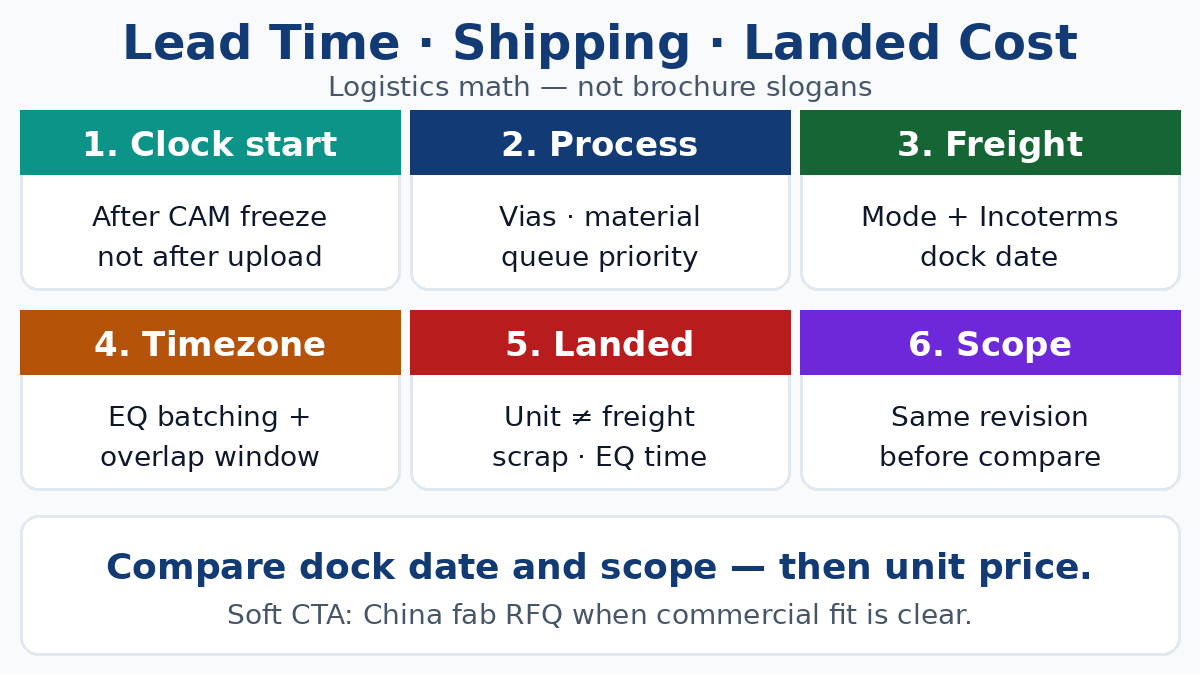
Lead time, shipping, and timezone — logistics, not slogans
Lead time is queue position, material availability, process complexity (especially sequential vias and special materials), and whether your CAM package is frozen. Expedite buys priority and overtime. File changes after CAM freeze reset the clock at any geography. A “fast USA turn” on an open EQ package can lose to a standard China turn on a clean traveler — and the reverse is also true when customs and express cutoffs dominate a tiny lot.
Shipping is mode (economy air, express, freight), Incoterms, packaging, and gate times. Domestic ground can beat international express on calendar for some inland destinations; international express can beat domestic when the overseas fab starts earlier on a frozen lot. Ask both bidders for production complete date and expected deliver-to-dock date under the same Incoterms. Board weight and carton count matter more than brochure claims.
Timezone is a handoff design problem. Overlap windows of a few hours, written EQ discipline, and a single revision owner beat hoping someone answers the phone at 2 a.m. Many overseas buyers run successfully with China fabs by batching questions, using clear fab notes, and accepting that deep CAM review happens on Shenzhen time. Poor communication is usually missing notes and mixed revisions — not the Pacific Ocean by itself.
Write calendar assumptions on the RFQ: when the clock starts (after payment, after CAM freeze, after material in stock), what “days” means (working days), and who owns customs paperwork. Then compare shops on those numbers.
Landed-cost math without invented price tables
Unit price is the factory-gate number under stated terms. Landed cost is what the program absorbs: fabrication, freight and duties where applicable, packaging and moisture protection, incoming inspection and scrap, rework from EQ churn, buffer stock while waiting on expedites, travel for on-site review if you require it, and engineering time spent clarifying what a cleaner RFQ would have stated.
A lower unit price with vague via notes, “impedance TBD,” and fragile panelization can lose to a higher unit price on a clean traveler. Domestic freight savings on a small lot can erase a unit-price gap — or fail to, once you add on-site travel and slower panel economics. Do not invent dollar menus for XFPCB or for generic “USA vs China” boards; process risk and quantity break structure differ by lot. Rank quotes on scope match, NRE versus unit split, panel assumptions, test/class depth, lead-time clock start, and exclusions — then look at the headline number.
Ask every bidder to price the same frozen Gerber/ODB++ revision with the same field table. Still-divergent quotes usually mean mismatched assumptions, not a morality story about geography.
IP and NDA practices buyers should require anywhere
Geography is not a substitute for controls. Require the same baseline from USA and China fabs:
- NDA before sharing non-public schematics, Gerbers, or BOM strategy when the design is sensitive.
- Named data handlers and a rule against using your files as sales samples or training props without written consent.
- Access control: limit who can download the job pack; prefer controlled portals over open email threads for production files.
- No unauthorized second-source builds from your data; subcontracting disclosed in writing.
- Retention and destruction: how long CAM keeps files, and how you revoke access after the program ends.
- Marking: classification or “customer proprietary” on drawings when your policy requires it.
USA shops are not immune to leaks; overseas shops are not doomed to them. Audit the practice, not the brochure. For controlled technical data, follow export rules first — then apply the same operational hygiene.
Stolen prototype risk is real. Patents and copyrights protect some aspects after the fact; shop process and contracts reduce exposure before the fact. Buyers who only “choose USA for IP” without an NDA and access policy are still under-protected.
Buyer checklist before you shortlist geography
Use this as a gate, not as a scorecard that always crowns one country.
- Compliance filter. ITAR, DFARS, customer domestic-only clauses, export-controlled data — yes or no. If yes, domestic path first.
- Capability filter. Layer count, via type, material, finish, class/test, flex/HDI needs — match published menus at each candidate. Do not award on hope.
- Calendar filter. Need-by dock date, overnight engineering churn versus frozen CAM, on-site witness frequency.
- Cost structure filter. Proto versus volume, NRE exposure, panel utilization, landed cost drivers — same revision package to every bidder.
- IP filter. NDA, access control, subcontract disclosure — required everywhere before sensitive files move.
- Dual-source filter. If you need two shops, freeze AVL rules and revision lock so the second source does not become a silent redesign.
Only after those gates should marketing themes (ISO badges, “fast turn,” “easy to call”) break ties. Geography is an input to the matrix, not the matrix itself.
Soft next step
Build the matrix before you build the slogan. If ITAR/DFARS, domestic plant lists, or mandatory on-site cadence apply, shortlist USA (or approved domestic) fabs and stop forcing an overseas comparison that cannot clear compliance. If the program is commercial, files can freeze, and capability fits a Shenzhen menu, a China fab RFQ is rational — compare landed cost and process scope, not brochure geography.
For XFPCB, send one revision-locked package when a China fab fits: Gerbers or ODB++, drill map, stack and finish notes, via plan, impedance targets or an explicit waiver, class and test depth, quantity band, and lead-time tier. Name NDA needs up front. We will price process and yield risk inside stated capability — not invent a USA factory story, and not pad unknowns you already clarified on the drawing.