
Brochure posts that list ITAR, RoHS, ISO, and UL — then close with “we hold all relevant standards” — still leave buyers awarding China fab and PCBA without knowing what each certification actually gates, what a wall certificate does not buy on the traveler, and how to verify scope, certificate number, and expiry before the PO. Treat competitor industry overviews as outside orientation, not XFPCB plant claims. This page owns a different frame: a buyer certification map (ISO 9001, ISO 13485, IATF 16949, RoHS / REACH, UL recognition, IPC workmanship) written as RFQ language — what each gates, why certificate ≠ product Class, how to verify claims honestly, and China fab context without inventing AS9100D, IATF, ISO 13485, or ITAR credentials for XFPCB. Soft CTA only. Sibling XFPCB posts already own AS9100D verify depth, IPC Class 2 vs Class 3 product locks, and broad partner checklists — do not merge those angles here. A later AS9100D-vs-ISO 9001 comparison stays separate too.
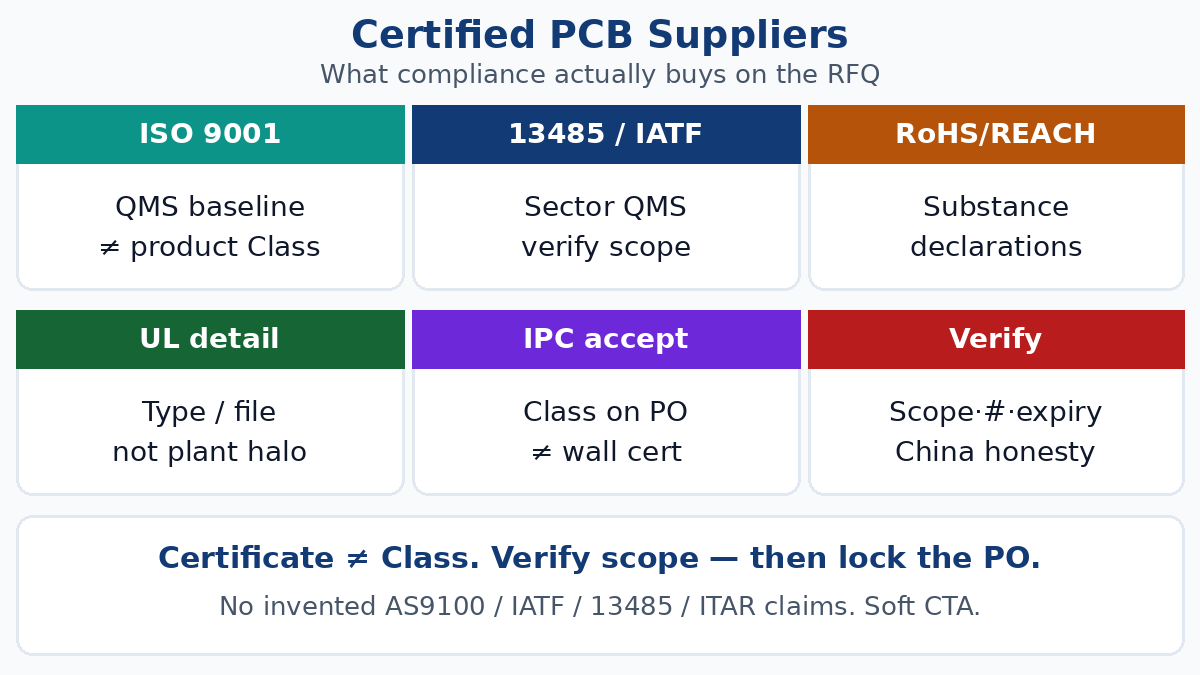
What “certified supplier” should mean on a buyer RFQ
A certification is evidence that an organization (or a product family) was audited or recognized against a named standard at a named scope and date. It is not a substitute for stackup, IPC class, test gates, lot traceability, or alloy / finish locks on your drawing. The useful RFQ question is not “are you certified?” — it is which certificate, which site, which scope statement, which expiry, and which product fields still must appear on the PO even when the PDF looks perfect.
Buyer-facing map categories that belong on this page:
- QMS certificates — ISO 9001 (general quality system); ISO 13485 (medical device QMS); IATF 16949 (automotive QMS).
- Substance / market access — RoHS and REACH as substance and communication obligations, not plant pride logos.
- Product recognition — UL recognition for specific constructions / types, not a blanket “UL factory” slogan.
- Workmanship accept — IPC-A-600 / IPC-A-610 / related fab-assy criteria as product language, not a wall cert replacement.
- Verify discipline — scope, certificate number, expiry, and China-fab honesty about what XFPCB does and does not claim.
Plant process and inspection flow for day-to-day quality work lives on XFPCB’s quality management page. Capability depth that is not a certificate lives on Technical Capabilities. This guide stays on certification map + RFQ verify language.
ISO 9001 — baseline QMS, not Class or flight readiness
ISO 9001 is the general quality-management system standard most export electronics buyers already expect from a serious China fab / PCBA house. It signals documented processes, corrective action, management review, and customer-requirement control — at the organization / site level. XFPCB’s public site framing includes ISO 9001:2015 as that China-fab baseline; treat it as a QMS filter, not as proof that every lot ships to a specific IPC class.
What ISO 9001 gates (usefully):
- Whether the house claims a managed system for quotations, change control, nonconformances, and supplier control.
- A starting point for audits, questionnaire packs, and long-program supplier files.
What ISO 9001 does not gate:
- IPC-6012 / IPC-A-610 Class on your boards.
- Medical device design controls, automotive APQP / PPAP flow-downs, or aerospace AS9100 program requirements.
- RoHS substance conformity for a specific BOM finish / solder alloy.
Write Class, test, and material locks as if the house were “QMS-present” — then keep ISO 9001 on the supplier qualification line. Do not let “ISO certified” erase missing accept criteria.
ISO 13485 — medical QMS when the program flows it
ISO 13485 is a medical-device QMS standard. When a supplier claims it, the honest read is: this organization runs (or claims to run) a medical-oriented quality system for how medical-related work is controlled — not that every PCB is a cleared device, and not that your risk file, UDI, or clinical claims were chosen for you.
What it gates: medical-oriented document control, traceability expectations, and supplier / process discipline when your program flows ISO 13485 to the board or assembly house.
What it does not gate: FDA / MDR device approval, biocompatibility of the finished product, or silent Class 3 fab windows under a medical logo.
XFPCB honesty: this guide does not invent or imply an XFPCB ISO 13485 certificate. Buyers who need ISO 13485 should verify the claiming supplier’s certificate, scope (fab vs assembly vs design), site address, and expiry. Buyers who do not flow it still need Class, CoC / lot, and test language when risk demands it.
IATF 16949 — automotive QMS, not a silent PPAP
IATF 16949 is the automotive QMS standard built on ISO 9001 with sector-specific expectations. A claim means the organization positions itself for automotive customer QMS flow-downs — PPAP, process capability, and change notification culture — when those are actually flowed.
What it gates: automotive-oriented QMS scope for plants that hold it; a filter for OEMs / Tier suppliers who require IATF on the AVL.
What it does not gate: your PPAP level, MSA plan, IMDS entries, or AEC component grades. Those remain program / BOM locks.
XFPCB honesty: do not invent IATF 16949 for XFPCB. If a quote mentions “automotive quality” without IATF scope or without product APQP fields, treat the phrase as marketing until scope and PO locks are written.
RoHS and REACH — substance gates, not quality trophies
RoHS restricts certain hazardous substances in electrical / electronic equipment for markets that enforce it. REACH adds EU chemical registration, evaluation, and communication duties (including SVHC awareness) that often show up as declarations and material communication — not as a substitute for solderability or reliability testing.
What they gate:
- Alloy / finish / solder choices that keep the product inside allowed substance limits for the target market.
- Documentation expectations: RoHS declarations, material declarations, and REACH SVHC responses when buyers require them.
- Process alignment with Lead-Free Assembly when lead-free is the compliance path — still write alloy, peak profile notes, and finish explicitly.
What they do not gate:
- IPC class, impedance coupons, or AOI coverage.
- “Green” marketing as proof that a specific lot’s CoC matches the BOM revision you froze.
Ask for declarations against your finish / alloy / BOM revision — not a generic homepage badge. When kits are turnkey, also lock substitution rules via Component Sourcing so a “RoHS OK” broker part does not silently enter the traveler.
UL recognition — construction / type, not a factory halo
UL recognition (for example flammability or PCB construction recognition) applies to specific constructions, types, or marks under defined conditions. Brochure language that says “UL certified plant” without type / file / construction detail is soft.
What UL-related claims can gate: whether a given board construction is recognized for a stated flammability / type path when your product or customer requires that mark trail.
What they do not gate: ISO QMS strength, medical or automotive program readiness, or IPC Class accept criteria.
XFPCB’s public About framing notes products as UL recognized in general terms — still verify the type / file / construction that matches your stack and solder-mask system when a customer flows UL. Do not paste “UL” into the SOW without the recognition details the auditor will ask for.
IPC workmanship — product accept language, not a wall certificate
IPC standards such as IPC-A-600 (bare board), IPC-A-610 (assembly), and related fab documents (for example IPC-6012 families) define how to accept product. They are not interchangeable with ISO 9001. A house can be ISO-audited and still default to Class 2 cosmetic windows unless your PO cites Class and revision.
What IPC language gates: annular ring, solder fillet, cleanliness, and defect disposition criteria on the lot you buy.
What a QMS certificate does not replace: naming Class 2 vs Class 3 (and which document) on the drawing / PO. Deep Class comparison lives on XFPCB’s dedicated Class 2 vs Class 3 guide — leave that pedagogy there. Here only the rule matters: certificate ≠ product Class.
Pair IPC accept language with named inspection on PCB board testing and inspection so “IPC compliant” is not an orphan slogan without electrical / optical gates.
Certificate ≠ product Class (and ≠ AS9100 / ITAR)
Keep these categories separate on every RFQ:
| Artifact | Buys you | Does not buy you |
|---|---|---|
| ISO 9001 certificate | Org QMS filter at a scope / site | IPC Class, FAI forms, substance CoC for a BOM |
| ISO 13485 / IATF claim | Sector QMS filter when verified | Device approval / PPAP pack without flow-down |
| RoHS / REACH declaration | Substance / communication evidence | Reliability or Class |
| UL recognition detail | Construction / type trail when matched | Blanket plant halo |
| IPC Class on PO | Product accept criteria | A substitute for QMS audits |
| AS9100D / ITAR | Aerospace QMS / export-control regimes when truly held | Anything this page invents for XFPCB — do not |
AS9100D verify depth (scope, surveillance, counterfeit, FAI vs QMS) owns a dedicated XFPCB aerospace page — cite that lane when programs flow AS9100; do not clone it here. ITAR is a US export-control regime, not a quality badge; never invent ITAR registration for a China fab narrative.
How to verify certificates before you award
Soft PDFs fail audits. Use the same verify block for every bidder:
- Legal name + site address on the certificate matches the plant that will run your lots (not a sister company in another city).
- Scope statement lists PCB fabrication, assembly, and/or design as you buy them — machining-only or “electronics” without PCB processes is a red flag.
- Certificate number + issuing body are readable; prefer bodies you can look up.
- Issue and expiry dates are current; calendar a refresh on long programs.
- Surveillance / recert status — ask whether major nonconformances are open when risk is high.
- Product locks still written — Class, CoC / lot, test gates, alloy / finish, and file revision on the PO even after the PDF checks out.
China fab honesty: many capable export houses operate under ISO 9001 (and related plant systems) without holding every sector certificate a US brochure stacks. That is normal. The failure mode is inventing missing certs — or treating a real ISO 9001 PDF as if it already wrote Class 3 and RoHS lot evidence for you.
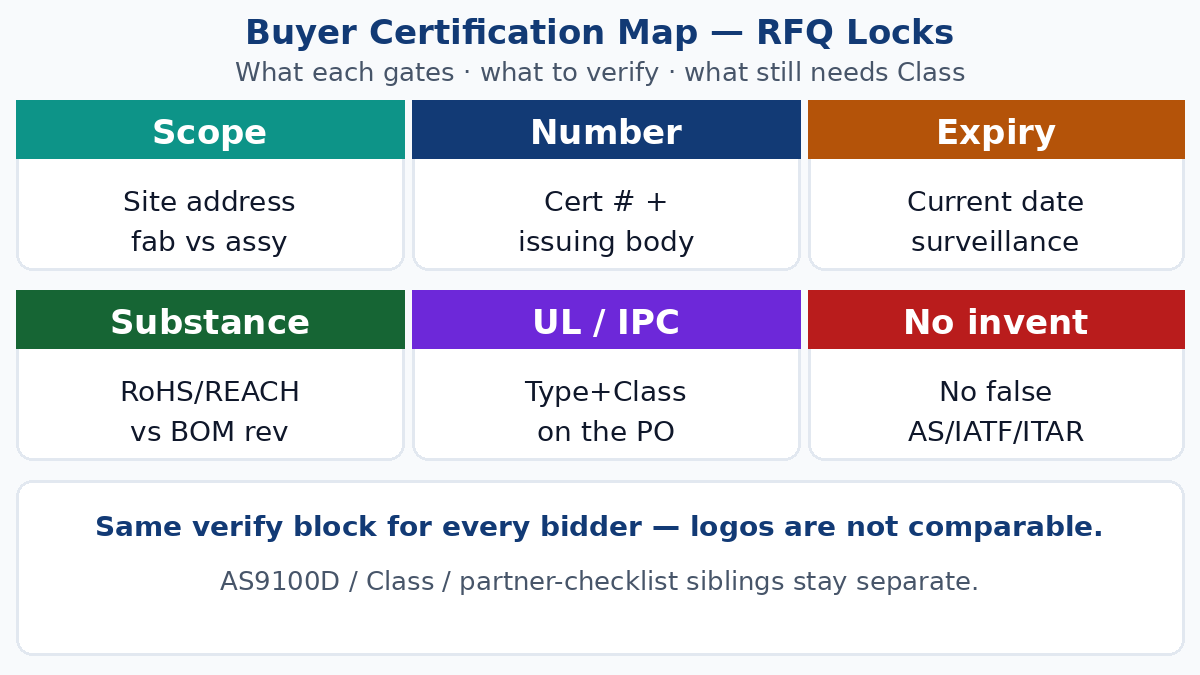
China RFQ paste block — certification map fields
Export quotes diverge when cert language stays soft. Paste a comparable block:
- Required QMS — ISO 9001 required? ISO 13485 / IATF / AS9100 only if the program truly flows them — never as decoration.
- Certificate evidence — PDF with scope, number, site, expiry due with the quote or before award.
- Substance path — RoHS / REACH declaration against named finish, solder alloy, and BOM revision; lead-free process notes when applicable.
- UL — required recognition type / file / construction — or explicitly “not required.”
- IPC accept — IPC-A-600 / IPC-A-610 (and fab Class document) with Class number and revision; no “IPC compliant” alone.
- Test / inspection named — electrical, AOI, X-ray, or functional ownership on the testing service path — not “certified testing included.”
- Traceability — CoC, lot / date code fields the program needs.
- No silent downgrade — Class, alloy, or cert-scope changes need signed EQ.
- Files frozen — Gerbers/ODB++, stack, BOM, and process notes on one revision before cert claims are treated as comparable.
Soft next step
Map which certificates your market and customer actually flow — then verify scope, certificate number, and expiry, and still write Class, substance, UL detail, and test gates as product language. Soft next step when the certification map and frozen files are clear: route the award through your normal path via How to Place an Order — after compliance is tied to verifiable artifacts and PO locks, not after a logo collage reopens Class and RoHS evidence post-PO.