
A flex PCB RFQ fails most often at the spec gate, not at copper L/S. Buyers mix three decisions China fabs price as different constructions: bend class (static vs dynamic), construction family (pure flex / flex + stiffener / rigid-flex), and the RFQ package that makes quotes comparable. Miss the gate and you buy the wrong stack at a low price — then respin when the part cracks at mate or fails cycle life.
This is a procurement/engineering decision gate, not a materials encyclopedia, bend-radius rewrite, or stiffener / coverlay / ZIF / micro-bump playbook. Those topics have dedicated articles — use them as boundaries. Thickness ratios and bend multipliers here are industry starting guidance only; confirm with your fab. They are not XFPCB capability claims.
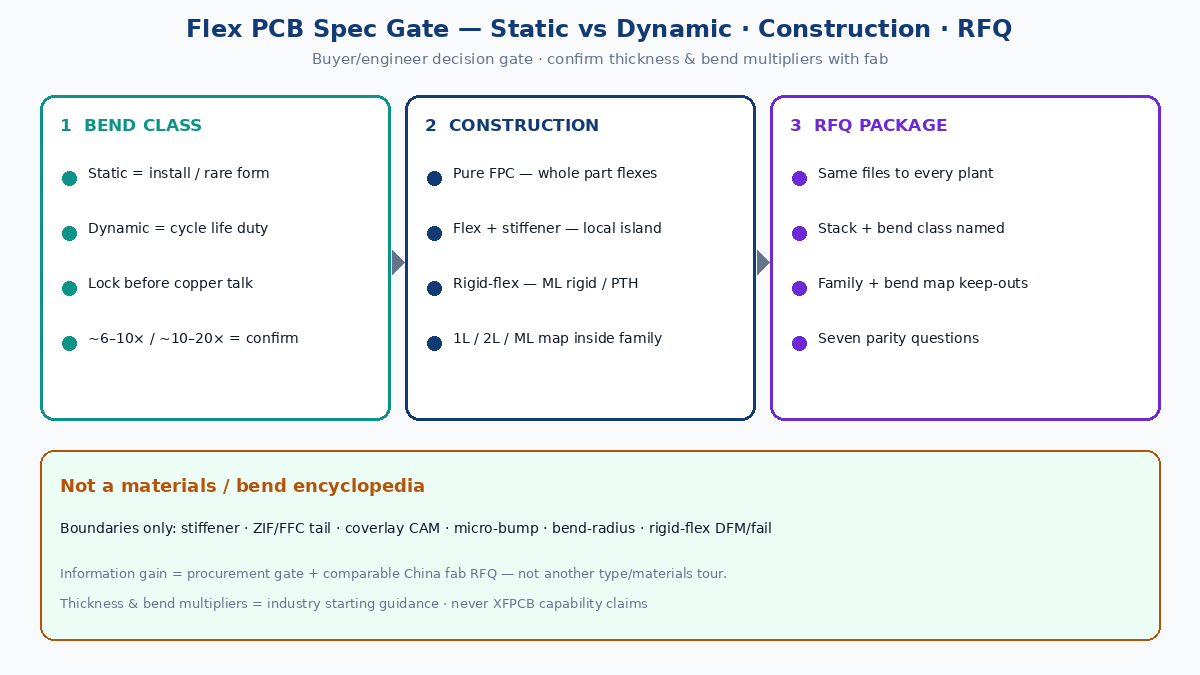
Quick answer
- Classify bend duty first — static (form once or rare service bend) vs dynamic (repeated flex cycles in the product life). Dynamic class drives copper type, stack thinness, and whether plated vias belong in the bend zone.
- Pick construction family second — pure flex when the whole part must flex and local rigidity is unnecessary; flex + stiffener when you need local islands for connectors / SMT / leaded parts; rigid-flex when you need multilayer rigid circuitry, plated through in the rigid, or transitions that stacked stiffeners cannot own cleanly.
- Map layer count lightly to the gate — single-sided for simple static routes; double-sided when you need two copper faces or selective vias; multilayer flex when routing density or controlled impedance forces more layers; rigid-flex when rigid sections carry the dense / PTH work. Do not tour “types” as a catalog — lock family from duty.
- Freeze the RFQ package before you shop price — gerbers / ODB++, stack-up with bend class called out, construction family, stiffener or rigid notes if any, finish, coverlay/mask, test class, quantity tiers, and the same questions to every plant.
- Keep specialized DFM out of this gate — bend-radius and dynamic-life numbers, stiffener material/adhesive, coverlay CAM oversize, ZIF/FFC finished thickness, micro-bump height, and rigid-flex bend-failure diagnosis live in their own playbooks. Reference them; do not rewrite them here.
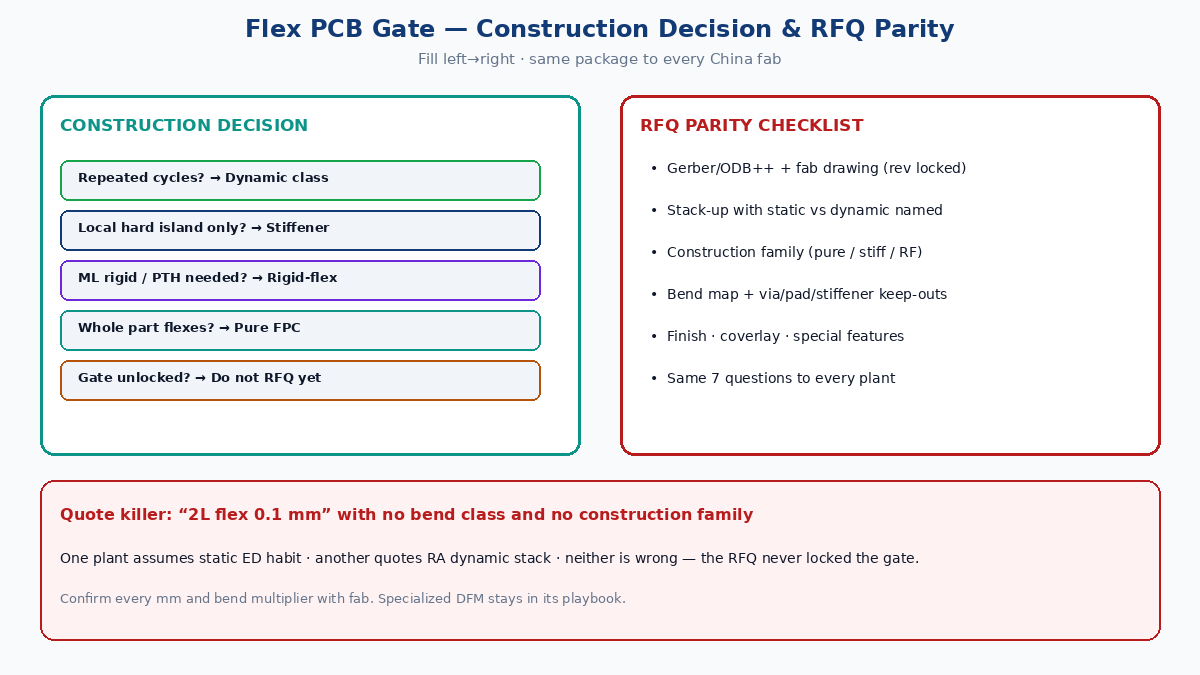
Factory tip: A quote that only says “flex PCB, 2 layer, 0.1 mm” with no static/dynamic class and no construction family is not comparable across plants. One fab will assume static PET-leaning habits; another will quote RA copper dynamic stack; neither is wrong — your RFQ never locked the gate.
Why the gate exists (and what a catalog guide misses)
Broad “flex design guides” walk types, materials, bend formulas, and applications in parallel. That is useful encyclopedia reading. It is a weak buyer tool because price and yield move on three locked fields:
| Gate field | What the plant actually quotes | What goes wrong if unlocked |
|---|---|---|
| Bend class | Static vs dynamic copper/stack assumptions, via-in-bend policy | Dynamic part quoted as static → early crack; static part over-specced → unnecessary cost |
| Construction family | Pure FPC vs stiffened FPC vs rigid-flex process route | Stiffener island quoted as “flex”; rigid-flex quoted as FR4 + flex patch |
| RFQ package parity | Same files + same questions to every China fab | Lowest price wins on incomplete data; first articles teach what was assumed |
Information gain for sourcing is the gate plus a comparable RFQ package, not another materials tour.
Step 1 — Static vs dynamic (bend class)
Lock bend class before you argue copper brand or coverlay thickness.
Static flex (install / service form): bent at assembly or rare service, then stays put (fold-to-fit straps, once-formed hinges). Specify form radius; “static” is not unlimited sharp fold. Plated features belong outside the form zone unless the fab owns that class.
Dynamic flex (cycle life): product flexes repeatedly (lid hinges, wearables, mechanisms with stated cycles). Expect thinner copper, RA copper discussions, strict keep-outs for vias and coverlay steps in the bend, and acceptance tied to cycle targets — confirm multipliers and life-test method with fab. If you cannot state cycles or motion type, do not RFQ “dynamic” as a buzzword.
Gate checks before construction: (1) one-time/rare vs repeated use; (2) approximate cycles if dynamic (confirm test method with fab — do not invent IPC numbers without agreement); (3) vias, pads, or stiffener edges inside the bend map? redesign before quoting; (4) shield or stiffener across the hinge? that often forces selective EMI / stiffener / rigid-flex — detail in those playbooks.
Industry buyers often discuss static form in ~6–10× thickness radius classes and dynamic in ~10–20×+ classes by copper, layers, and duty. Treat multipliers as confirm-with-fab conversation numbers, never XFPCB guarantees or silent drawing defaults. Full bend-radius / dynamic-life detail lives in the bend-radius playbook.
Step 2 — Construction family (pure / stiffened / rigid-flex)
After bend class, pick the family. Layer count sits inside the family — it is not a substitute for it.
| Construction | Choose when | Do not choose when | Gate note |
|---|---|---|---|
| Pure flex (FPC) | Whole area must flex or fold; no local SMT / connector island that needs rigidity | You already know ZIF insert thickness or SMT reflow needs a hard island | Lowest part count; black-box still needs bend class + stack |
| Flex + stiffener | Local rigidity for connector support, SMT island, leaded/TH, or metal heat/EMI mass | You need multilayer rigid circuitry or many PTH in a “rigid” zone | Stiffener is a bonded island — material/adhesive/side/keep-out live in the stiffener applications playbook |
| Rigid-flex | Multilayer rigid sections, plated through owned by the rigid stack, dense transitions, or reliability duty that stacked islands fail | You only need one dumb FR4 spacer under a connector | Different process route and price; DFM and bend-failure detail live in rigid-flex playbooks |
Light layer map (tied to the gate, not a type catalog): single-sided for simple static/dynamic ribbons; double-sided when you need two faces or selective vias (keep vias out of dynamic bend unless the fab owns that class); multilayer flex only when density or impedance forces it (dynamic ML is a harder reliability talk — confirm with fab); rigid-flex when the gate says stiffener is not enough.
Do not RFQ “2L flex or rigid-flex, whichever is cheaper” without stating whether the hard zone needs PTH and multilayer circuitry.
Boundaries (detail lives in specialized playbooks): stiffener material/adhesive/side; ZIF/FFC finished insert thickness; coverlay CAM oversize; micro-bump height/coplanarity; rigid-flex transition DFM and bend-failure causes; dynamic copper/adhesive selection. This gate only decides which door you walk through.
Step 3 — Construction decision table (buyer / engineer)
Use this table on the RFQ kickoff call. Fill left to right; stop when a cell forces a family.
| Question | If yes → lean | If no / unclear → |
|---|---|---|
| Repeated flex cycles in product life? | Dynamic class; thin stack / RA copper conversation; via-in-bend policy | Static class; still lock form radius |
| Need local hard island for connector / SMT / leaded only? | Flex + stiffener | Stay on pure flex or escalate |
| Need multilayer rigid circuitry or PTH in the hard zone? | Rigid-flex | Stiffener may still be enough |
| Dense routing only on flex, no hard zone? | Pure flex (1L / 2L / ML as density requires) | Re-check stiffener vs rigid-flex |
| Shield or metal mass across a hinge? | Selective construction; often stiffener/EMI or rigid-flex conversation | Keep shield out of dynamic bend map |
| Cannot state bend class or construction family? | Do not send RFQ yet | Lock gate fields first |
A filled table is more valuable than a materials paragraph. Plants quote what you lock; they invent what you leave blank.
Step 4 — RFQ package that makes China fab quotes comparable
Price shopping without package parity produces three numbers for three different products. Send the same package to every plant.
Files and drawings
| Package item | Why it must be present | Minimum note on the drawing / traveler |
|---|---|---|
| Gerber or ODB++ + fab drawing | Geometry and stack authority | Revision locked; units and layer names clear |
| Stack-up with bend class | Static vs dynamic changes copper/stack assumptions | “Static install” or “Dynamic, ~N cycles (confirm test)” |
| Construction family | Route and price family | Pure FPC / FPC+stiffener / rigid-flex |
| Bend map | Where form or cycle happens | Keep-outs for vias, pads, stiffener edges |
| Stiffener notes (if any) | Island material/side/adhesive | Point to stiffener playbook fields — do not leave “FR4 TBD” |
| Rigid section notes (if RF) | Layer count, PTH, impedance | Do not imply stiffener = rigid-flex |
| Coverlay / mask / finish | Solderability and contact | Finish type; coverlay openings called where critical |
| Impedance / shield (if any) | Controlled lines and EMI | Spec targets; confirm with fab — no brochure default |
| Array / special features | ZIF tail, micro-bump, etc. | Reference specialized acceptance; do not bury in “flex notes” |
| Quantity + panel prefs | Price break and tooling | Proto vs MP tiers asked the same way |
Questions every plant must answer the same way
- Which construction family are you quoting (pure / stiffened / rigid-flex)?
- What copper type and thickness do you assume for the stated bend class?
- Are vias or pads allowed in the bend map as drawn? If not, what change do you require?
- For stiffened parts: material, adhesive class, side, thickness — confirm mm with your process (not a silent shop default).
- For rigid-flex: do you own PTH in the rigid and the transition construction shown?
- What FAI / electrical test is included at this price tier?
- Lead time for the same revision at proto and at MP quantity?
If two quotes disagree on family or bend-class assumptions, they are not comparable — re-ask before awarding.
Common gate failures
| Failure | Buyer wrote | Plant assumed | Outcome |
|---|---|---|---|
| Dynamic as static | “Flex cable, bend to fit” | One-time form | Crack after hinge use |
| Stiffener as rigid-flex | “Need hard area” | Bonded FR4 island | No multilayer/PTH story |
| Rigid-flex as stiffener | “Rigid-flex” + one FR4 pad | Full RF process | Over-price or silent simplify |
| Incomplete RFQ | Gerbers only | Shop stack/finish | First articles mismatch |
| Spec DFM dumped in gate notes | ZIF + coverlay + bend in one para | Conflicting defaults | CAM loop / slip |
Fix gate fields before negotiating panel cents.
Using specialized playbooks
Walk bend class → construction family → RFQ package. When a cell needs depth: bend-radius / dynamic-life; dynamic material selection; stiffener applications; ZIF/FFC tail; coverlay opening accuracy; micro-bump array; rigid-flex DFM and bend-failure. Advantages / functional-flex articles explain why flex — they do not replace this gate. Do not merge those RFQ note sets into one vague “flex PCB” line.
Closing checklist
- Bend class locked (static vs dynamic) with one duty line.
- Construction family locked (pure / flex+stiffener / rigid-flex).
- Layer count chosen inside that family — not as a catalog tour.
- Bend map keep-outs reviewed (vias / pads / stiffener edges).
- Specialized features pointed to their own notes.
- Same package + same seven questions to every fab.
- Thickness / bend-multiplier figures marked confirm with fab — never silent capability claims.
Lock the gate first. Then shop price.