
SMT benefits lists that open with “smaller, cheaper, faster” and close with a partner CTA still leave buyers quoting China PCBA without knowing when those benefits show up on the traveler — and when they do not. Competitor industry write-ups often stack autocorrect, EMC, dual-side density, and vibration reliability as universal wins; treat those as outside orientation, not XFPCB factory facts, and never paste invented “90% smaller” or “10× faster” ratios into an SOW as plant capacity. This page owns a different frame: when SMT benefits actually pay for buyers (density, dual-side placement, automation yield, signal / EMC loop control, vibration-friendly mass), honest limits (rework access, mechanical stress / connector yank, mixed-tech reality), and China fab RFQ fields that make paste / stencil, reflow profile notes, AOI coverage, and moisture / MSL comparable. Soft CTA only. Sibling XFPCB posts already own the SMT-vs-through-hole showdown, assembly-era landscape pressure tests, QA-test catalogs, and AOI role pedagogy — do not merge those angles here.
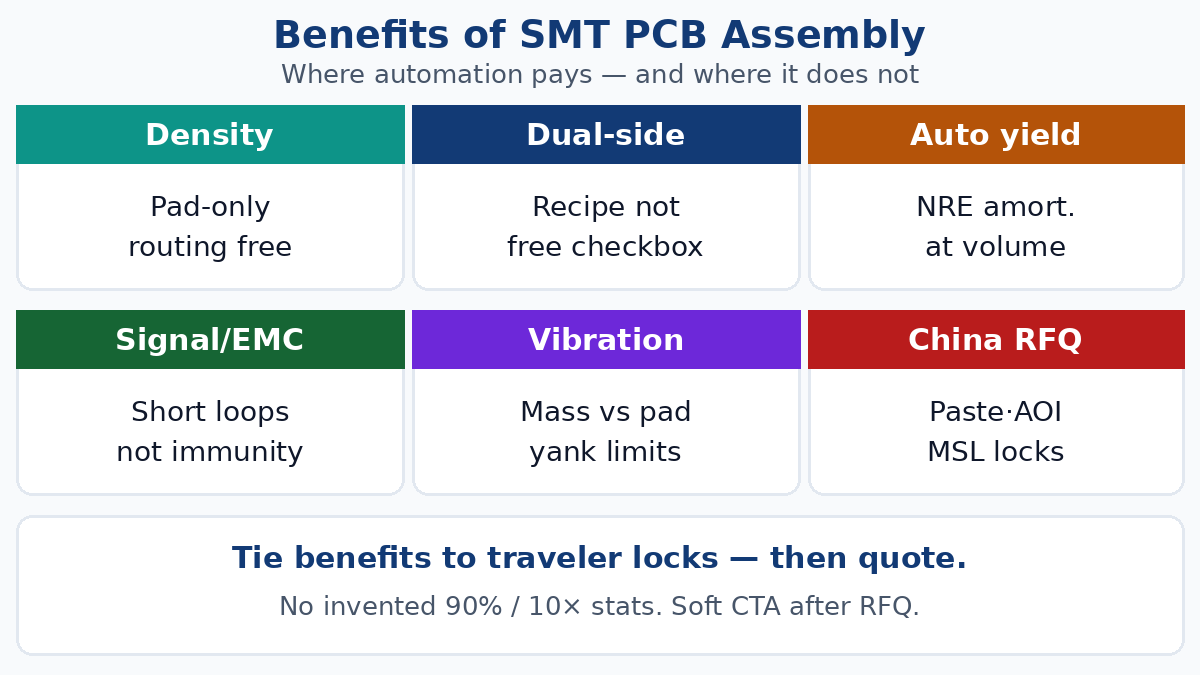
What “SMT benefit” should mean on a buyer RFQ
Surface-mount technology mounts components on copper pads and solders them in reflow (sometimes with selective or hand touch-up). On a China traveler that usually means paste print → pick-and-place → reflow → inspection, not a marketing era. The useful question is not “is SMT better than through-hole?” — that comparison lives on XFPCB’s dedicated SMT-vs-THT buyer guide. The useful question here is which SMT benefits your BOM and volume actually unlock, and which RFQ fields lock them so two export houses price the same process window.
Buyer-facing benefit categories that belong on this page:
- Density and dual-side real estate — when pad-only mounting frees routing and both sides of the board.
- Automation yield and NRE amortization — when pick-and-place + reflow beat hand or wave economics for your lot size.
- Signal / EMC loop control — when short SMT leads shrink parasitics that long through-hole stubs would add.
- Vibration-friendly mass — when lighter packages reduce inertial stress if pads and underfill are designed for the duty.
- Honest limits — rework, mechanical yank, and mixed-tech connectors that still force through-hole or selective steps.
Service depth for running the line lives on SMT PCB Assembly. This guide stays on buyer timing and RFQ language.
Density — when pad-only mounting actually pays
SMT pays on density when the design needs more nets, finer pitch ICs, or a smaller outline than plated holes will allow. Every through-hole pin consumes a vertical copper column and blocks routing on every layer the drill pierces. Surface pads leave inner layers freer and shrink land sizes for chip passives and fine-pitch packages.
Benefits show up when:
- The BOM is dominated by chip resistors / capacitors, QFN / LGA / BGA PCB packages, and connectors available in surface-mount form.
- Outline or stack height is constrained (modules, wearables, dense industrial controllers).
- You are already driving HDI PCB microvia architecture because BGA pitch or escape routing demands it — SMT is then the assembly counterpart to that fab choice, not a brochure upgrade.
Benefits stay soft when:
- The board is sparse and already meets outline with through-hole parts on the bench.
- Density claims are copied from industry averages without panelization, keep-out, and side-constraint notes on your drawing.
Do not invent XFPCB “X× denser” ratios. Ask the house for panel density and side constraints against the frozen Gerber instead of pasting competitor brochure numbers into the PO.
Dual-side placement — second side as a real traveler choice
Mounting parts on both sides is a classic SMT advantage. It is also a process recipe, not a free checkbox. Bottom-side glue, dual reflow, or carefully ordered selective steps change fixturing, thermal budget, and AOI access.
Dual-side pays when:
- Top-side real estate cannot hold the BOM without growing the outline or layer count.
- Both sides use packages the plant’s stencil / place / reflow window already qualifies.
- You write which side reflows first, whether adhesive is required, and how tall parts on side A shadow side B inspection.
Dual-side fails quietly when:
- The RFQ says “SMT both sides” with no sequence, no max component height per side, and no note on connectors that must stay clear of carriers.
- Odd-form through-hole parts still land on the wave side without selective or pallet language — that is mixed-tech, not dual-side SMT.
Prototype and quick-turn paths amplify this: a Prototype PCB Assembly or Quick Turn PCB Assembly spin that invents dual-side mid-quote will miss stencil and fixture NRE that a production traveler already amortized.
Automation yield — where pick-and-place economics show up
SMT’s automation story is real at the right volume: paste, place, and reflow are machine-paced once feeders and the PCB SMT Stencil are proven. Yield improves when SPI / AOI gates catch paste and placement escapes before lots leave the line — provided coverage and human EQ are named, not implied.
Automation pays when:
- Mid- or high-volume runs reuse the same stencil, feeder setup, and oven profile across lots.
- Fine-pitch and BGA packages need repeatable placement that hand soldering cannot match at rate.
- You lock first-article / pilot gates before releasing rate production, so programming bugs die on ten boards instead of a thousand.
Automation does not magically pay when:
- Lot size is a handful of boards and stencil + program NRE dominate total cost — hand or selective paths can still win for THT-heavy protos.
- “High yield” appears on the quote with no AOI stage, no SPI mention, and no accept criteria tied to IPC class.
- Moisture-sensitive devices ship without MSL / bake language, then fail after reflow for reasons the placement rate never predicted.
Honest framing: automation amortizes setup; it does not erase setup. Write volume assumptions and NRE ownership on the RFQ so proto and mass quotes do not hide different travelers.
Signal integrity and EMC — short loops, not slogan immunity
Shorter SMT terminations reduce lead inductance and radiation loop area versus long through-hole leads. That helps high-speed digital edges and many RF front-ends. It is not a substitute for stackup, return paths, filtering, or enclosure design.
Signal / EMC benefits show up when:
- Critical nets were designed for surface-mount packages and controlled impedance from the start.
- You keep stub length and package choice aligned — swapping a THT connector onto a GHz path undoes the SMT loop win at that interface.
- EMC is treated as a system property; SMT is one contributor, not a certificate.
Keep claims honest:
- Do not paste competitor “better EMC compatibility” bullets as XFPCB test results.
- Name finish, stack revision, and any impedance coupons when SI matters; assembly alone cannot rescue a soft FR-4 assumption on multi-gigabit nets.
Deep SI / EMI essays stay on dedicated posts. Here the buyer lock is simple: choose SMT packages where loop control was a design goal, then still write electrical / functional ownership on PCB board testing and inspection when the product needs proof beyond optical gates.
Vibration and mechanical duty — lighter mass with pad limits
Smaller SMT packages reduce mass and can improve survival under shake when pads, copper weight, and underfill / staking match the duty. SMT joints are not automatically tougher than through-hole under cable yank or panel-mount loads.
Vibration-friendly SMT pays when:
- The failure mode is package inertia on a well-supported board, not connector side-load.
- Undefilled BGAs / CSPs and tall cans have support or underfill called out when the environment demands it.
- Conformal coat or staking is named as a separate process, not assumed inside “SMT.”
Mechanical limits that still favor through-hole or hybrid:
- Connectors with repeated mating, cable side-load, or chassis mount loads that would lift SMT pads.
- Power pins and heavy magnetics that need hole copper and thermal mass.
- Field-service sockets and replaceable modules expected to survive iron rework.
Those limits are why Through-Hole Assembly still appears on most industrial travelers — usually as a mixed board, not a pure SMT romance. The SMT-vs-THT showdown page owns when to mix; this page only refuses to sell SMT vibration benefits without pad and duty honesty.
Honest limits — rework, stress, and mixed-tech reality
Buyers lose money when benefit lists hide the costs SMT still carries.
Rework access. Fine-pitch QFNs, BGAs, and 0201 passives are harder to rework than large through-hole leads. Budget hot-air / BGA rework skill, X-ray confirmation after rework, and scrap risk on dense modules. “Easy rework” is not an SMT universal.
Thermal and moisture windows. Lead-free reflow peaks stress moisture-sensitive parts. MSL level, floor life, and bake instructions belong on the kit traveler — especially on Turnkey PCB Assembly jobs where the house owns moisture-sensitive device handling.
Mixed-tech is the default. Most “SMT” production boards still carry a handful of through-hole connectors or power parts. Quoting pure SMT unit rates against a BOM with THT pins is how cheap bids omit selective tooling. Call mounting types on the BOM and process intent on the RFQ.
NRE vs piece price. Stencil fabrication, feeder setup, and oven profiling are real costs. They pay back across volume; they punish one-off spins that pretended to be high-volume SMT.
China fab / PCBA RFQ fields that lock SMT benefits
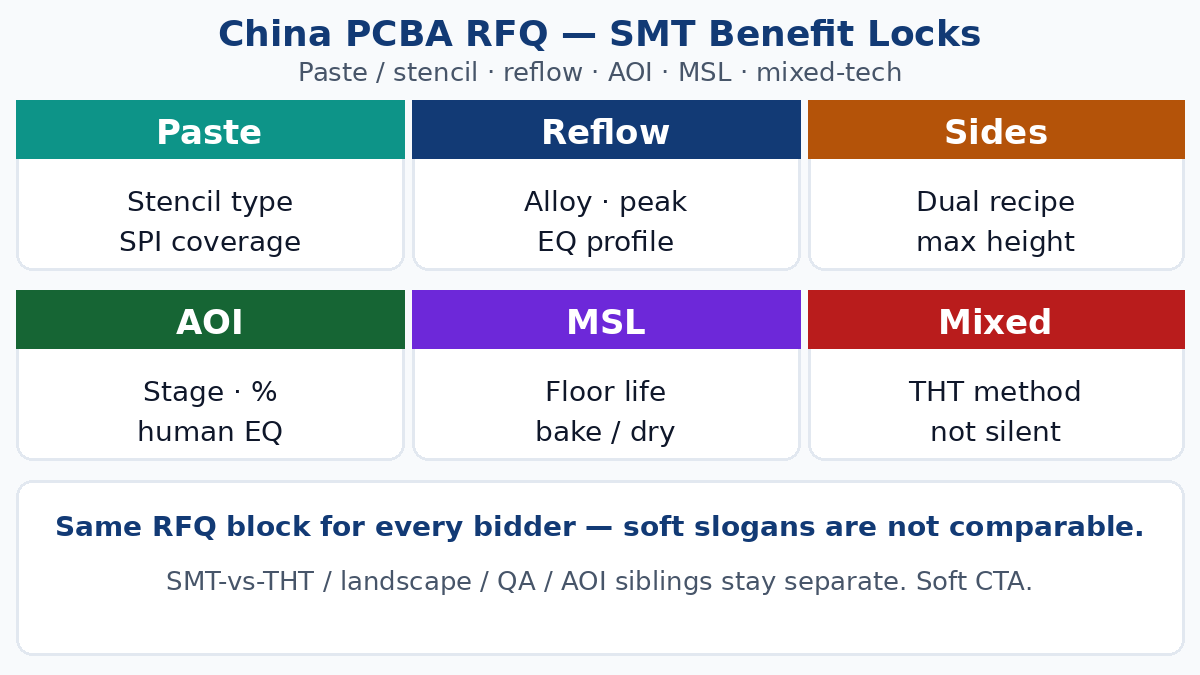
Export quotes diverge when paste, profile, inspection, and moisture language stay soft. Paste the same block so every bidder prices the same window:
- Paste / stencil — laser-cut vs electroformed when pitch demands it; stencil thickness / aperture reduction notes; SPI yes/no and sample vs 100%. Tie the physical tool to PCB SMT Stencil expectations, not “paste included.”
- Reflow profile notes — alloy (SAC305 / other), peak and time-above-liquidus targets or “house profile within IPC band + EQ for exceptions”; which packages are profile-critical (BGA, large electrolytic, LED).
- Side / sequence — single-side vs dual-side; order of reflow; adhesive or carrier requirements; max height per side.
- AOI coverage — post-reflow stage; 100% vs sample; human false-call EQ. Prefer named coverage over “optical inspection included.” Pedagogy for AOI as a method lives on the dedicated AOI role post — here only the PO coverage field matters.
- Hidden-joint proof — X-ray sample plan for BGA / QFN / LGA when fillets are hidden.
- Moisture / MSL — MSL floor-life handling, bake before reflow when required, dry-pack / humidity-indicator expectations on inbound kits or turnkey buys.
- Mixed-tech honesty — SMT-only vs SMT + THT; wave vs selective vs hand for through-hole pins; no silent assumption of pure SMT rates.
- Class / accept — IPC class and whether cosmetic vs electrical criteria differ; change control so paste volume and oven changes need signed EQ.
- Volume path — proto vs rate assumptions so Prototype PCB Assembly and mass quotes do not hide different stencil / AOI travelers.
- Files — Gerbers/ODB++, BOM with package + mounting type, CPL / XY, paste-layer intent, and process notes on one revision.
How this differs from sibling XFPCB pages
- SMT vs through-hole owns the head-to-head showdown, when to mix, and mixed-tech order of operations — pair for package decisions; do not clone comparison scoreboards here.
- PCB assembly landscape owns assembly-era tech pressure tests (AI inspection expectations, HDI/flex/HF, sustainability honesty) — leave landscape framing there.
- PCB quality assurance tests owns the QA-test catalog — cite testing service pages when locking gates; do not merge test menus into this benefits guide.
- Role of AOI owns AOI pedagogy — this page only forces AOI coverage language on the SMT RFQ.
- Service hubs (SMT PCB Assembly, Through-Hole Assembly, turnkey / proto / quick-turn) own commercial scope — this post is the buyer timing and RFQ companion, not a second service brochure.
Soft next step
Map which SMT benefits your product actually needs — density, dual-side, automation amortization, loop control, vibration mass — then paste the paste / stencil, reflow, AOI, and MSL block so every China PCBA bidder prices the same window. Soft next step when Gerbers, BOM mounting types, CPL, and named gates are frozen: route the award through your normal path via How to Place an Order — after benefits are tied to traveler locks, not after a benefits brochure reopens stencil thickness and AOI coverage post-PO.