
Automotive PCB RFQs that stop at “automotive quality” still ship lots with soft Tg defaults, undersized fillets on connectors, and no named inspection gate for the vibration class the module will see. The failure is rarely that the factory cannot build multilayer boards. It is that cabin infotainment, body control, lighting, under-hood sensors, and power stages punish different process windows — and brochure pages that celebrate market growth do not translate environment stress into fab and assembly choices. Competitor industry write-ups often open with electronics-share-of-vehicle narratives and mean-time-to-failure chatter; treat those as industry talk, not factory data. This page owns a different buyer frame: why harsh automotive environments force specific fab/assy decisions (vibration and solder joints, thermal path, load-dump / power integrity, flex and rigid-flex packaging, inspection gates) plus an RFQ checklist for China fab buyers. Soft CTA only. Sibling XFPCB marketing pages already cover automobile electronics applications and NEV capability overviews — do not merge those angles. Leave AS9100D, Class 2 vs Class 3, dedicated HDI, and flex-depth posts alone; link service pages only when prose names the same topic. No invented XFPCB IATF / AS9100 plant certificates; no invented market dollars or CAGR.
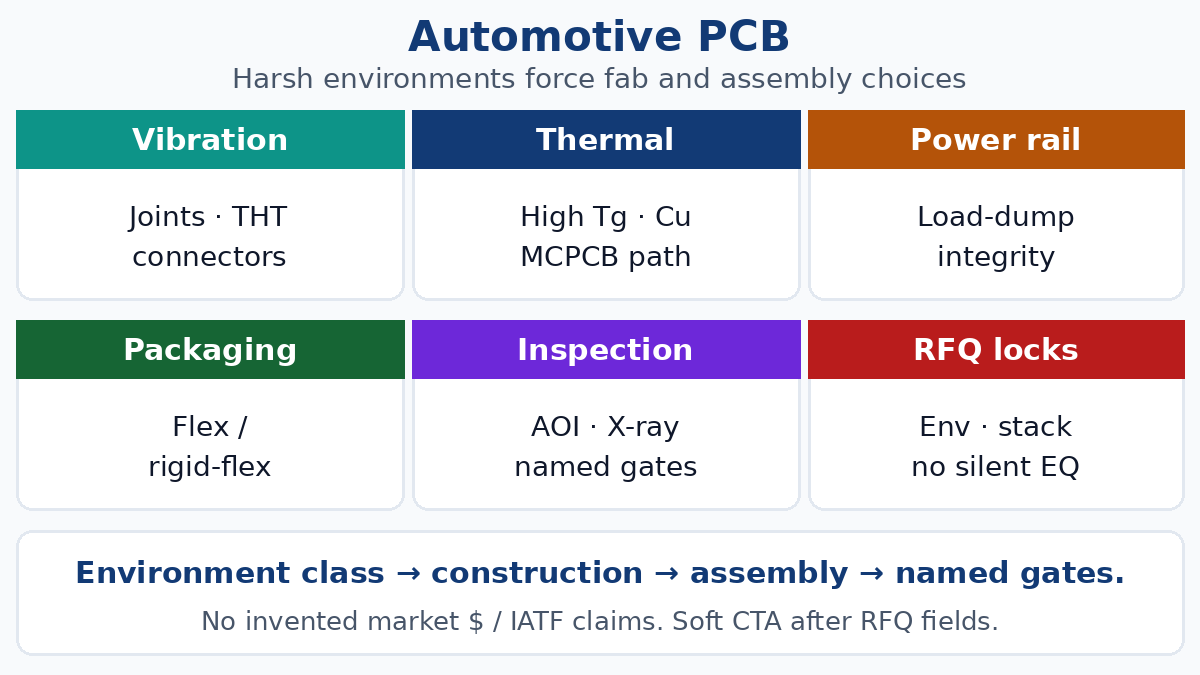
Why “automotive quality” is not a fabrication specification
“Automotive” on an RFQ does not enlarge annular rings, pick copper weight, or invent conformal-coat keep-outs. It usually means: long service life under thermal cycling, vibration from road and powertrain, humidity and contamination risk, and electrical abuse on the vehicle power rail that consumer gadgets never see. Factories fill blank travelers with house defaults — standard FR-4 Tg, sample AOI, soft “IPC Class 2,” no coat — unless the buyer writes environment → process locks.
Separate three jobs before you choose construction:
- Environment class — cabin vs under-hood vs chassis-mounted sensor vs high-current power stage.
- Construction — laminate Tg / thermal conductivity, copper weight, metal-core vs FR-4, flex vs rigid vs rigid-flex, finish, coat.
- Assembly and proof — SMT vs through-hole on connectors, underfill / staking where vibration demands it, named inspection and electrical gates.
Marketing pages list modules (controls, lighting, sensors, chargers). Buyers need the translation: which stress forces which process window on the PO. Capability context for automobile modules lives on the applications page PCBs for Automobile Electronics; this blog owns the RFQ and process-choice depth those pages intentionally keep short.
Vibration and solder joints — what fab and assembly must lock
Road and powertrain vibration turn weak mechanical joints into intermittent opens long after bring-up passed. The usual escape is not “missing AOI.” It is a connector or large mass part that was treated like a phone PCB: undersized pads, thin fillets, no through-hole where the drawing needed it, or SMT-only on a tall electrolytic that should have been staked or supported.
Fab-side locks that matter under vibration:
- Hole size and annular ring for press-fit or through-hole connectors sized to the pin and plating stack — not “minimum drill.”
- Copper balance and board thickness so connectors do not lever the laminate into pad cratering.
- Finish chosen for contact reliability and coat adhesion when corrosion or humidity is in scope (state ENIG vs alternatives; do not leave “default HASL” if the OEM drawing forbids it).
Assembly-side locks:
- Prefer Through-Hole Assembly (or mixed technology) for high-mass connectors and power terminals that see repeated mechanical load; keep fine-pitch logic on SMT PCB Assembly where density belongs.
- Call out staking, underfill, or adhesive for tall parts when the vibration class demands it — “automotive SMT” alone does not invent glue process.
- Define conformal-coat keep-outs around connectors early so coat does not block mating or trap residues under vibration-prone shells.
Write vibration class (or OEM customer standard reference) on the RFQ so the house does not silently treat a chassis ECU like cabin UI.
Thermal path — High Tg, heavy copper, and metal-core choices
Temperature extremes and thermal cycling drive delamination, via fatigue, and solder joint creep. Cabin boards may survive on mid-Tg FR-4; under-hood and power stages often need higher glass-transition laminate, thicker copper, or a metal-core path. Soft “high reliability FR-4” without a Tg number inherits the cheapest stock.
Translate heat into construction language:
| Thermal driver | Construction buyers usually force | What still belongs on the drawing |
|---|---|---|
| Elevated ambient / reflow margin | High Tg PCB callout (state Tg, not “automotive FR-4”) | Max operating temp, peak reflow profile notes |
| High continuous current | Heavy Copper PCB on power planes / traces | Copper weight per layer, current density limits |
| LED / localized heat sinking | Aluminum PCB or Metal Core PCB | Dielectric thickness, thermal resistance target |
| Mixed heat + dense logic | Hybrid stack or separate power MCPCB + signal FR-4 | Which nets live on which construction |
Do not invent a single “automotive stackup.” Lighting MCPCB, gateway multilayer, and on-board charger power stages are different products. Share temperature range, power dissipation map, and whether coat is required so CAM does not guess.
Load-dump, cold crank, and power integrity on the board
Vehicle electrical systems abuse electronics in ways USB gadgets never do: load dump, cold crank, reverse polarity, double-battery jump scenarios, and noisy ground returns. Industry application notes discuss these events qualitatively; treat quantitative pulse tables as program / OEM standard flow-down, not as XFPCB factory facts. What belongs on the fab/assy RFQ is the board-level consequence:
- Copper weight and plane strategy for surge and continuous current — again Heavy Copper PCB when the power path is real.
- Creepage / clearance and slotting when high-voltage NEV stages are in scope (flow OEM spacing rules; do not invent them here).
- Controlled Impedance Control PCB coupons when camera, radar, or high-speed gateway nets need SI — environment stress does not remove SI discipline.
- Decoupling and return-path rules called out in the design package so assembly cannot “optimize away” critical caps during DFM cost-down without EQ.
Power integrity is a drawing and BOM lock, not a slogan on a China quote. If the module sits on a 12 V / 24 V / HV bus with defined transient classes, name the standard or attach the OEM clause — “automotive power” without a reference is soft.
Flex and rigid-flex packaging when space and connectors fight you
Automotive packaging often needs boards that fold into irregular housings, replace wire harness segments, or survive repeated motion in mirrors, seats, and steering-adjacent modules. Flexible PCB and Rigid-Flex PCB constructions reduce connector count — and connector count is a vibration and cost failure mode. That does not mean every automotive RFQ should say “make it flex.”
Buyer discipline:
- Static flex (install bend) vs dynamic flex (life-cycle bend) change coverlay, copper type, and bend-radius rules — write which you have.
- Rigid-flex earns its keep when rigid islands need controlled impedance or dense SMT and the flex necks replace cables; it is not a free upgrade for a flat cabin UI board.
- Stiffener, coverlay openings, and ZIF/FFC tails are product locks — deep flex DFM essays live on dedicated flex posts; here, only force the packaging choice from environment and connector risk.
If density (not bend) is the driver, HDI PCB via architecture may matter on camera or ADAS companions — name microvia needs on the drawing; do not merge full HDI stackup guides into this page.
Inspection gates automotive travelers actually need
Environment stress does not excuse soft “QA included.” Name stages so China quotes stay comparable:
- Incoming / kit — when Turnkey PCB Assembly or component purchasing is in scope, lock authorized sources and no silent substitution on safety-related parts.
- Post-reflow optical — AOI coverage and stage on the traveler after SMT.
- Hidden joints — X-ray inspection when BGA / QFN / LGA hide fillets that vibration will find later.
- Electrical — bare-board electrical test plus flying probe or ICT language when nets demand it; functional script when the module must prove behavior.
- Coat / cleanliness — ionic or visual criteria when conformal coat is flowed.
- Lot identity — date code, board lot, and CoC fields the OEM program needs for field returns.
Prefer explicit gates on PCB board testing and inspection over “automotive testing included.” Sampling vs 100%, first-article vs production, and fail disposition change price more than machine brand names — write them. Do not invent XFPCB IATF 16949, AS9100, or Class 3 plant certificates; if your program flows IATF or customer-OEM audits, put those claims on the supplier qualification line and verify scope, then still lock product class and inspection on the PO.
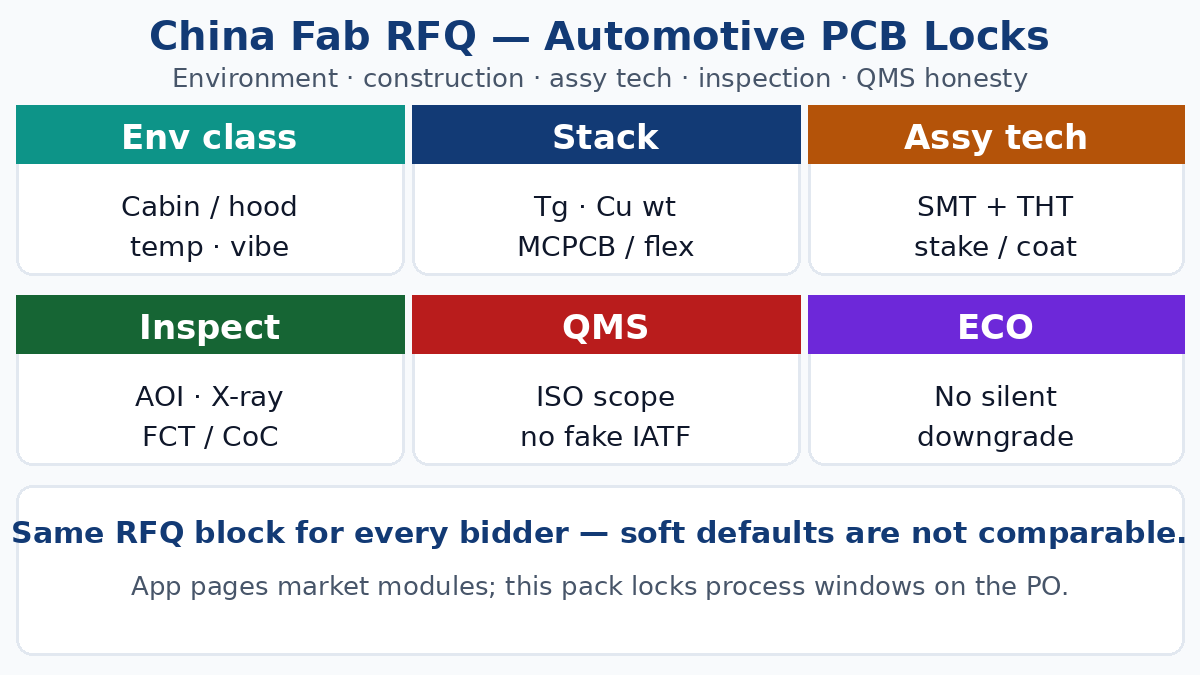
RFQ checklist for China fab and PCBA buyers
Paste a short block so every house answers the same prompts:
- Environment class — cabin / under-hood / chassis sensor / power stage; temperature range; vibration or OEM standard reference; coat yes-no and keep-outs.
- Construction — layer count; Tg (or MCPCB / aluminum callout); copper weight per power layer; finish; impedance coupons yes-no; flex / rigid-flex / HDI only if the packaging or density truly needs them.
- Assembly technology — SMT-only vs mixed SMT + through-hole; which connectors are THT; staking / underfill requirements; lead-free profile notes.
- Inspection gates — AOI stage and coverage; X-ray sample plan for hidden packages; electrical / functional script owner; coat inspection; lot CoC fields.
- QMS honesty — state which certificates you actually hold for the building site (e.g. ISO 9001). Do not imply IATF / AS9100 unless the current scope PDF matches the site that will build this lot. XFPCB operates in the China export / ISO 9001 conversation — this guide does not invent IATF 16949 or AS9100 plant credentials.
- Change control — no silent Tg, copper, finish, or test downgrade without signed EQ; mixed-revision ship prohibited.
- Files — Gerbers / ODB++, stack table, fab notes, BOM, CPL, and environment notes on one revision so fab and assy do not diverge.
When answers are clear and files are frozen, commercial award can move through normal channels via How to Place an Order — after environment and process locks are written, not before.
How this differs from sibling XFPCB pages
- Automobile electronics applications page owns module marketing, capability overview, and quote focus for control / lighting / sensor / charger boards — pair with this post; do not clone it.
- NEV / new-energy vehicle application pages own EV-specific capability messaging — leave market-growth and NEV brochure angles there.
- AS9100D / aerospace QMS posts own aerospace certificate verify — automotive IATF ask is related in spirit but not merged here beyond “verify scope, don’t invent certs.”
- Class 2 vs Class 3 posts own acceptance-class product language — cite class on the PO when risk demands it; do not retell that essay.
- HDI / flex deep-dive posts own stackup and bend-life detail — this page only forces packaging choice from environment and connector risk.
- Queued “future automotive market growth” sister URL (if published later) owns industry narrative — do not merge CAGR / electronics-share storytelling into this fab/assy RFQ pack.
Soft next step
Map the module’s environment class to construction (Tg, copper, MCPCB, flex/rigid-flex), assembly technology (SMT vs through-hole on mechanically loaded parts), and named inspection gates — then paste the RFQ block above so every China bidder prices the same traveler. Soft next step when Gerbers, stack notes, BOM/CPL, and environment fields are frozen: route the award through your normal order path with those locks intact — not a brochure callback that reopens Tg and X-ray after the PO.