
Buyers awarding China fab and PCBA often see “ISO 9001” and “AS9100D” stacked in the same brochure paragraph — then get three incompatible quotes: one house treats AS9100D as optional decoration, another refuses the bid without it, and a third quotes “aerospace quality” without either scope PDF. This page owns a different job from the live AS9100D aerospace verify guide and from the certification shopping map: AS9100D vs ISO 9001 as a buyer decision when you award multilayer boards or turnkey assemblies from export China plants. When is ISO 9001 enough? When do programs expect AS9100D? What do the extra aerospace clauses mean in RFQ practice — risk, product safety, configuration management, counterfeit prevention, supplier control, and traceability? How do you read a certificate scope without inventing plant trophies? Soft CTA only. Sibling XFPCB lanes already own deep AS9100D verify / traveler questions, multi-cert maps, Class 2 vs Class 3 product pedagogy, and automotive QMS angles — name those lanes in prose; do not clone them. No competitor brands. No invented XFPCB AS9100D, ITAR, or fake UL aerospace awards.
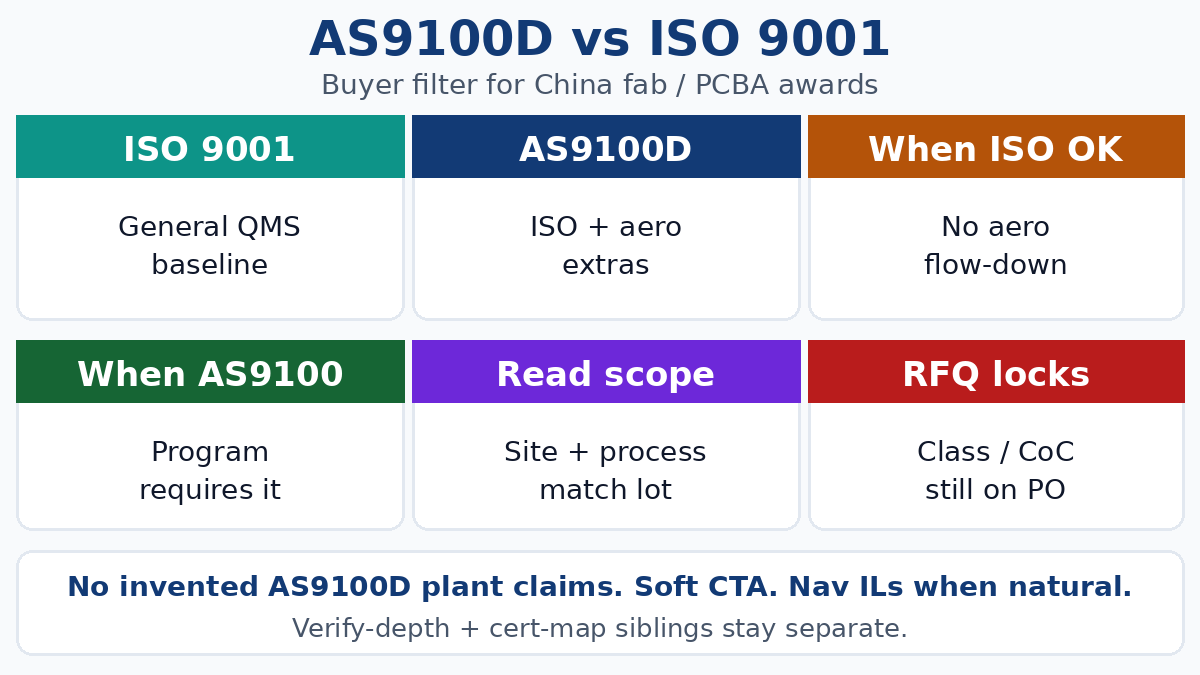
Shared foundation, different buyer filter
ISO 9001 is the general quality-management system (QMS) standard. It asks organizations to run documented processes, handle nonconformances, review performance, and improve — across any industry. For China export electronics houses, ISO 9001:2015 is the common baseline buyers already expect on supplier questionnaires. XFPCB’s public About framing includes that ISO 9001:2015 plant baseline; treat it as a QMS filter, not as proof that every lot ships to a named IPC class.
AS9100D builds on ISO 9001 and adds aerospace / defense sector requirements. A supplier certified to AS9100D is meeting ISO 9001 plus those aerospace extras. Buyers should not treat “ISO + AS9100” as two unrelated trophies that cancel each other — and should not treat either certificate as a product specification.
| Decision question | ISO 9001 answer | AS9100D answer |
|---|---|---|
| What is certified? | Organization QMS at named scope / site | Same foundation + aerospace extras at named scope / site |
| Typical China export role | Default QMS filter for commercial / industrial awards | Program filter when aerospace / defense flow-down requires it |
| Does it pick IPC Class? | No | No |
| Does it replace FAI / CoC fields? | No | No — FAI remains a program flow-down |
| Does it equal ITAR? | No | No — export control is separate |
Write product locks (Class, stack, test, lot CoC) as if the house were QMS-present — then decide whether AS9100D belongs on the supplier qualification line.
When ISO 9001 is enough for China fab / PCBA
ISO 9001 is enough when your customer and program do not flow AS9100, and the risk profile is commercial, industrial, or non-flight. That covers a large share of overseas awards into Shenzhen and other China export hubs: consumer and industrial controllers, many IoT and communications boards, prototype and NPI lots that will later be gated by product Class — not by aerospace QMS.
Practical signals that ISO 9001 (verified) is the right QMS filter:
- No AS9100 / aerospace QMS clause on the customer AVL or SOW.
- End use is not flight, space, or defense-flowed hardware.
- Your team already locks IPC Class, electrical test, and lot CoC on the PO — and those product fields matter more than sector QMS branding.
- You are comparing China houses on traveler discipline, DFM feedback, and named test gates — not shrinking the bid list to AS9100 logos alone.
Honesty for buyers: many capable China fab and Turnkey PCB Assembly houses operate under ISO 9001 without holding AS9100D. That is normal. Inventing an AS9100 requirement your program does not have just to “look aerospace” shrinks capacity, raises price, and still fails if Class and FAI language stay soft. Conversely, skipping product locks because “they are ISO certified” is how Class 2 defaults survive under a quality title.
Capability context that is not a certificate lives on Technical Capabilities and day-to-day PCB Manufacturing process pages — keep those separate from QMS comparison.
When AS9100D is expected (or wisely required)
AS9100D is expected when the program flows it: customer AVL, prime contractor quality clauses, defense / aerospace purchase terms, or an internal policy that already maps flight or safety-critical electronics to aerospace QMS suppliers. In those cases, ISO 9001 alone will not clear supplier approval — even if the fab’s ISO PDF is current and the traveler looks disciplined.
Expect AS9100D (and verify it) when:
- The SOW or quality notes explicitly require AS9100 (revision D or as flowed).
- The end item is aerospace, aviation, or defense electronics with formal QMS flow-down.
- Your configuration-control and counterfeit clauses assume aerospace QMS language (approved sources, formal risk records, stronger change control).
- First-article / AS9102-style evidence is already flowed — AS9100D does not invent FAI, but programs that flow both usually want them aligned.
Do not auto-require AS9100D for every “high reliability” board. High reliability often means IPC Class 3, tighter coupons, and named inspection — product language owned elsewhere — not an automatic aerospace QMS stamp. Automotive programs usually point to IATF-style QMS, not AS9100; leave that automotive lane alone here. Commercial aviation and flight programs that do flow AS9100 belong in the aerospace verify conversation — this page only decides ISO vs AS9100 as the filter, then points buyers to verify depth when AS9100 is truly required.
This guide does not claim XFPCB holds AS9100D. Public site framing supports ISO 9001:2015 as the China-fab baseline. Buyers who need AS9100D should require certificate evidence from the claiming supplier and still write Class / CoC / FAI on the product line.
What AS9100D adds — RFQ meaning of the extra clauses
Brochure lists of “risk, safety, traceability” help nobody unless they translate into RFQ and traveler asks. Below is the comparison buyers need when awarding China fab / PCBA — not a rewrite of the deep aerospace verify post.
Risk management
ISO 9001 expects risk-based thinking. AS9100D pushes more formal risk processes for planning and change. On an RFQ, ask: how is risk scored for a new stackup, fine-pitch package, or second-source laminate? Soft “we manage risk” without an example is not comparable across bidders.
Product safety
AS9100D elevates product safety as a system theme — stop-ship authority, special-process control, escalation when a board or assembly could create an unsafe condition downstream. Ask who can release a lot after a major engineering query (EQ), and how safety-related nonconformances are classified. Do not accept a homepage “safety culture” sentence as evidence.
Configuration management
Aerospace programs hate mixed-revision ships. AS9100D expectations strengthen configuration control: ECO discipline, revision-controlled work instructions, and clear ownership when Gerbers, BOM, or process notes change after PO. On the RFQ, name who owns ECO after award and how mixed-revision scrap is prevented. Freeze files via Manufacturing Files language so “latest files” is not a verbal CAM habit.
Counterfeit prevention
Especially on turnkey kits, AS9100D-era expectations push approved sources, incoming suspect-part checks, quarantine, and no unauthorized substitution. ISO 9001 supplier control is thinner for this failure mode. If the award includes Component Sourcing, write AVL / authorized-channel rules explicitly — “AS9100D” alone does not tell you whether broker parts can enter the traveler.
Supplier control
Both standards care about suppliers. AS9100D is stricter on qualification, monitoring, and flow-down. For bare-board fab that means laminate and process-material CoC lineage; for assembly it means kit and special-process vendors. Ask how critical suppliers are approved and re-evaluated — not whether a logo collage includes “approved vendor.”
Traceability
ISO 9001 documentation is not the same as aerospace lot genealogy. AS9100D programs typically expect stronger end-to-end traceability from materials through delivery. Still write the product fields you need on the PO: board lot, laminate lot, date code, CoC contents. Certificate language does not invent those columns for you.
What still stays on the product line
Neither standard replaces named gates on PCB board testing and inspection, IPC Class numbers, or FAI forms when the program flows them. Put QMS on the supplier line; put Class, CoC, test, and FAI on the product line.
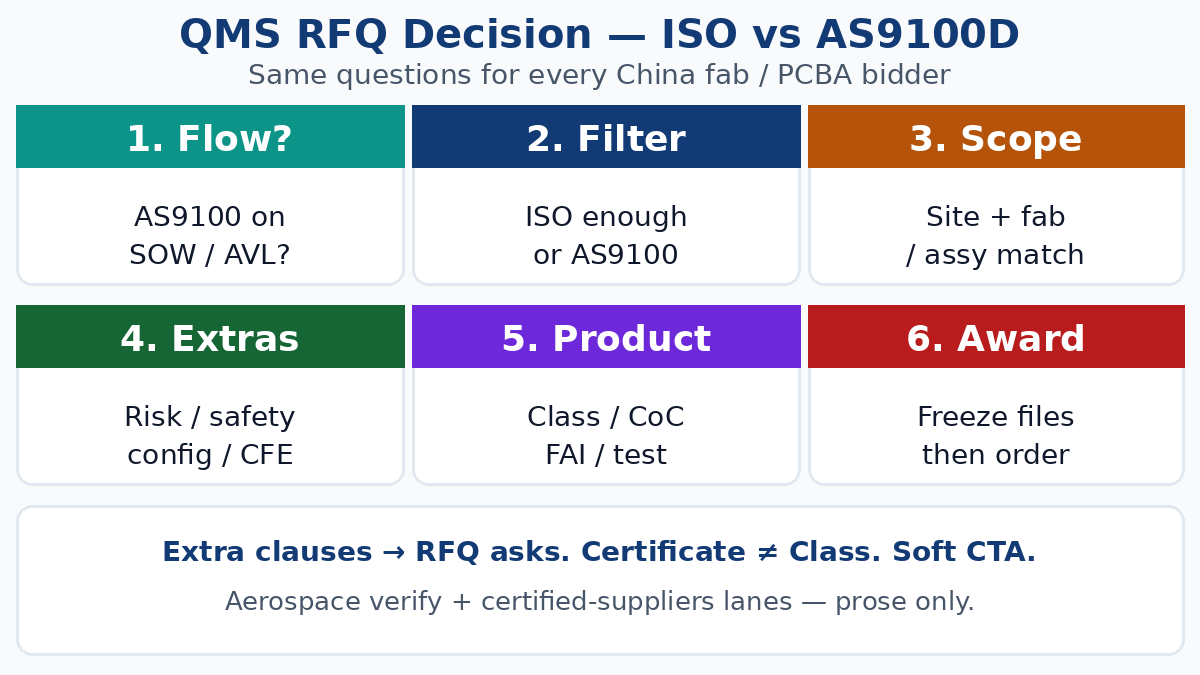
How to read a certificate and scope (buyer checklist)
A wall photo is not evidence. Whether the claim is ISO 9001 or AS9100D, read the same artifacts:
- Legal name + site address — Must match the plant that will run your lots, not a sister company in another city.
- Scope statement — PCB fabrication, assembly, and/or design as you buy them. “Electronics” or “machining” without PCB processes is a red flag.
- Standard + revision — ISO 9001:2015 vs AS9100D (or the revision your SOW names).
- Certificate number + issuing body — Readable; prefer bodies you can look up.
- Issue and expiry — Current; calendar a refresh on long programs.
- Exclusions — Design exclusion is common; know whether you need design in scope.
- Surveillance status — On higher-risk awards, ask whether major nonconformances are open against the PCB scope you need.
China fab honesty: a current ISO 9001 PDF from an export house is useful supplier-file evidence. It is not AS9100D. An AS9100D PDF whose scope lists the wrong site or omits assembly while you buy turnkey PCBA is also weak. Broader multi-cert shopping (ISO 13485, IATF, RoHS, UL) belongs on the certified-suppliers map — keep this page on the ISO vs AS9100 fork.
RFQ paste block — ISO vs AS9100 for China awards
Paste a comparable block so every bidder answers the same prompts:
- Required QMS — ISO 9001 required? AS9100D only if the program truly flows it — never as decoration.
- Evidence — Current certificate PDF with scope, site, number, body, and expiry due with the quote or before award.
- If AS9100D not held — Confirm ISO 9001 (or other named QMS) and how Class / CoC / FAI / counterfeit fields will still be met.
- Extra-clause asks (when AS9100 flowed) — Risk records on NPI, product-safety release authority, configuration / ECO ownership, counterfeit path for kits, supplier re-evaluation cadence, lot traceability fields provided.
- Product locks (always) — IPC Class and revision, named electrical / optical / X-ray gates, CoC / lot columns, FAI yes-no when flowed, stack / material table, no silent downgrade without signed EQ.
- Files frozen — Gerbers/ODB++, stack, BOM, and process notes on one revision before QMS claims are treated as comparable.
- Export / ITAR — Separate from QMS. Do not treat either certificate as ITAR registration; flow export controls only when the program truly requires them, and verify independently.
When answers are clear and files are frozen, commercial award can move through normal channels via How to Place an Order — after the QMS filter and product locks are written, not before.
Soft next step
Decide the filter first: ISO 9001 when the program does not flow aerospace QMS; AS9100D when it does — then verify scope and expiry, and still write Class, CoC, test, and FAI as product language. Use the live AS9100D aerospace page when you need deep verify / traveler questions after you have already decided AS9100 applies. Use the certification map when you are shopping multiple frameworks. Soft next step when the ISO-vs-AS9100 decision and frozen files are clear: route the award through your normal order path with those fields locked — not a brochure callback that reopens QMS and Class after the PO.