
Aerospace PCB RFQs that stop at “must be AS9100D” still ship lots with soft Class defaults, thin lot history, and missing first-article evidence. The failure is rarely that the supplier has no certificate PDF. It is that AS9100D is an organization quality-management system (QMS) — product safety, risk, counterfeit control, human factors, and audit cadence — while IPC class, lot traceability, and FAI remain product locks on the PO and drawing. US brochure pages praise the cert and invite plant tours. Aerospace PCB buyers need a different frame: what the claim signals in fab and assembly practice, how to verify scope and status, which RFQ questions keep quotes comparable, and what still belongs on the purchase order even when the QMS is strong. This page owns that buyer verify / RFQ angle only. Certificate-versus-ISO comparison tables live elsewhere. Sibling XFPCB posts already cover aerospace board use-cases, fab/assy process tours, Class 2 vs Class 3, and USA-based sourcing — do not merge those angles here. Soft CTA only; no competitor brands; no invented plant credentials.
What AS9100D signals when a supplier claims it
AS9100D is the aerospace-sector QMS standard that builds on ISO 9001 with extra aerospace expectations. When a fab or assembler says “we are AS9100D,” the honest read is: this organization runs (or claims to run) a managed system for how work is planned, controlled, changed, audited, and improved — not that every board automatically ships to IPC-6012 Class 3, not that the site is ITAR-registered, and not that your stackup, materials, or accept criteria were chosen for you.
Treat the claim as a supplier filter, not a product specification:
| Claim you hear | Useful signal | Does not mean |
|---|---|---|
| “AS9100D certified” | Aerospace-oriented QMS scope at a named site | Every lot is flight-ready without drawing locks |
| “Aerospace quality” | Marketing umbrella | Class, FAI, and CoC fields already filled |
| “ISO + AS9100” | Two related but different system layers | Redundant — you may need program-flowed AS9100 and product class |
| “Certified plant, so Class 3 OK” | Category error | Silent Class 2 process windows under an aerospace title |
China fab context (honesty): many capable export houses operate under ISO 9001 (and related plant systems) without holding AS9100D. XFPCB is in that China-fab / ISO 9001 conversation — this guide does not invent or imply AS9100D, ITAR, or Class 3 plant certificates for XFPCB. Buyers who need AS9100D for a flowed program should verify the claiming supplier’s certificate, scope, and site. Buyers who do not flow AS9100D still need Class, lot traceability, and FAI language on the PO when risk demands it. System discipline and product acceptance are related; they are not interchangeable.
Write product requirements as if the house were ISO-only — then add AS9100D on the supplier qualification line only when the program actually flows it.
What the QMS covers in fab and assembly practice
Brochure lists often stop at five nouns. Buyers need those nouns translated into traveler and RFQ behavior for bare-board fab and PCBA.
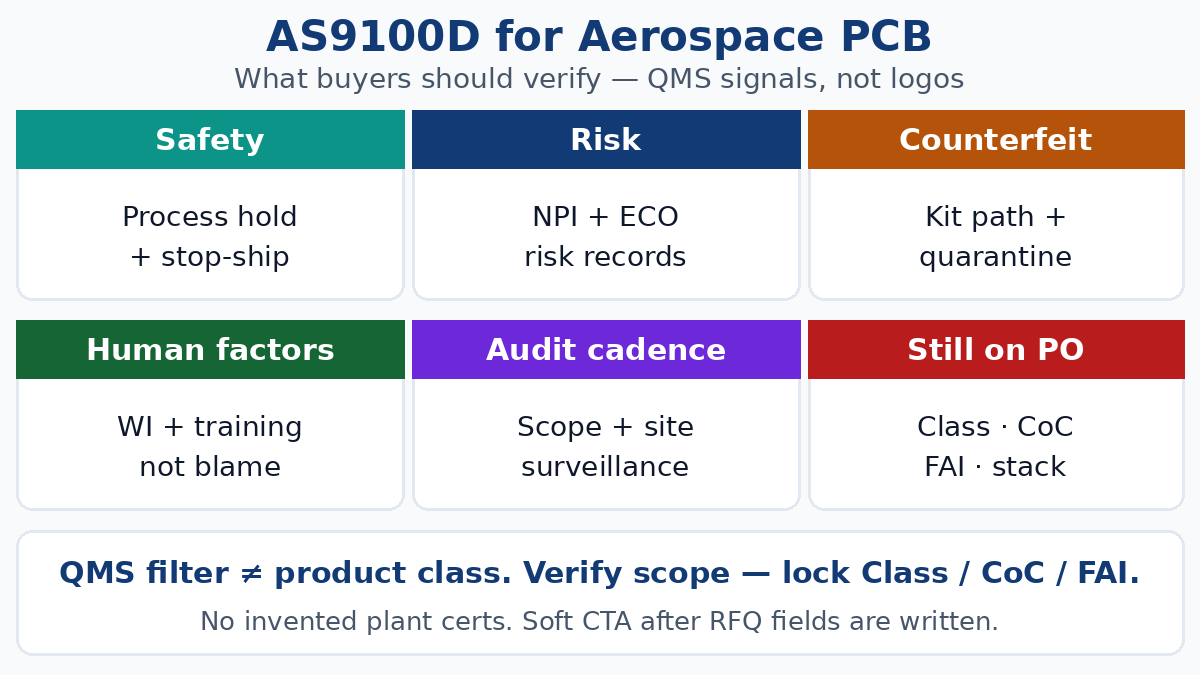
Product safety
Under AS9100D thinking, product safety is not a slogan on the homepage. It shows up as controlled process steps, documented special processes, and escalation when a board or assembly could create an unsafe condition downstream. In PCB practice that means: process FMEAs or equivalent risk records for plating, lamination, and critical assembly steps; clear stop-ship authority; and change control when a process window moves. Ask how safety-related nonconformances are classified and who can release a lot after a major EQ — not whether the word “safety” appears on a marketing slide.
Risk-based thinking
Risk language in AS9100D pushes planning beyond “inspect at the end.” For fab and assy, useful evidence looks like: risk assessment on new stackups or fine-pitch packages before first article; supplier risk scoring for laminate and component sources; and mitigation when a second-source resin or paste is introduced. Soft “we manage risk” without examples is not enough. Ask for one recent NPI risk register excerpt (redacted) or how ECO risk is scored when copper weight or surface finish changes mid-program.
Counterfeit parts prevention
Aerospace supply chains treat counterfeit electronic parts as a real scrap and field-failure driver. AS9100D expectations push documented prevention — especially on the assembly / turnkey side: approved distributor lists, incoming inspection for suspect parts, quarantine and reporting paths, and obsolescence / unauthorized substitution rules. Bare-board fab still cares about authentic laminate and process materials with CoC lineage. On RFQs that include Component Sourcing or turnkey populate, name counterfeit controls and substitution authority explicitly. “AS9100D” alone does not tell you whether the kit path allows broker parts without written approval.
Human factors
When escapes happen, AS9100D-era QMS work treats people–process interaction as part of the system — fatigue, unclear work instructions, fixture ambiguity, mixed revision travelers — not only “operator error.” In practice, ask how work instructions are revision-controlled at the line, how training is tied to special processes (e.g. X-ray review, conformal coat), and whether recurring human-factor findings appear in management review. A certificate does not remove the need for clear travelers; it should make unclear travelers a nonconformance rather than a habit.
Audit cadence
Certification is not a one-time PDF. Typical patterns include certification / recertification audits plus surveillance on a defined cadence, plus the organization’s own internal audits. Buyers should ask: certificate issue and expiry dates; certifying body; scope statement (design? fab only? assembly? which site address?); and whether any major nonconformances are open. A logo with an expired date or a scope that lists “machining” while you buy multilayer PCB fab is not useful evidence. Schedule a certificate refresh check on long programs — annual PO renewals without re-checking status is how stale claims survive.
What still belongs on the PO (Class, lot traceability, FAI)
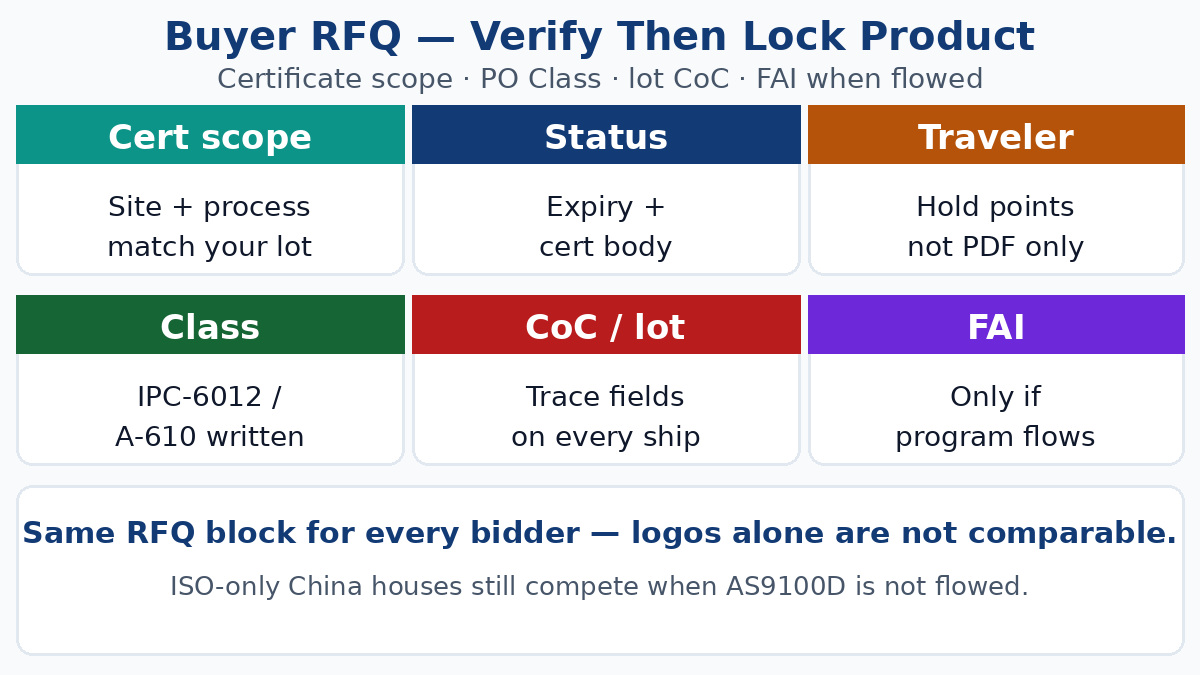
AS9100D does not enlarge annular rings, pick Tg, or invent first-article forms. Keep product locks on the order even when supplier QMS is strong:
- IPC class — Cite IPC-6012 Class (and revision) for bare board when reliability demands it; cite IPC-A-610 separately when assembly accept criteria matter. Soft “aerospace class” without a number inherits house defaults.
- Lot traceability / CoC — Board lot, laminate lot, date code, and certificate of conformance fields the program needs for field returns and configuration control.
- FAI / AS9102 (when flowed) — First-article evidence is a program flow-down, not an automatic side effect of AS9100D. Write whether FAI is required, on which dash number, and what forms or microsections ship with the lot.
- Stackup and materials — Layer count, dielectric family, Tg / thermal needs (High Tg PCB when temperature margins matter), and RF laminate notes when nets demand them. QMS does not choose Rogers-vs-FR-4 for you.
- Electrical / density process windows — Controlled Impedance Control PCB coupons when SI is critical; HDI PCB via architecture when density is real; High Frequency PCB stack notes when RF loss budgets are written. Capability context without treating a page as a cert: Technical Capabilities.
- Test and inspection named on the traveler — Prefer explicit gates on PCB board testing and inspection rather than “AS9100D testing included.”
- No silent downgrade — EQ / concession rules: Class, material, or test cuts require signed approval — not a verbal CAM note.
Rule of thumb: put AS9100D (if required) on the supplier qualification line; put Class, CoC/lot, FAI, stack, and test gates on the product line. Mixing them into one “aerospace quality” sentence is how soft defaults survive quote review.
How to verify a supplier’s AS9100D claim
Do not stop at a JPEG of a certificate wall.
- Read the scope — Sites, processes (PCB fab, PCBA, design), exclusions. Match the address that will build your lot.
- Check status and dates — Issue, expiry, certifying body. Ask for the current PDF under NDA if the public portal is unclear.
- Ask for recent surveillance evidence — Not proprietary findings — confirmation that surveillance is current and no open major NC blocks the scope you need.
- Separate ITAR / export — ITAR registration and export-control programs are not AS9100D. Do not treat a QMS logo as ITAR. If your program needs US-person / ITAR controls, flow that separately and verify independently.
- Walk one traveler — For a like-complexity part, ask which QMS clauses show up as hold points (counterfeit kit check, FAI gate, change-control ECO). A strong PDF with a weak traveler is still a weak buy.
- Keep ISO-only houses in the matrix when AS9100D is not flowed — Comparable quotes still need Class, CoC, and test language. Do not invent a requirement your program does not have just to shrink the bid list.
RFQ questions aerospace PCB buyers should ask
Paste a short block so every house answers the same prompts:
- Do you hold current AS9100D for the site that will fab / assemble this part number? Provide scope PDF, cert body, and expiry.
- If AS9100D is not held, what QMS do you operate (e.g. ISO 9001), and how do you meet our flowed Class / CoC / FAI fields anyway?
- How do product safety and risk show up on NPI travelers for multilayer / HDI / fine-pitch work?
- What is your counterfeit prevention path for turnkey kits (approved sources, quarantine, no unauthorized substitution)?
- How are human-factor recurring issues captured (training, WI revision, fixture clarity)?
- What is your audit cadence (internal + certification / surveillance), and are any major NCs open against PCB scope?
- Confirm PO product locks: IPC-6012 / A-610 class, lot CoC fields, FAI/AS9102 yes-no, material/stack table, named test gates, no silent downgrade without EQ.
- Who owns ECO after PO — and how does configuration control prevent mixed-revision ship?
When answers are clear and files are frozen, commercial award can move through normal channels via How to Place an Order — after the QMS ask and product locks are written, not before.
How this differs from sibling XFPCB pages
- Aerospace use-case / applications posts own where boards fly and environment stress — not this QMS-verify RFQ pack.
- Aerospace fab/assembly process posts own process-tour depth — not certificate verification cadence.
- Class 2 vs Class 3 posts own acceptance-class product language — pair with this page; do not merge.
- USA-based sourcing posts own geography / ITAR / domestic capacity angles — separate from AS9100D QMS verify.
- AS9100 + HDI drawing-lock posts own HDI/microvia product locks beside organization QMS — different density angle.
- AS9100D vs ISO 9001 comparison (queued separately) owns side-by-side standard tables — do not merge that comparison into this buyer-verify post.
Soft next step
If your program flows AS9100D, put current scope, site, and expiry on the supplier line — then still write Class, lot CoC, FAI when required, stack/material, and named test gates on the product line. If your program does not flow AS9100D, do not fake the requirement; lock the same product fields and judge China ISO 9001 houses on traveler discipline, not on logo envy. Ask every bidder the RFQ block above so “aerospace quality” stops meaning three incompatible quotes. Soft next step when the matrix is filled and Gerbers / BOM / stack notes are ready: route the award through your normal order path with those fields frozen — not a brochure callback that reopens Class and FAI after the PO.