
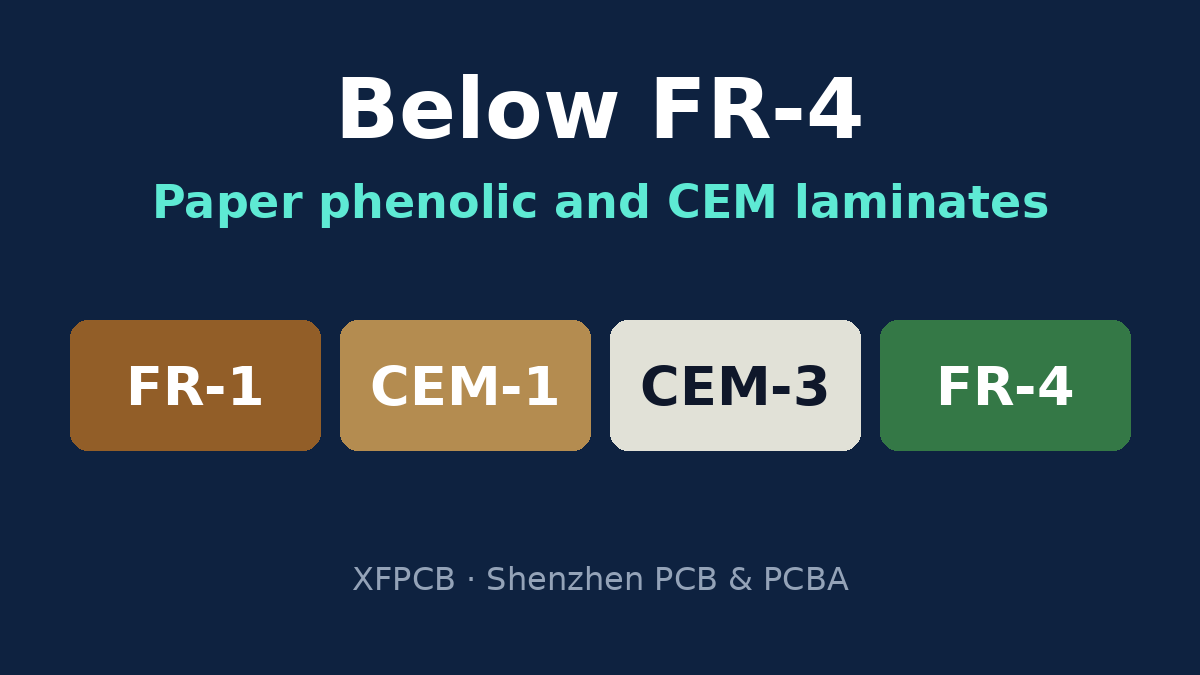
Guides to PCB materials usually start with FR-4 and move upwards: high-Tg epoxy, low-loss laminates, PTFE, polyimide, metal core, ceramic. That is the right direction for most of the boards we build. But there is also a ladder below FR-4, made of paper-based and composite laminates that still go into large numbers of remote controls, power adapters, appliance controls, toys and lighting products.
Buyers meet these materials in two ways. Either a cost-down exercise asks whether a simple board could move to a cheaper laminate, or an existing product drawing calls out FR-1 or CEM-1 and the buyer wants to know whether that still makes sense. This article covers what those materials are, what they can and cannot do, and the practical question that usually decides it: whether the cheaper laminate is actually cheaper for your order.
The cost-tier family
The names come from the NEMA laminate grades, and IPC-4101 also covers these materials in its specification sheets.
FR-1 and FR-2: paper phenolic. Layers of cellulose paper impregnated with phenolic resin, with flame retardant added. FR-1 and FR-2 are very similar; they differ mainly in temperature rating. They are typically brown, and designed to be punched rather than drilled. FR-3 is a related paper-based material that uses epoxy instead of phenolic resin.
CEM-1: paper core, glass surfaces. A composite epoxy material with a paper core and woven glass cloth on the outer faces. The glass skins give better mechanical strength and surface properties than plain paper phenolic, while keeping the punchable paper core.
CEM-3: glass mat core, glass surfaces. Here the paper core is replaced by a non-woven glass mat, with woven glass on the faces and epoxy throughout. Electrically it behaves much like FR-4, and it is usually milky white and smooth. It is used for double-sided boards in some consumer and lighting products.
FR-4: woven glass epoxy throughout. Every reinforcing layer is woven glass cloth. FR-4 is the reference point, and the material almost all PCB factories are built around.
The limit that matters most: plated through-holes
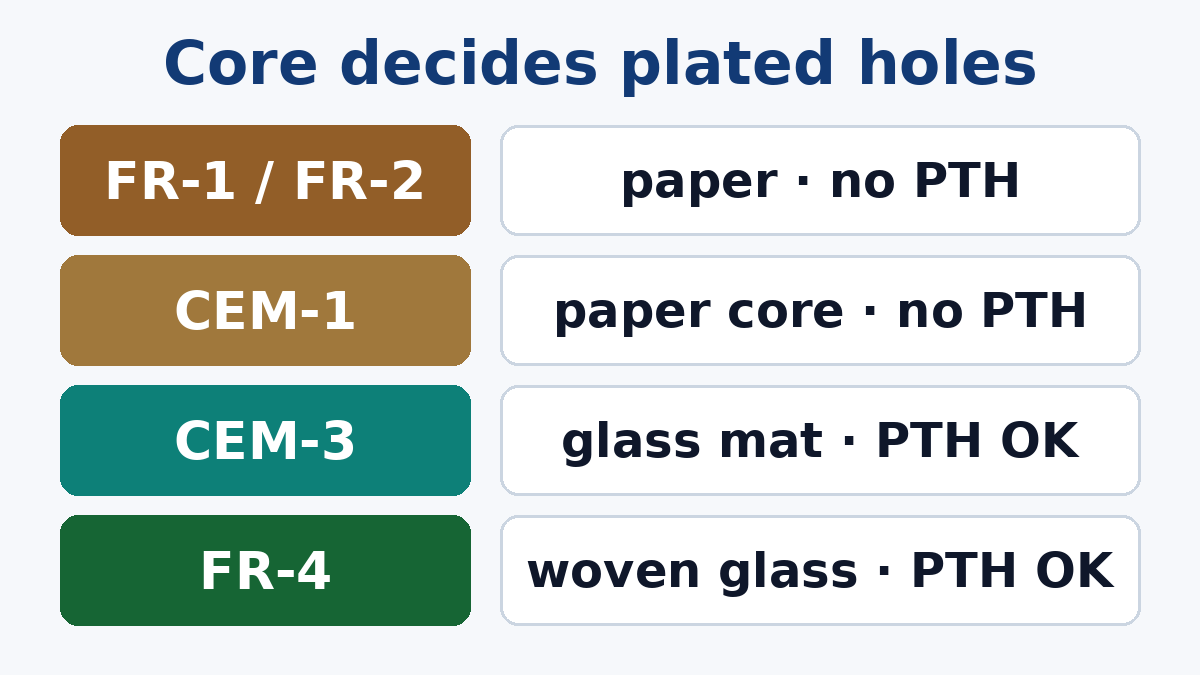
The biggest practical difference is not electrical, it is structural. Paper-based materials (FR-1, FR-2 and CEM-1) are not suitable for plated through-holes. The paper absorbs process chemistry, the hole wall is not a good base for plating, and the material moves too much with temperature to keep a plated barrel intact reliably.
That means these materials are, in practice, single-sided materials. Components are inserted through unplated holes and soldered on the copper side, or surface-mount parts are placed on the copper side. Jumpers or wire links take the place of a second layer.
CEM-3 can be plated, which is why it is the only real alternative to FR-4 for double-sided boards in this family. Multilayer boards are an FR-4 (or better) job.
Punching versus drilling
Paper phenolic and CEM laminates were developed for high-volume single-sided production in which holes and outlines are punched with hard tooling, sometimes after preheating the material. A punch die forms all the holes in a board at once, which is very fast once the tool exists.
That process advantage only pays at high volume. The die must be made before production and changed whenever the design changes. For a few hundred or a few thousand boards, holes are drilled and the outline routed, and paper-based laminates do not drill and route as cleanly as glass epoxy: edges can be rough, and holes can be less clean.
Other properties to check
Moisture. Paper absorbs moisture far more than glass epoxy. That affects insulation resistance in humid conditions and dimensional stability, and it makes boards more prone to blistering in soldering if they have been stored in humid air.
Heat. Paper phenolic tolerates less heat than FR-4. Single-sided boards were traditionally wave soldered; check that the material's rating suits your process, especially for lead-free soldering or reflow of surface-mount parts.
Mechanical strength. Paper-based boards are less stiff and can crack around mounting holes or under heavy components such as transformers. CEM-1's glass skins help; CEM-3 is closer to FR-4.
Flame rating. Flame-retardant grades are available in all of these families, but do not assume: if the product needs a specific UL flammability rating for the board, it has to be stated and confirmed for the exact laminate.
Smell and appearance. Phenolic boards can give off a characteristic odour when hot. It is not usually a functional issue, but it can surprise people who are used to FR-4.
When is the cheaper material actually cheaper?
The raw laminate cost of paper phenolic or CEM-1 is lower than FR-4. Whether the board ends up cheaper depends on where it is made.
Factories that specialise in high-volume single-sided boards stock these materials, punch them with dedicated dies and print with screen-printing processes. For that kind of factory and that kind of volume, the savings are real.
Factories built around double-sided and multilayer FR-4, which is most PCB factories serving overseas engineering customers, often do not stock paper-based laminates at all. Running them means buying a special material lot, adjusting drilling and routing, and accepting a different process route. For such factories, a single-sided FR-4 board on the standard line is often the lower-risk and similarly priced option, and for small to medium volumes it is usually the one we recommend. A 1-Layer PCB on FR-4 also gives you the option of moving to plated holes or a second layer later without changing material.
A simple decision guide
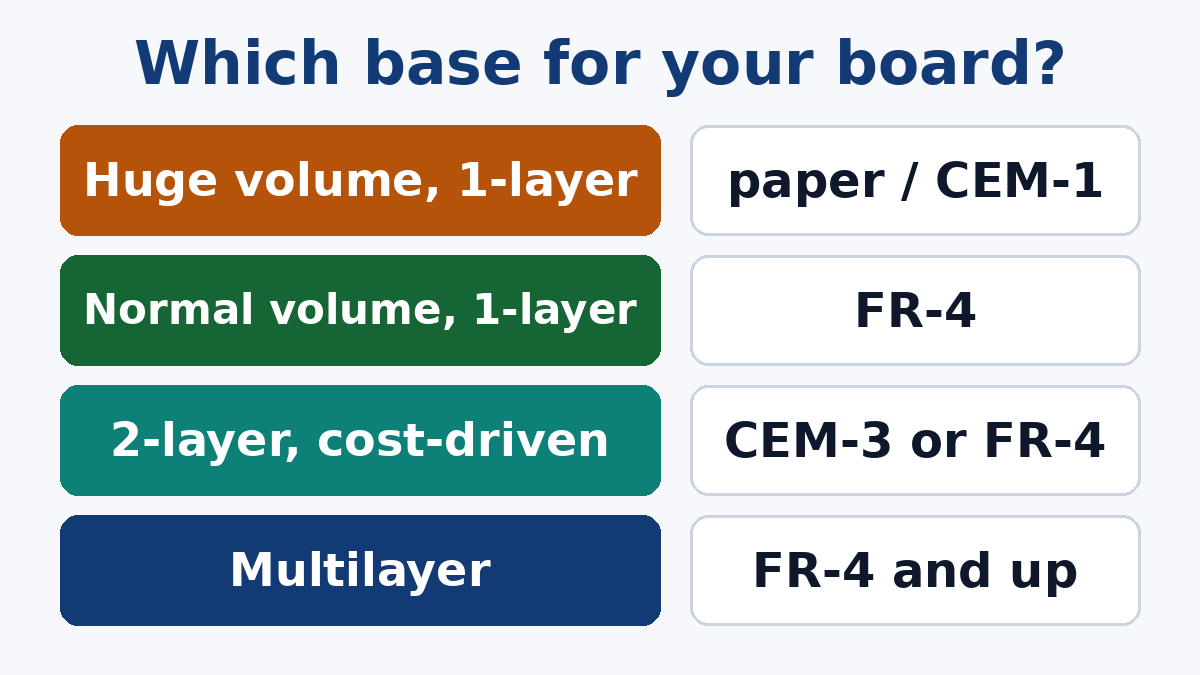
- Very high volume, single-sided, simple, low-heat, dry environment, hard tooling acceptable: paper phenolic or CEM-1 can make sense, made by a factory set up for it.
- Single-sided, small or medium volume, or any humidity or reliability concern: single-sided FR-4.
- Double-sided with plated holes, cost-sensitive, high volume: CEM-3 or FR-4; compare quotes for the exact board, as availability varies by factory and region.
- Double-sided at normal volumes: FR-4. A 2-Layer PCB on FR-4 is the industry's standard product.
- Multilayer, lead-free reflow of fine-pitch parts, or any need above basic performance: FR-4 or higher-performance laminates.
If an old drawing calls out FR-1 or CEM-1
Legacy products sometimes specify paper-based materials because they were designed for a particular single-sided factory. Moving such a product to a different supplier is a good moment to ask whether the specification still matters. If the product is not certified with that specific laminate, single-sided FR-4 is a common upgrade: better moisture resistance, stronger mounting holes, and easier sourcing. If the product's safety certification lists the laminate, any change needs to go through that certification first.
If you have a simple board and want to know which base material makes sense at your volume, send us the drawing and expected quantities. Our engineers will tell you what we would build it on and why.