

Ask anyone outside the industry to picture a modern PCB factory and they will describe something close to a lights-out plant: boards gliding from machine to machine, nobody touching anything. Walk our floor in Shenzhen and you will see plenty of that. You will also see people stacking prepreg by hand in the lamination clean room, operators at AOI verification stations deciding whether a flagged spot is a real defect, a technician hand-soldering a connector that could not go through reflow, and an inspector turning a finished panel under a magnifier.
The public conversation about automation tends to be about jobs: which ones machines take, which new ones appear. That question is real, but for an engineer or buyer placing an order it is the wrong level of detail. What matters to you is narrower and more useful: on your particular board, which steps are owned by a programmed machine, which still depend on a person's skill and judgment, and what that split means for consistency from the first lot to the twentieth.
This article walks through that split from the factory side, for bare-board fabrication and for assembly, and then looks at what you can do in design and in your purchase documents to put more of your product in the hands of machines and to control the steps that will stay manual.
Why the split matters more than the machine list
A machine that is programmed and verified does the same thing every time. A placement machine does not get tired at the end of a shift, and a CNC drill does not misread a drawing. Once the program is right, variation comes from the materials and the machine's own tolerance, both of which can be measured.
Manual steps are different, not worse. A skilled operator can handle things no affordable machine can: an odd-shaped part, a judgment call on a borderline solder fillet, a board that arrived slightly bowed. But manual work varies with training, attention, fatigue and instructions. So when quality engineers look for where lot-to-lot variation will come from, they look first at the manual touchpoints on the traveler.
There is also a second, quieter point. Even the automated steps begin with human work: someone writes the placement program, someone builds the AOI library, someone chooses etch compensation in CAM. Automation moves skill upstream rather than removing it. A factory with excellent machines and weak programming engineers will reproduce its mistakes with great consistency.
Bare-board fabrication: mostly machines, with judgment at the edges
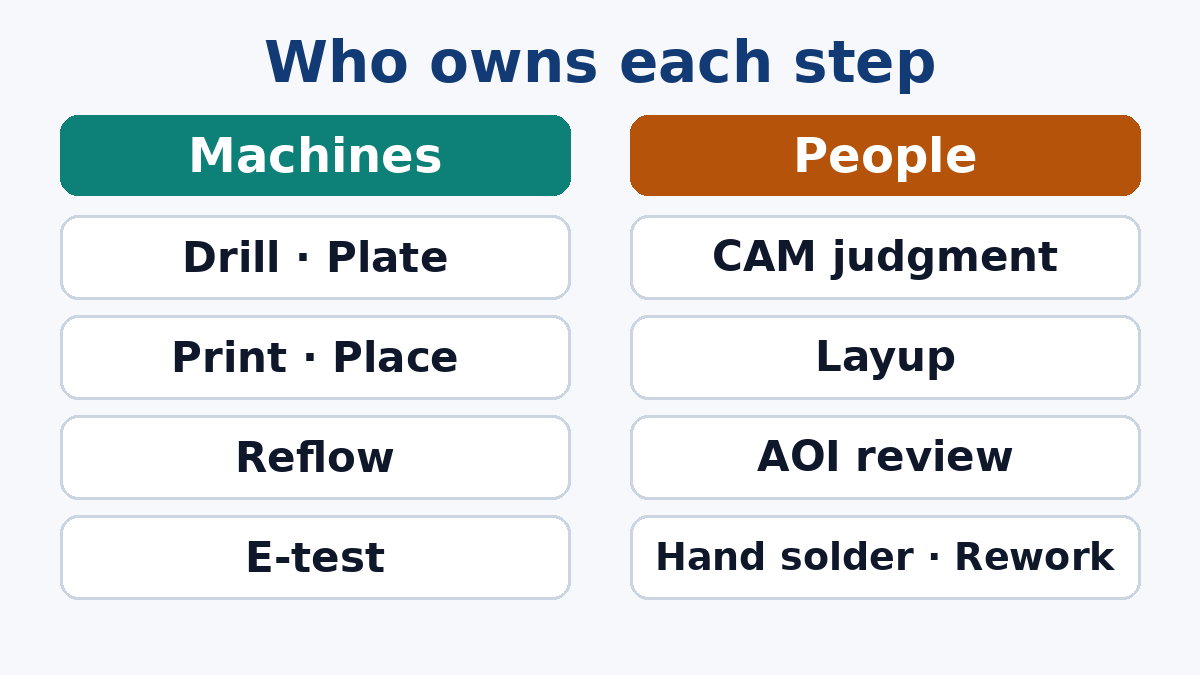
The PCB fabrication process is more automated than most people expect, but the human steps sit exactly where judgment or dexterity is needed.
CAM and front-end engineering is software-driven but not automatic. DRC and DFM tools flag issues in your Gerbers or ODB++ data; an engineer decides what each flag means, applies etch compensation, chooses panelization, and writes engineering queries when the data is ambiguous. This is the step where a design's intent is either correctly understood or quietly misread, and it is entirely dependent on people.
Imaging of inner and outer layers is typically done by laser direct imaging or by exposure through phototools. The exposure itself is machine-controlled. Handling panels between steps may be automated or manual depending on the line.
Inner-layer AOI scans every layer automatically against the CAM data. The machine is deliberately sensitive, so it flags more than it should. An operator at a verification station reviews each call, separates real opens and shorts from false alarms, and decides whether a defect can be repaired or the layer must be scrapped. The scan is automated; the decision is human.
Lamination layup, stacking cores, prepreg sheets and copper foil in the right order and orientation, is in many factories still a manual or semi-manual clean-room operation. The press cycle that follows is fully programmed: temperature, pressure and vacuum profiles run without intervention. A layup error, such as a prepreg sheet of the wrong style, is one of the few fabrication mistakes that a machine downstream will not catch until a cross-section or impedance coupon shows it.
Drilling and routing are CNC operations. Tool changes, hit counts and depth control are programmed; X-ray target drilling aligns multilayer panels automatically.
Plating lines run on programmed dwell times and currents. Chemistry is analyzed in the lab and replenished, sometimes with automatic dosing, but someone has to interpret the analyses and respond when a bath drifts.
Electrical test by fixture or flying probe is automated. A board that fails gets verified by an operator, because test failures can come from contamination or probe contact rather than a real fault. Our flying probe testing page covers how that step works on low and medium volumes.
Final inspection is still largely visual and largely human, sometimes supported by automated visual inspection machines. Microsectioning, when your order requires cross-section evidence, is skilled lab work: cutting, potting, polishing and measuring a coupon is a craft.
The pattern: machines own the repetitive physical processes; people own interpretation, exception handling, and a few dexterity steps.
Assembly: the SMT line versus everything around it
On the assembly side the split is sharper. A surface-mount line is close to fully automated once it is set up: stencil printing, solder paste inspection, placement, reflow and AOI run in sequence with operators feeding material and watching alarms. That is why consistency on purely SMT boards tends to be good and why SMT PCB assembly scales well from small to large volumes.
But look at what surrounds the line:
Programming and setup. The placement program is generated from your centroid (CPL) file and BOM, but an engineer checks rotations, polarity and package definitions, and those checks are where many first-article errors are caught or missed. Loading reels onto feeders is manual, which is why barcode verification of each reel against the feeder slot matters so much.
First article inspection is a person comparing the first board against the BOM, the drawing and measured component values. Some factories use computer-assisted FAI systems; the judgment is still human.
AOI review. As with inner-layer AOI, the machine flags and a person decides. An AOI system is only as good as its program and the discipline of the people reviewing its calls. A line where operators get used to clicking "false call" is a line where real defects eventually slip through.
Through-hole and odd-form parts. Connectors, transformers, large electrolytic capacitors and similar parts are frequently inserted by hand. Soldering may then be done by wave, by a selective soldering machine, or by hand. If your board has through-hole assembly content, this is usually the most manual part of its journey.
Conformal coating. Selective coating robots can apply coating with good repeatability, but spray and dip processes often need masking of connectors and test points, and masking is manual.
Rework is skilled manual work, even when a BGA rework station automates the heating profile. Every reworked joint is a process outside the validated reflow, which is why rework should be recorded per serial number and limited.
Functional test fixtures are usually operator-loaded. The test is automatic; handling, connection and the response to a failure are not.
Final assembly and packing, including screws, cables, labels and ESD packaging, remain largely manual in most box-build work.
Volume changes the split, and that is a process change
One thing buyers rarely ask: will the process for my board change when the volume does?
It often should. At prototype quantities, a few through-hole connectors are hand soldered because programming a selective solder machine for ten boards is not worth it. At several thousand boards, the same connectors may move to selective soldering. A hand-applied coating may become a robot program. Hand-loaded functional tests may get an automated handler.
Each of those transitions is generally good for consistency, but it is still a process change. A hand-soldered joint and a selective-soldered joint have different thermal histories and can look different. If you qualified your product on boards built one way and production moves to another, you should know about it and decide whether a re-qualification sample is needed. Asking up front which steps are manual at each volume tier removes that surprise.
Design choices that hand work back to the machines
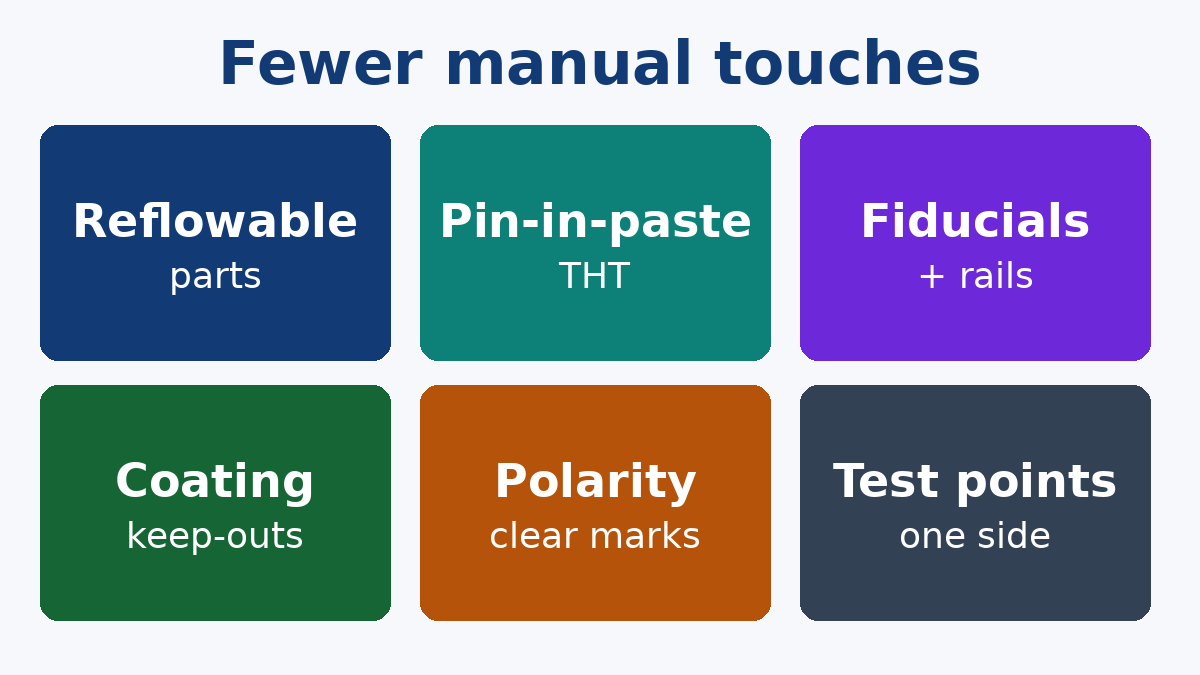
The most effective way to reduce manual variation is to design it out. Several choices do this directly:
- Prefer reflow-compatible parts. Every component that cannot survive reflow becomes a hand-solder or secondary operation. Check the reflow rating of connectors, displays, batteries, buzzers and similar parts before the BOM is frozen.
- Consider pin-in-paste for through-hole parts where the part tolerates reflow and the hole and paste volume can be designed for it. It removes a separate soldering step entirely. It needs stencil and hole design attention, so discuss it early with the assembler.
- Group remaining through-hole parts on one side and leave clearance around them for selective solder nozzles or wave pallets.
- Give the line what it needs to run unattended: global and local fiducials, tooling holes, conveyor rails or a panel design that suits automated handling.
- Make polarity unambiguous on silkscreen and in the assembly drawing. Clear marking helps the programmer, the AOI library and the human inspector alike.
- Define coating keep-out areas in the drawing so the coating process can be programmed rather than masked by eye.
- Plan test access. Test points accessible from one side make fixture or flying probe testing faster and less dependent on manual probing.
Controlling the steps that stay manual
Some manual work will remain on almost any real product. It can be controlled well; it just has to be specified and checked rather than assumed.
Workmanship acceptance should be defined by class: IPC-A-610 for acceptability of assemblies, and J-STD-001 where you want requirements on soldering processes and materials, including hand soldering. State the class on the drawing or purchase order. For manual operations, it is reasonable to ask how operators are trained and qualified, whether work instructions exist for your board's manual steps with pictures of acceptable and unacceptable results, and how those instructions are controlled when your design revises.
For AOI and electrical test, ask how false calls are handled and whether review decisions are recorded. For rework, ask whether rework is logged by serial and location, and what limit the factory applies to repeated rework of the same joint or component. If your product needs traceability, ask how manual steps are linked to the serial record, since they are the ones that do not record themselves.
When you audit or visit, ask to follow your type of board along the traveler and point to each step where a person touches it. A factory that can answer that clearly, and explain how each manual step is controlled, usually has the rest of its house in order.
What automation has actually changed on the floor
From inside a factory, the job question looks less dramatic than it sounds in headlines. Machines have taken over the tasks that are repetitive and that humans do inconsistently: placing tens of thousands of parts, drilling holes, scanning every layer. The work that remains, and has grown, is programming, process engineering, inspection judgment, maintenance, and the handling of exceptions. The people doing those jobs determine whether the machines produce good boards or consistent scrap.
For you as a buyer, that suggests a practical question to add to every supplier evaluation: not only which machines are on the floor, but who programs them, who reviews what they flag, and how the steps that are still done by hand are trained, instructed and recorded. If you are preparing a new design and want to know where its manual touchpoints will be, send us the files; our engineers can mark them on a proposed process flow before the first board is built.