
Shielding effectiveness charts look decisive until the fab quote returns with EQ on how the shield attaches. EMC basics and can-versus-coating tradeoffs are already covered on XFPCB. This post is narrower: when board-level EMI options become drawing callouts—and the fab/assembly cost traps those callouts create.
Shields that stay “design intent” vs shields that hit CAM
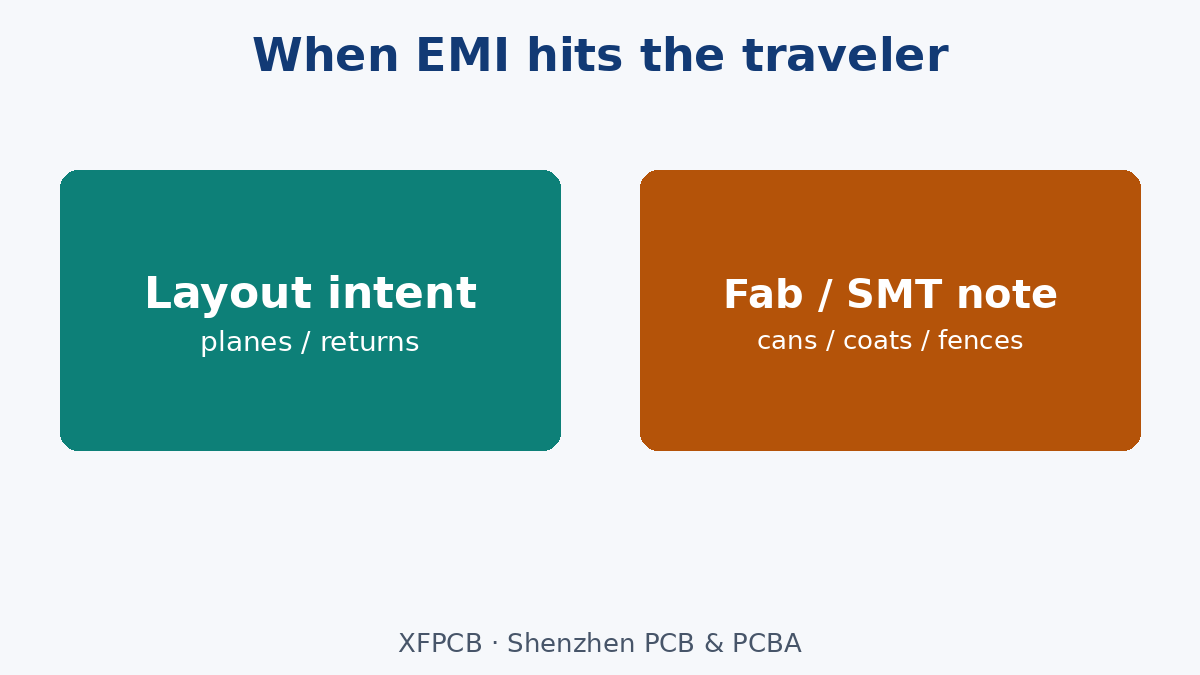
A continuous ground plane and short return paths are layout work. The moment you add a soldered can, fence of vias + lid, conductive coating, or selective plated shield, the traveler owns footprints, keep-outs, plating masks, and sometimes second-side process. Flex foil/silver shields are a pointer only—see the flex EMI post when the stack is flex.
Ask early: is this feature on the bare-board fab note, the assembly SOW, or both?
Drawing callouts that actually move cost
Shield cans / frames
- Footprint, polarity, and solderable vs clip-on.
- Ground-via fence pitch and unbroken periphery under the can wall.
- Height clearance to components and lid vents—openings are EMI leakage and also solder-paste / wash traps.
- Whether the can is customer-supplied or turnkey-sourced (assembly price, not fab copper).
Conductive coatings / paints
- Mask-defined regions, thickness class if you own one, and keep-out from connectors and gold fingers.
- Cure / adhesion expectations on the finish you already chose (ENIG vs HASL changes surface energy stories).
- Rework rules—coatings are rarely “wipe and respray” on a production traveler.
Plane and copper as shield
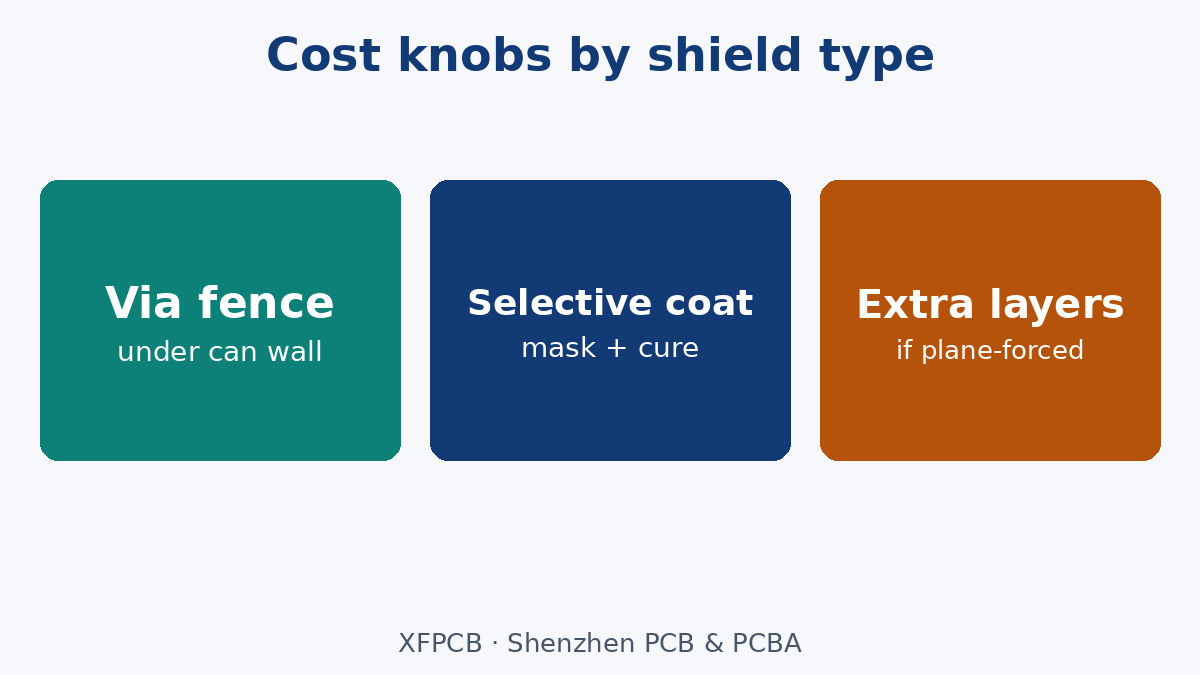
- Continuous GND under RF or clock regions is often free copper—until you order extra layers, heavy copper, or via stitching density that forces laser or HDI process.
- Slotting a plane for “isolation” without a return bridge is an SI/EMI own-goal and a fab copper-balance headache.
Gaskets, foam, chassis bonds
- Usually mechanical / system BOM—not PCB fab. Do not bury them as “PCB EMI” line items on a bare-board RFQ.
Cost traps overseas buyers hit
- Can footprint without via fence — fab builds pads; EMC fails; respins cost more than the can.
- Coating area larger than needed — selective process quotes like specialty finish.
- Openings sized for airflow only — high-frequency leakage; adding honeycomb later is a new mechanical SOW.
- Split planes + shield can — can bridges domains the layout meant to separate; EQ and redesign.
- Assuming “shielded” = ITAR or military grade — never claim export-control capability from a can drawing.
Effectiveness vs the drawing
Shielding attenuation in dB is a system result—material, seams, grounding, and apertures together. A drawing that only says “add EMI shield” without fence, finish, and opening rules cannot be quoted as an effectiveness target. Freeze mechanical and electrical attachment first; chase chamber numbers after the hardware is buildable.
What to freeze on the note
- Shield type and owner (fab feature vs SMT part vs conformal/coat process).
- Ground attachment: via fence, solder joints, chassis studs—named.
- Keep-outs for mask, silkscreen, and components under/near the shield.
- Opening map if lids vent; do not leave vents as “TBD in enclosure.”
- Test expectation (visual, continuity to GND, or EMC chamber)—so scrap criteria exist.
For product context see Communication Equipment and process placement under PCB Fabrication Process. Assembly attach of cans sits with SMT PCB Assembly.
What we are not claiming
No invented dB attenuation tables, no material brand rankings, no rewrite of electrostatic/magnetic/EM textbook categories, and no flex-shield process deep dive. Put the callouts on the drawing so effectiveness talk and the quote describe the same hardware.